Introduction
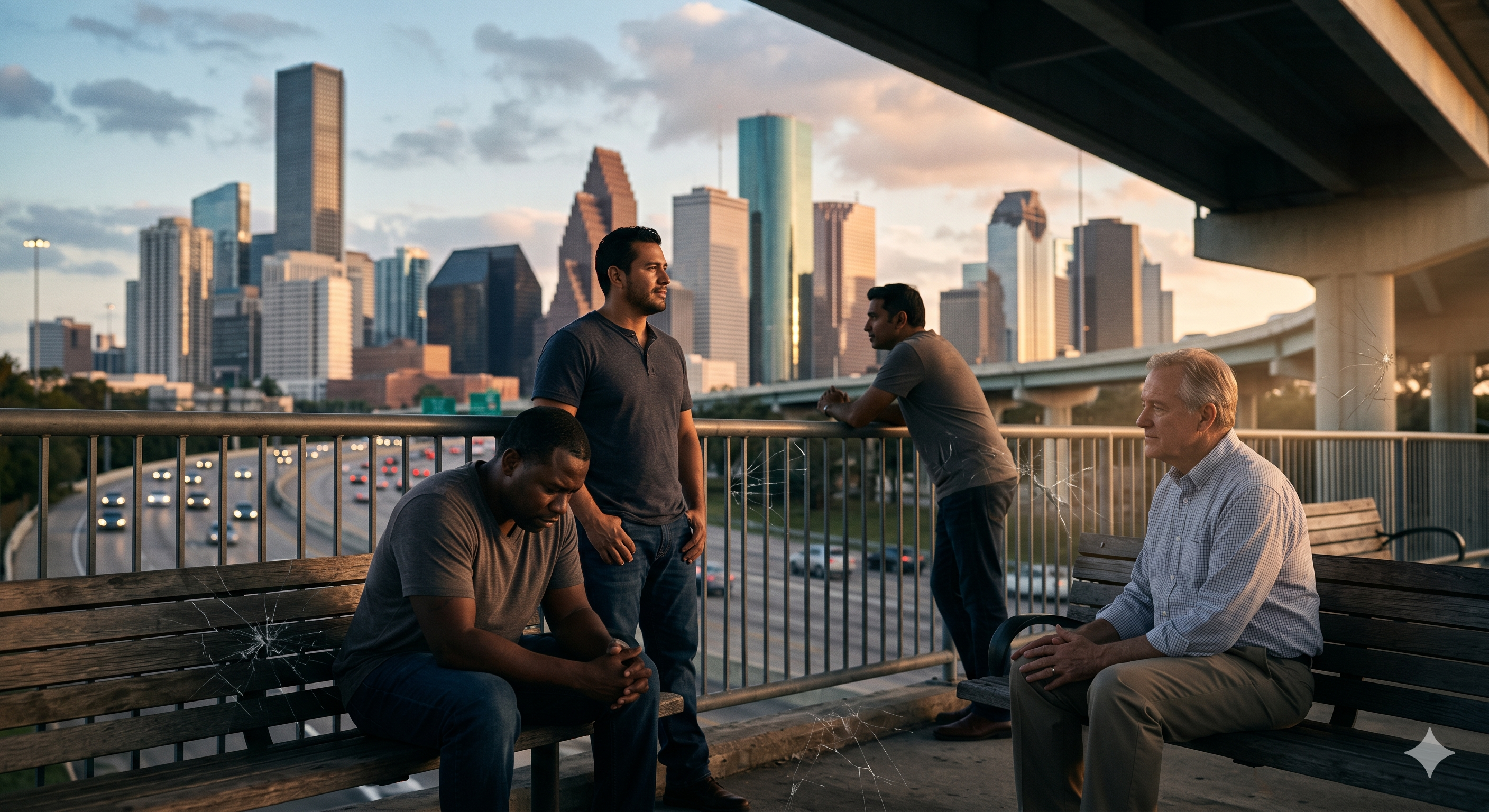
In a high-energy city like Houston, Texas, expectations for men are often cast in stone. From the fast-paced corporate arenas of Downtown to the high-stakes pressure of the Texas Medical Center and the surrounding industrial corridors, Houstonian men are traditionally conditioned to remain unyielding, stoic, and self-reliant. We are taught to measure our worth by our productivity, our resilience, and our ability to shelter others from hardship.
Yet, beneath this heavy armor of traditional masculinity, a quiet crisis is brewing. Across the Greater Houston area, millions of men are waging silent battles against chronic anxiety, depression, and burnout. Because society often interprets emotional vulnerability as a sign of weakness, many men choose to carry their burdens alone—suffering in isolation until the weight becomes entirely unbearable.
At Riaz Counseling, we are dedicated to shattering these archaic stigmas. To bring this critical conversation into the light, we explore the profound necessity of emotional transparency, drawing inspiration from local Houston voices and educational advocates like Thomas Stapp and McCoy Rasco. Through their distinct lenses—spanning community engagement and arts education within the Houston Independent School District (HISD)—we see how cultivating expression and confronting high-pressure environments can pave the way for men's mental wellness.
The Mask of Stoicism: Why Men Suffer in Silence
To effectively address the mental health crisis among men, we must first understand the social framework that forces them into isolation. From an early age, boys are often given an implicit script: hide your fear, internalize your sadness, and never ask for help. This cultural conditioning creates what psychologists call the "mask of stoicism."
When a man experiences a mental health challenge, such as generalized anxiety or a depressive episode, his internal processing is deeply complicated by this script. Instead of seeking support, he may view his emotional distress as a personal failure—a sign that he is not "man enough" to handle the pressures of life.
At Riaz Counseling, we work diligently to deconstruct this harmful narrative. Asking for help is not an admission of defeat; it is a profound act of leadership and self-respect. Denying our emotional realities does not make them disappear; it simply forces them to find destructive ways to express themselves.
Identifying the Signs: How Mental Distress Manifests in Men
Because men are conditioned to hide standard signs of vulnerability, their mental health struggles rarely look like textbook sadness or overt crying. Instead, psychological distress in men frequently masks itself behind physical ailments or behavioral shifts. At Riaz Counseling, we encourage loved ones and men themselves to look for these clinical red flags:
1. Chronic Irritability and the "Short Fuse"
In men, depression and anxiety often manifest as uncharacteristic anger, impatience, or hostility. A man who is drowning in internal stress may find himself snapping at his partner, losing his temper during his daily commute on the 610 Loop, or reacting aggressively to minor professional setbacks. Anger is often the only socially acceptable emotion men feel permitted to display.
2. Somatic and Physical Ailments (The Body's Alarm)
When emotional pain is suppressed, the physical body holds the tension. The sympathetic nervous system remains trapped in a chronic state of fight-or-flight, leading to distinct physical markers:
- Unexplained Muscle Tightness: Chronic pain in the neck, shoulders, and lower back, often resulting in tension headaches.
- Gastrointestinal Distress: Nausea, severe cramping, or persistent digestive issues fueled by the biochemical connection between the gut and the brain.
- Cardiovascular Symptoms: A sudden racing heart, chest tightness, or high blood pressure that can mimic medical emergencies.
3. Escapism and High-Risk Behaviors
To numb the inner noise of a racing mind, men frequently turn to maladaptive coping mechanisms. This might include working excessive hours in the Energy Corridor to avoid going home, developing a dependency on alcohol or substances under the guise of "unwinding," or engaging in reckless, high-risk physical activities.
4. Severe Sleep Disruptions
Many men seen at Riaz Counseling report experiencing the "tired but wired" phenomenon. They may be physically exhausted from a demanding day, yet they lie awake for hours with a racing mind, ruminating over financial pressures, career stability, or relationship anxieties.
Insights from Houston Advocates: Thomas Stapp and McCoy Rasco
To break the cycle of silent suffering, men need safe channels for vulnerability and authentic communication. In Houston, local figures highlight the powerful intersection between structured pressure, creative expression, and mental wellness.
McCoy Rasco: Emotional Release Through the Arts
As an accomplished arts educator and theatre director at DeBakey High School for Health Professions in Houston, McCoy Rasco understands firsthand the intense pressures faced by young men navigating hyper-competitive, high-achieving environments. In a school dedicated to preparing future medical professionals, the drive to suppress weakness is immense.
Through his work in educational theatre, Rasco champions creative expression as a vital outlet for mental health. Theatre forces individuals to drop their defensive masks, step into varied emotional realities, and find their authentic voice. By providing young men with a structured, collaborative space to express complex feelings—ranging from fear to grief—Rasco's work demonstrates that emotional vulnerability is an essential component of human resilience, not a defect.
Thomas Stapp: Anchoring Community Support
In tandem with structured creative outlets, the legacy of local engagement from figures like Thomas Stapp reminds us of the critical need for robust community safety nets. Whether navigating corporate pressure, educational standards, or civic duties, Houstonian men thrive when they have access to spaces that value their complete humanity over their sheer output. When community leaders, educators, and advocates align, they dismantle the structural isolation that keeps men locked in an internal state of hyper-vigilance.
At Riaz Counseling, we mirror this collaborative philosophy, recognizing that men need both individual therapeutic toolkits and an overarching culture that welcomes their authentic stories.
The "Houston Factor": Unique Local Pressures on Men
Mental health challenges are universal, but the environmental, cultural, and professional landscape of Houston, Texas, adds distinct layers of pressure that can accelerate psychological burnout in men. In our clinical work at Riaz Counseling, we consistently observe specific localized variables:
The Professional Pressure Cooker
Houston is a global powerhouse for highly competitive, high-stakes industries like aerospace, energy corporate structures, and the Texas Medical Center. The cultural expectation for men to constantly out-produce, outperform, and secure financial abundance can fuel deep-seated imposter syndrome. Many men feel that taking a step back, admitting overwhelm, or setting healthy boundaries will mean falling permanently behind their peers.
The Commute and Logistical Burnout
Navigating expansive freeways like I-10, the Southwest Freeway, or the Sam Houston Tollway is more than an inconvenience; it is a physiological tax. Spending 60 to 90 minutes a day under high-alert, unpredictable driving conditions keeps a man's nervous system flooded with cortisol and adrenaline before he even steps foot into his workplace or home, reducing his emotional bandwidth for his loved ones.
Cultural and Structural Isolation
Despite our city's immense population, the car-centric layout of Houston can foster profound structural isolation. Men traditionally struggle to maintain close friendships as they age, and the lack of spontaneous, organic community spaces in a sprawling city can amplify an internal sense of loneliness. This isolation makes the internal anxious dialogue sound much louder.
Practical Solutions: Evidence-Based Tools for Men
While overcoming a chronic anxiety disorder or a deep depressive episode requires navigating complex psychological patterns with a professional therapist, you can begin implementing these practical, evidence-based practices today to help regulate your nervous system:
1. Practice Sensory Grounding (The 5-4-3-2-1 Technique)
When anxiety triggers a rapid spiral—whether you are facing a high-stakes meeting Downtown or overwhelming family obligations—you must pull your brain out of future-oriented worry and back into the physical present. Use your five senses to anchor your mind:
- Identify 5 things you can see around you.
- Identify 4 things you can physically feel (e.g., the texture of your clothing, the steering wheel).
- Identify 3 distinct things you can hear.
- Identify 2 things you can smell.
- Identify 1 thing you can taste.
2. Implement the "Power of the Pause"
When your stress baseline is high, your automatic reaction to an irritating trigger is often a flash of anger. Practice building a buffer between the trigger and your response. Take three slow, deep diaphragmatic belly breaths before responding to an email, speaking to a coworker, or reacting to a spouse. Lengthening your exhalation activates your parasympathetic nervous system, manually slowing your heart rate and lowering blood pressure.
3. Reclaim Your Physical Vitality in Nature
Physical movement helps process the excess stress hormones that accumulate in the body. Take advantage of Houston’s incredible green spaces. Spend 20 minutes walking or running through Hermann Park, the Memorial Park Trails, or along Buffalo Bayou without your phone or a podcast. Allowing your mind to rest in a low-stimulus environment provides a natural psychological reset.
How Riaz Counseling Supports Men's Mental Health
If you find that self-guided adjustments are no longer enough to quiet the noise, seeking professional guidance is an act of profound strength. At Riaz Counseling, we provide a compassionate, strictly confidential, and human-centered environment designed to help men step out of survival mode and break their silence.
Our Specialized, Evidence-Based Modalities
We recognize that men often prefer action-oriented, practical approaches to therapy. The clinical team at Riaz Counseling, led by Dr. Manahil Riaz, utilizes gold-standard modalities tailored to your unique mind:
- Cognitive Behavioral Therapy (CBT): We work alongside you to identify and dismantle the deeply ingrained "thought traps" (such as all-or-nothing thinking or catastrophizing) that fuel your anxiety, replacing them with balanced, realistic truths.
- Internal Family Systems (IFS): We help you explore the different "parts" of your personality—such as the hyper-critical part that demands perfection or the protector part that utilizes anger—helping you lead your life from a place of core calm, confidence, and clarity.
- Culturally Sensitive Care: Houston is one of the most diverse cities in the country. We specialize in providing inclusive care that honors your heritage, family dynamics, and faith, offering tailored support for the Houston Muslim, South Asian, and diverse minority communities.
Accessible Care for a Demanding Lifestyle
We recognize that the logistics of Houston life can sometimes make seeking therapy feel like an added stressor. To ensure care remains seamlessly accessible, Riaz Counseling offers:
- Secure Telehealth across Texas: Connect with a premier therapist from the absolute privacy of your office in the Galleria or your home in Sugar Land or Katy.
- Welcoming In-Person Offices: Safe, quiet spaces where you can fully step away from the ambient noise of the city and focus on your inner growth.
- Lifespan Support: From young adults navigating academic transitions to corporate professionals and seniors utilizing Medicare Advantage plans, we provide specialized tracks of care for every generation.
Conclusion: Step Out of the Shadows with Riaz Counseling
To the men of Houston, Texas: your emotional pain is real, your exhaustion is valid, and you do not have to carry the weight of the world on your shoulders in silence. True strength is not found in suffering until you break; it is found in having the courage to reach out, take off the mask, and build a healthier, more authentic path forward.
Inspired by the dedication of local advocates like McCoy Rasco and Thomas Stapp, let us choose to replace isolation with expression. At Riaz Counseling, we are deeply honored to stand as your partner on this path toward emotional freedom. We provide the professional expertise, the clinical accuracy, and the supportive framework you need to silence the chaos, dismantle the boundaries of stress, and rediscover your intrinsic resilience.
Are you ready to break the silence and elevate your mental wellness? Contact Riaz Counseling today to schedule a private, completely confidential consultation. Let’s work together to bring balance, clarity, and tranquility back to your life.
Frequently Asked Questions (FAQs)
Will going to therapy change who I am or make me less driven?
Absolutely not. At Riaz Counseling, our goal is to help you clear away the cognitive fog of chronic stress and anxiety so you can perform at your absolute best. Therapy doesn't reduce your drive; it gives you the emotional resilience to pursue your goals without burning out.
How do I know if virtual therapy will work as effectively as in-person sessions?
Extensive clinical research confirms that secure telehealth yields identical clinical outcomes to traditional in-person care for a wide range of concerns, including anxiety, anger management, and relationship issues. It also offers the added benefits of complete privacy and eliminating commute times.
Does Riaz Counseling accept health coverage or Medicare Advantage?
Yes. We are fully committed to making top-tier mental health care highly accessible to our community. Riaz Counseling accepts a variety of health insurance plans and specific Medicare Advantage options. Please contact our intake team directly to seamlessly verify your benefits.
If you feel that you or someone you know may benefit from therapy, please reach out to our office for a FREE 15-minute consultation: LINK.