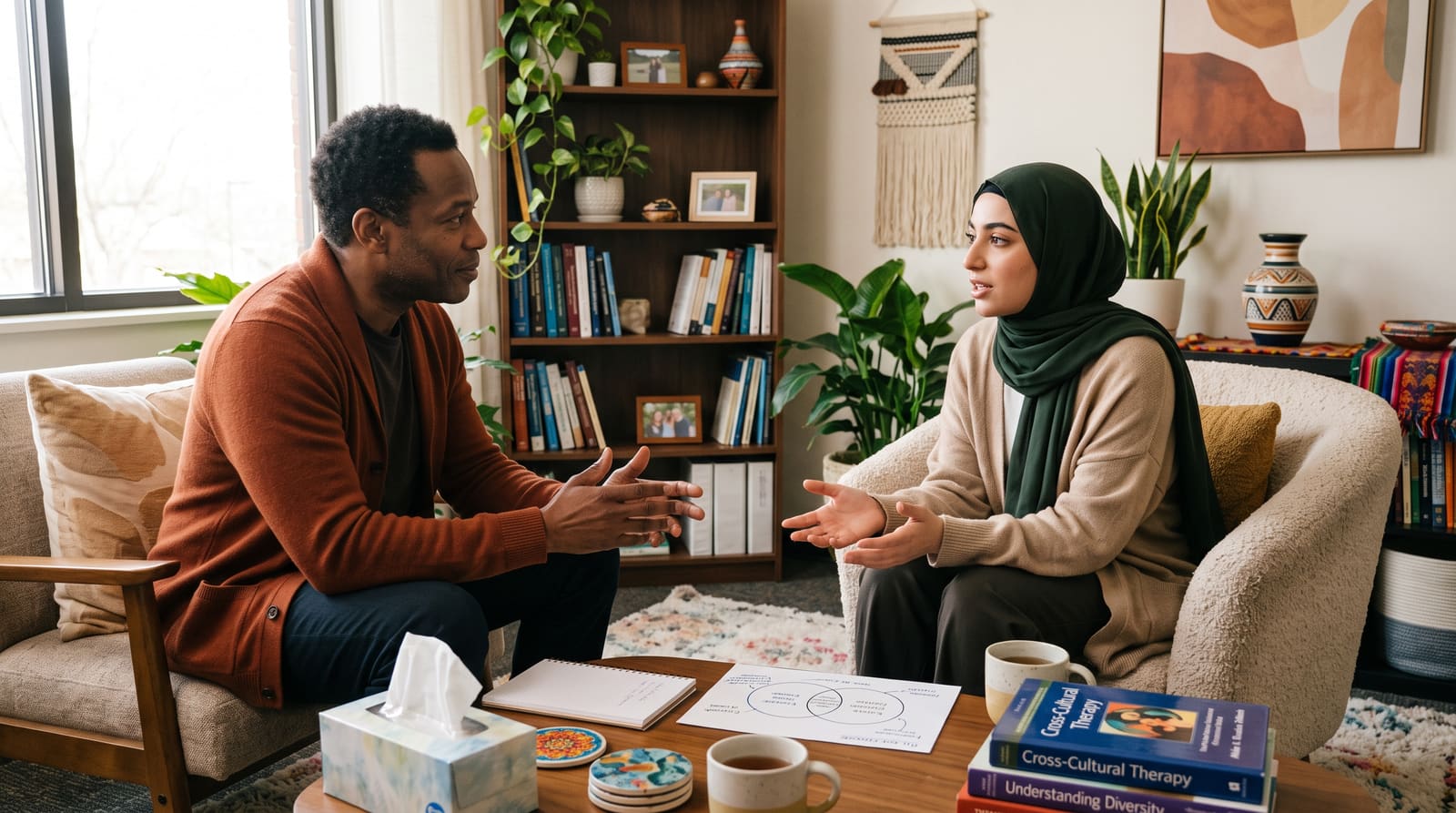
Topic Understanding
Relationships bring together two people with different experiences, beliefs, personalities, and expectations. When partners also come from different cultural backgrounds, they may discover that they have different ideas about family, marriage, communication, religion, parenting, and what it means to show love.
These differences do not automatically create relationship problems. In many relationships, cultural differences can be a source of learning, connection, and personal growth. Difficulties may arise, however, when partners misunderstand each other's expectations, feel pressured to choose between their relationship and their cultural values, or struggle to discuss sensitive topics without conflict.
Therapy for cultural differences can help partners understand how their backgrounds influence their expectations, communicate more openly, and find ways to respect each other's values while building a relationship that works for both people.
At Riaz Counseling, individuals and couples can explore relationship concerns with professional support. Whether you are navigating different family traditions, religious beliefs, communication styles, or expectations about marriage, understanding the underlying issues can be an important step toward a healthier relationship.
Key Highlights
- Cultural differences can influence how partners communicate, express affection, handle disagreements, and make decisions.
- Conflict does not necessarily mean two people are incompatible. Sometimes, partners have different expectations that they have never clearly discussed.
- Multicultural couples counseling can provide a space to explore family traditions, faith, identity, boundaries, and relationship goals without automatically treating one person's values as more important.
- Culturally sensitive counseling considers each person's background while recognizing that individual experiences differ even among people from the same culture.
- A relationship therapist can help partners develop practical communication strategies, negotiate differences, and identify shared values.
How Do Cultural Differences Affect Relationships?
Culture can influence how people understand relationships and what they expect from a partner. It may include language, ethnicity, religion, family traditions, social norms, community expectations, and experiences growing up in a particular environment.
Culture is not limited to nationality. Two people who grew up in the same country, city, or community may have very different beliefs about marriage, independence, gender roles, or family responsibilities.
The American Psychological Association emphasizes that identity develops within a broader social and cultural context. A person's experiences may also be shaped by factors such as race, gender, socioeconomic circumstances, religion, and other intersecting aspects of identity.
In a relationship, these influences may become visible in everyday situations.
For example, one partner might believe that discussing relationship problems with parents is a sign of respect and family closeness. The other might feel that relationship concerns should remain private between partners.
Neither preference automatically makes someone wrong. The challenge is understanding what each person believes, why it matters to them, and how the couple can agree on boundaries that respect both partners.
1. Different Expectations About Family Involvement
Family relationships can play a significant role in how people approach dating, marriage, and long-term commitment.
One partner may expect to consult parents before making major decisions. Another may believe that decisions about finances, housing, parenting, or marriage should be made privately as a couple.
These differences can create tension when one person feels that family members are too involved while the other feels that their partner is dismissing important family relationships.
Questions worth exploring include:
- How involved should our families be in major decisions?
- What information about our relationship should remain private?
- How will we handle family expectations that conflict with our preferences?
- What boundaries would help both of us feel respected?
A productive conversation focuses on the meaning behind each person's expectations rather than simply labeling one approach as right or wrong.
2. Different Communication Styles
Partners may have different ways of expressing emotions, addressing conflict, and showing disagreement.
For example, one person may prefer to discuss a problem immediately. The other may need time to reflect before speaking.
One partner may view direct communication as honest and necessary. The other may have learned that maintaining harmony and choosing words carefully are important ways to show respect.
When these styles clash, misunderstandings can develop.
The partner who wants to talk immediately may interpret silence as avoidance. The partner who needs time may experience repeated questions as pressure.
Neither interpretation necessarily reflects the other person's intentions.
A useful agreement might be:
"I want us to talk about this, but I understand that you need time. Let's take a break and agree on when we will return to the conversation."
This approach acknowledges both needs without allowing the problem to remain unresolved indefinitely.
3. Religious and Spiritual Differences
Faith and spirituality can influence relationship expectations, daily routines, family traditions, and decisions about marriage or children.
Partners may differ in their religious beliefs, the importance they place on religious practice, or how they want to incorporate faith into their shared lives.
Potential areas of disagreement include:
- Religious ceremonies or marriage traditions
- Celebrations, holidays, and observances
- Expectations about raising children
- Religious participation and community involvement
- Dietary practices or other lifestyle choices
- The role of faith in major decisions
These conversations can be particularly sensitive when religion is closely connected to family identity or personal meaning.
Rather than assuming that one partner will eventually change their beliefs, couples can discuss which practices are essential, which are flexible, and where they may be able to make room for each other.
A relationship therapist can help partners approach these discussions with curiosity and respect while keeping their individual beliefs and choices visible.
4. Gender Roles and Expectations About Marriage
People may grow up with different expectations about household responsibilities, finances, caregiving, career priorities, and decision-making.
One person might expect responsibilities to be divided equally. Another might have grown up seeing partners take on different roles based on tradition, personal preference, or family circumstances.
Cultural background can influence these expectations, but it does not determine what every person believes.
Problems may arise when partners assume that their expectations are obvious or that the other person should automatically understand them.
Before making major commitments, discuss questions such as:
- How should household responsibilities be divided?
- How will we make financial decisions?
- What happens if one partner wants to prioritize a career?
- How will we approach parenting and caregiving?
- What does an equal and respectful partnership mean to each of us?
These conversations are not about proving which model of marriage is best. They are about establishing expectations that both people understand and can freely agree to.
5. Language, Identity, and Belonging
Language can be more than a way to communicate. It can also carry family history, humor, memories, and a sense of belonging.
In relationships where partners speak different first languages or have different levels of familiarity with each other's communities, misunderstandings may occur even when both people have good intentions.
A partner may struggle to explain a feeling in a second language. Humor, expressions, or indirect communication may not translate easily. One person may also feel excluded when family conversations happen in a language they do not understand.
Partners can work toward greater inclusion by:
- Explaining unfamiliar expressions or traditions without embarrassment.
- Slowing down during difficult conversations.
- Checking whether a message was understood as intended.
- Making an effort to include both partners during family gatherings.
- Asking questions instead of assuming they understand the meaning of a behavior.
A strong relationship does not require both people to have identical cultural experiences. It does require a willingness to understand the experiences that matter to each person.
When Do Cultural Differences Become Relationship Problems?
Cultural differences become more difficult when partners cannot discuss them safely or constructively.
A disagreement about family traditions, for example, may become a recurring conflict if one partner feels that their background is being criticized. A discussion about religious practice may become painful if either person feels pressured to change their beliefs.
Some common warning signs include:
- Having the same argument repeatedly without reaching an understanding.
- Feeling that your partner does not respect your family, faith, or identity.
- Avoiding important conversations because you expect criticism or conflict.
- Feeling pressured to abandon meaningful traditions or personal beliefs.
- Experiencing ongoing disagreements about boundaries with extended family.
- Feeling caught between your partner's expectations and your family's expectations.
- Struggling to make shared decisions about marriage, parenting, or the future.
- Feeling unheard, dismissed, or misunderstood.
These experiences do not automatically mean that a relationship cannot work.
They may indicate that the couple needs clearer communication, more effective ways to resolve disagreements, or support in understanding the emotional meaning behind recurring conflicts.
It is also important to distinguish ordinary cultural disagreements from coercion, intimidation, or abuse. Respect for culture does not require anyone to tolerate threats, control, or harm.
Can Therapy Help With Cultural Differences in Relationships?
Yes. Therapy can help partners understand how cultural backgrounds influence their relationship and develop practical ways to manage differences.
Multicultural couples counseling is not about deciding which culture is correct or asking partners to become more alike. Instead, it can help each person understand their own expectations, listen to their partner's perspective, and negotiate decisions that reflect their shared goals.
The American Psychological Association's multicultural guidelines encourage mental health professionals to consider clients' cultural identities, social contexts, and individual experiences when providing psychological services.
In relationship counseling, that perspective can help prevent important cultural factors from being overlooked.
1. Understanding the Meaning Behind Conflict
A recurring disagreement often has a deeper meaning for each partner.
Consider a couple arguing about how frequently they visit their families.
One partner may view regular visits as a way to show love, loyalty, and responsibility. The other may see frequent visits as a loss of privacy or time together.
On the surface, the disagreement is about scheduling.
Underneath, the partners may be trying to protect different needs: family connection, independence, privacy, or shared time.
A therapist can help the couple identify those needs and explore possible compromises.
For example, they might agree on regular family visits while reserving certain evenings or weekends for their relationship.
The goal is not necessarily to eliminate every disagreement. It is to help partners understand one another and develop solutions they can both accept.
2. Improving Communication Without Dismissing Cultural Values
A therapist can help partners communicate concerns without attacking each other's background or character.
Instead of saying:
"You always let your family control our relationship."
A partner might try:
"I feel overwhelmed when we make plans without discussing them together. I want us to find a way to stay connected with your family while making decisions as a team."
The second statement describes a personal experience and a specific need rather than criticizing an entire family or culture.
Therapy may involve practicing skills such as:
- Expressing feelings without blame.
- Listening to understand rather than preparing a response.
- Asking questions about unfamiliar traditions.
- Recognizing assumptions before reacting.
- Taking breaks when conversations become overwhelming.
- Returning to difficult discussions at an agreed time.
- Negotiating clear boundaries and shared decisions.
These skills can help couples discuss sensitive topics more constructively.
3. Creating Space for Both Partners' Experiences
Culturally sensitive counseling recognizes that people have individual experiences within their cultural communities.
A therapist should not assume that someone follows particular traditions simply because of their ethnicity, nationality, religion, or family background.
For example, two partners from the same cultural community may have very different views about marriage, independence, or gender roles.
Similarly, a person may feel deeply connected to some traditions while questioning others.
Therapy can provide space for partners to explain what their cultural identities mean to them personally.
The aim is to understand each person rather than reduce them to assumptions about a group.
4. Navigating Family Expectations and Boundaries
Extended family relationships can be a source of support, belonging, and practical help. They can also become a source of tension when expectations conflict with a couple's decisions.
Therapy can help partners explore how to maintain meaningful family connections while establishing boundaries that protect their relationship.
For instance, a couple may agree that they will listen respectfully to family advice but make final decisions about their household together.
Another couple may decide that some traditions are important to maintain, while others can be adapted to fit their current circumstances.
The appropriate arrangement depends on the people involved, their values, and their practical needs.
5. Developing a Shared Relationship Identity
Partners do not have to choose between preserving their backgrounds and building a shared future.
They can decide which traditions they want to maintain, which practices they want to adapt, and which new routines they want to create together.
This might involve celebrating holidays from both backgrounds, agreeing on how to raise children, creating new family rituals, or developing shared approaches to finances and household responsibilities.
A therapist can help partners discuss these choices without treating compromise as a loss of identity.
Over time, the couple can work toward a relationship that reflects both individual identities and their shared commitments.
What Does Culturally Sensitive Counseling Look Like?
Culturally sensitive counseling involves understanding that a person's background and life circumstances may influence their concerns, values, and expectations.
It also requires recognizing that the therapist does not automatically know what a client's culture means to them.
The American Psychological Association discusses cultural humility as an ongoing process of exploring identity, recognizing the limits of one's knowledge, and remaining open to the client's experiences.
In practice, culturally sensitive counseling may include the following.
Curiosity rather than assumptions. A therapist asks what a tradition or belief means to the client instead of deciding what it must mean.
Respect for different values. Partners are given room to explain their beliefs without being pressured to adopt the therapist's personal preferences.
Attention to family and community. Counseling considers how family expectations, social pressures, discrimination, or community relationships may affect the couple.
Recognition of individual differences. The therapist does not assume that everyone from a particular background has the same beliefs or relationship expectations.
Practical and collaborative goals. Partners work toward realistic changes that reflect their needs, values, and relationship priorities.
Culturally sensitive counseling does not mean avoiding difficult conversations. It means approaching those conversations thoughtfully and respectfully.
Practical Ways to Navigate Cultural Differences With Your Partner
Therapy can be useful, but there are also steps partners can begin practicing in everyday life.
1. Ask Questions Before Making Assumptions
When a partner responds differently than you expect, pause before deciding what their behavior means.
Instead of thinking, "They don't care about my family," ask, "What does family involvement mean to you, and how do you feel about our current arrangements?"
Questions encourage conversation and give your partner an opportunity to explain their perspective.
2. Identify What Matters Most to Each of You
Not every difference requires a compromise, and not every tradition has the same importance to both partners.
Try separating preferences from core values.
For example:
- A preference might be how often you host family gatherings.
- A core value might be maintaining close relationships with relatives.
- A preference might be how you celebrate a holiday.
- A core value might be preserving a meaningful religious practice.
Understanding the distinction can help couples find flexibility in some areas while protecting what matters most to each person.
3. Discuss Boundaries Before a Crisis
It is easier to discuss boundaries before a disagreement becomes emotionally overwhelming.
Talk about privacy, family involvement, personal time, religious participation, and decision-making while you are both relatively calm.
Be specific about what you are asking for.
For example, "I would like us to discuss major financial decisions before involving our families" is clearer than "Your family needs to stay out of our business."
4. Avoid Treating Either Culture as the Problem
Statements such as "Your culture is too traditional" or "Your family doesn't understand relationships" can make a partner feel that their identity is under attack.
Try describing the specific behavior or disagreement instead.
You might say:
"I understand that this tradition is important to you. I'm struggling with how it affects our plans, and I would like us to discuss an arrangement that works for both of us."
This makes room for disagreement without turning the conversation into a judgment about an entire community.
5. Learn to Repair After an Argument
Even partners who communicate well will sometimes misunderstand each other.
Repair involves acknowledging what happened, listening to the impact, and taking responsibility for your part in the conflict.
A repair attempt might sound like:
"I realize I dismissed something that matters to you. I want to understand why it is important and talk about how we can handle it differently."
A sincere apology does not require you to abandon your own values. It means recognizing where your words or actions may have hurt your partner.
6. Recognize When You Need Help
If discussions repeatedly turn into arguments, if resentment is growing, or if you feel unable to talk honestly, consider seeking professional support.
You do not need to wait until the relationship is in crisis to speak with a relationship therapist.
Early support may help you clarify expectations and develop better communication habits before disagreements become more entrenched.
How to Choose a Relationship Therapist for Cultural Differences
Finding a therapist who makes both partners feel heard is important.
You do not necessarily need a therapist who shares your exact cultural background. However, it can be helpful to find someone who is willing to discuss cultural identity, family dynamics, religion, discrimination, and personal values without making assumptions.
When considering a therapist, you might ask:
- How do you approach cultural differences in couples counseling?
- How do you help partners navigate different religious or family expectations?
- How do you make sure both partners have space to express their perspectives?
- How do you handle disagreements about gender roles or family boundaries?
- What approaches do you use to help couples improve communication?
- How will we decide whether therapy is helping us make progress?
A therapist should be willing to explain their approach and help you understand what the process may involve.
You should also feel able to raise concerns if you believe a cultural issue has been misunderstood or overlooked during a session.
The therapeutic relationship should provide space for respectful questions, feedback, and clarification.
When Is Couples Therapy Appropriate?
Couples therapy may be worth considering when cultural differences are creating repeated conflict, emotional distance, or uncertainty about the future of the relationship.
It may be especially helpful when partners:
- Are preparing for marriage and want to discuss expectations.
- Have different religious or cultural backgrounds.
- Are struggling with extended family involvement.
- Disagree about parenting, finances, or household roles.
- Feel misunderstood during difficult conversations.
- Want to strengthen communication before making major decisions.
- Are experiencing tension after moving to a new country or community.
- Want help deciding how to preserve traditions while building a shared life.
Couples therapy is not limited to married partners. People who are dating, engaged, or in long-term relationships may also seek support.
In some circumstances, individual therapy may be a useful starting point, particularly when one partner wants to explore their own identity, family expectations, or relationship concerns before deciding whether to attend sessions together.
An important safety consideration: If a relationship involves intimidation, coercive control, or physical or sexual violence, joint counseling may not be appropriate in every situation. Individual support and a safety-focused assessment may be more suitable. Anyone facing immediate danger should seek emergency assistance.
How Riaz Counseling Can Help
Riaz Counseling offers couples therapy in Houston, Texas, for partners who want to improve communication, work through conflict, rebuild trust, or strengthen their connection. Its published couples therapy information describes approaches that include the Gottman Method, Emotionally Focused Therapy (EFT), cognitive behavioral couples therapy, and attachment-based approaches.
These approaches may offer different ways to explore relationship patterns and communication difficulties. The most suitable approach depends on a couple's concerns, goals, and circumstances.
If cultural differences are affecting your relationship, you can discuss those concerns when exploring whether couples therapy is a good fit. Relevant topics may include:
- Differences in family expectations.
- Communication and conflict-resolution difficulties.
- Religious or cultural traditions.
- Boundaries with extended family.
- Expectations about marriage and parenting.
- Feeling misunderstood or disconnected from your partner.
Riaz Counseling has offices in Houston Galleria, Sugar Land, and The Woodlands, and its website provides information about scheduling a free 15-minute consultation.
You can explore the practice's couples therapy services to learn more about the service and determine whether a consultation may be a helpful next step.
Seeking counseling does not mean your relationship has failed. It can be a way to understand each other more clearly and decide how you want to move forward.
Frequently Asked Questions
Can therapy help when partners come from different cultures?
Yes. Therapy can help partners explore how their backgrounds influence expectations, communication, family relationships, and decisions about their future. A therapist can help them identify shared values, discuss differences respectfully, and develop practical agreements without assuming that one partner must abandon their identity.
What is multicultural couples counseling?
Multicultural couples counseling is relationship therapy that considers how cultural identity, family traditions, religion, social expectations, and other aspects of a person's background may affect the relationship. It focuses on understanding each partner's individual experience and helping the couple work toward shared goals.
What if my partner does not understand my cultural values?
Start by explaining what the value means to you personally and why it matters. Ask your partner how they understand the issue and listen to their perspective as well. If conversations repeatedly become arguments or leave either person feeling dismissed, a relationship therapist may help you communicate more effectively.
Can cultural differences cause relationship conflict?
They can contribute to conflict when partners have different expectations about family involvement, religion, communication, gender roles, parenting, or decision-making. However, cultural differences alone do not determine whether a relationship will succeed. How partners communicate, negotiate boundaries, and respond to each other's needs also matters.
Do I need a therapist from my own cultural background?
Not necessarily. A shared background may feel helpful to some people, but it is not the only factor to consider. Look for a therapist who listens carefully, asks rather than assumes, respects your values, recognizes individual differences, and is willing to discuss cultural concerns openly.
Can couples therapy help with religious differences?
Couples therapy can provide a structured setting to discuss religious practices, family traditions, marriage expectations, and decisions about children. The goal is not to choose a religion for the couple but to help partners understand each other's beliefs and explore agreements that respect their values and autonomy.
Should we try therapy before getting married?
Premarital counseling can help partners discuss expectations about finances, family involvement, faith, parenting, communication, and household responsibilities before making a long-term commitment. It can be useful even when the relationship is generally healthy because it creates space to address topics that might otherwise remain unspoken.
What if cultural differences are only one part of our relationship problems?
That is common. Cultural background may interact with stress, trust, communication habits, family history, personality, or life transitions. Therapy can help explore these factors together rather than assuming culture explains every disagreement.
Conclusion
Cultural differences can influence how partners express love, handle disagreements, maintain family relationships, practice their faith, and imagine their future. These differences can sometimes create misunderstandings, but they can also offer opportunities to learn about one another and build a relationship that respects both partners.
Therapy for cultural differences can help couples move beyond assumptions, communicate more clearly, establish healthy boundaries, and develop shared expectations. The process is not about deciding whose culture is right. It is about understanding what matters to each person and determining how those values can fit into a respectful relationship.
If you and your partner keep having the same disagreements or struggle to feel understood, consider speaking with a qualified relationship therapist. With open communication and appropriate support, you can begin exploring ways to honor your individual backgrounds while building a future together.
Disclaimer
This article is for general educational purposes only and is not a substitute for individualized mental health or relationship advice. Every relationship and cultural experience is different. A qualified mental health professional can help you explore your circumstances and determine what type of support may be appropriate.
Suggested Internal Links
- Couples Therapy at Riaz Counseling — for readers considering professional support for communication problems and relationship conflict.
- Individual Therapy at Riaz Counseling — for readers who want to explore personal values, family expectations, or relationship concerns individually.
- Riaz Counseling Specializations — for readers exploring the practice's areas of support.
- Riaz Counseling Locations — for readers seeking information about in-person services in the Houston area.
Sources
American Psychological Association: Multicultural Guidelines: An Ecological Approach to Context, Identity, and Intersectionality — guidance on cultural identity and the social context of psychological practice.
American Psychological Association: Guidelines for Providers of Services to Ethnic, Linguistic, and Culturally Diverse Populations — principles for considering cultural context, family structures, values, and religious beliefs in psychological services.
American Psychological Association: Cultural Humility in Therapy — explanation of cultural humility and its role in therapeutic relationships.
American Psychological Association: Applying Cultural Humility Principles to Psychotherapy — practical discussion of identity, bias, and culturally responsive therapeutic practice.
Riaz Counseling: Couples Therapy — current information about couples therapy services and approaches offered by the practice.
If you feel that you or someone you know may benefit from therapy, please reach out to our office for a FREE 15-minute consultation: LINK.