Introduction
Choosing a college major, deciding what to do after graduation, or changing career direction can feel exciting—but it can also create uncertainty, pressure, and anxiety.
For some people, the difficult part is not a lack of options. It is having too many options and not knowing which one fits their interests, strengths, values, goals, or circumstances.
A student may wonder:
- What should I major in?
- Am I choosing the right career?
- What if I change my mind later?
- Should I follow my interests or choose the more practical option?
- What if my family expects me to choose something different?
- How do I know whether I am making the right decision?
- Why do I feel anxious whenever I think about my future?
These questions are common parts of educational and career decision-making. Career development is not always a straight path, and uncertainty does not necessarily mean that someone is making the wrong choice.
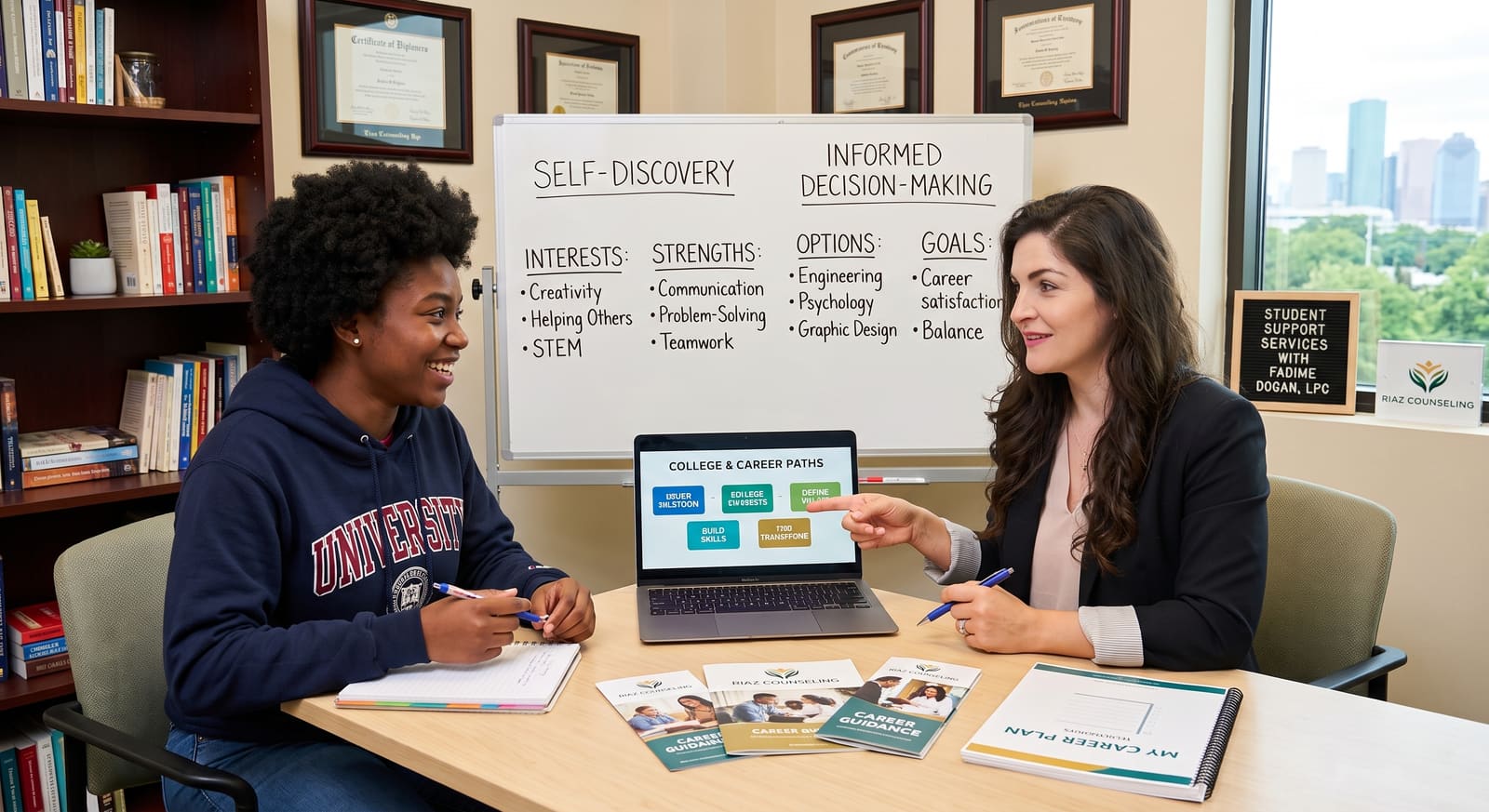
At Riaz Counseling, College & Career Guidance is one of the practice's listed areas of specialization, with an emphasis on self-discovery and informed decision-making about education and career paths.
For individuals interested in working with Fadime Dogan, LPC, her current Riaz Counseling profile identifies her as a fully licensed therapist whose primary areas of focus include anxiety, stress, and depression. She works with preteens, teens, adults, and older adults and uses approaches including Acceptance and Commitment Therapy (ACT), Adlerian, Attachment-Based, CBT, DBT, Emotionally Focused, Existential, Jungian, Multicultural, and Person-Centered approaches.
Key Highlights
- Career and college decisions can involve both practical questions and emotional challenges.
- You do not necessarily need to have your entire career figured out before choosing a major or taking your next step.
- Career counseling can involve self-exploration, identifying values and interests, exploring options, and creating realistic goals.
- College counseling may help students navigate academic pressure, uncertainty, transitions, confidence, and other emotional concerns.
- Research suggests that career-related stress and uncertainty can be connected with career indecision and anxiety.
- A mental health professional can provide a supportive space for exploring anxiety, self-doubt, stress, and other concerns that may affect educational or career decisions.
What Is Career and College Counseling?
Career and college counseling can help people explore questions related to education, work, goals, identity, and future planning.
It is not simply about being told which career to choose.
Instead, the process may involve understanding yourself more clearly and using that information to make decisions.
Career counseling can explore:
- Interests
- Strengths
- Values
- Skills
- Personal priorities
- Work preferences
- Educational goals
- Career possibilities
- Concerns about changing direction
- Barriers that may be making decisions difficult
The American Psychological Association describes counseling psychology as a field that includes educational and career development and emphasizes understanding the interaction between people and their environments.
Career counseling has also developed beyond simply matching personality traits or interests with a particular occupation. Contemporary approaches can help people connect their experiences, values, identity, and goals with possible career directions.
Why Choosing a Career Can Feel So Difficult
There is often an expectation that students should know what they want to do relatively early.
That expectation can create unnecessary pressure.
A high school student may feel they need to select a college major that determines their entire future.
A college student may feel that choosing the wrong major means losing years of progress.
A recent graduate may feel behind because they have not immediately found the "right" job.
A working adult may wonder whether changing careers means starting over.
These situations can produce thoughts such as:
"I should already know what I want to do."
"Everyone else has their future figured out."
"If I make the wrong choice, I'll regret it forever."
"I can't change my mind now."
These beliefs can make career decisions feel much more permanent than they actually are.
You Do Not Have to Choose Your Entire Future at Once
One useful way to approach career decisions is to distinguish between a decision and a direction.
A decision might be:
"I am choosing this major."
A direction might be:
"I am interested in healthcare, so I am going to explore programs and careers in that area."
The second approach leaves room for learning.
You can research.
You can talk to people.
You can gain experience.
You can discover that something fits—or does not fit.
The APA has highlighted the way career-related myths can contribute to anxiety among college students. In particular, research discussed by APA researchers found that stronger belief in career myths was associated with greater anxiety about career and academic-major decisions.
This does not mean that career choices are unimportant.
It means that you may not need to treat every educational decision as an irreversible commitment.
What Is College Counseling?
College counseling can address more than choosing a school.
Students may seek support for:
- Academic stress
- Major selection
- Career uncertainty
- Adjustment to college
- Confidence and self-esteem
- Relationship concerns
- Family expectations
- Anxiety
- Depression
- Perfectionism
- Time-management difficulties
- Questions about the future
- Stress surrounding graduation
For some students, educational uncertainty may be closely connected with emotional well-being.
Research involving university students experiencing doubts about their studies has found that uncertainty can involve factors such as insufficient information, unmet expectations, academic performance concerns, study conditions, and lack of future perspective. Mental health concerns may also interact with these doubts.
This is why college counseling may sometimes involve looking beyond the immediate question of "What should I major in?"
The deeper question may be:
"What is making this decision so difficult for me?"
Career Counseling Is Not About Telling You What to Do
A common misconception is that a career counselor will give you a single answer:
"You should become a teacher."
or:
"You should major in business."
Good career guidance is more nuanced.
The goal may be to help you understand the factors behind your decision so that you can make a more informed choice.
You may explore questions such as:
What matters to me?
Think beyond job titles.
Consider:
- Financial stability
- Creativity
- Helping others
- Independence
- Flexibility
- Intellectual challenge
- Leadership
- Family time
- Work-life balance
- Community
- Cultural values
What am I naturally interested in?
Interest does not automatically determine a career, but it can provide useful information.
Ask:
- What topics do I enjoy learning about?
- What activities make me lose track of time?
- What problems do I enjoy solving?
- What subjects do I want to understand better?
What are my strengths?
Strengths can include more than academic performance.
You may be strong at:
- Communication
- Organization
- Problem-solving
- Creativity
- Leadership
- Listening
- Writing
- Working with people
- Working independently
- Analyzing information
What kind of environment fits me?
Two people can enjoy the same subject but prefer very different work environments.
You might prefer:
- A structured workplace
- A flexible schedule
- Remote work
- Team-based work
- Independent work
- A fast-paced environment
- A predictable routine
- A people-focused environment
Understanding these preferences can make career exploration more meaningful.
Career Decisions and Anxiety
Career decisions can become especially difficult when uncertainty triggers anxiety.
For example:
Uncertainty → worry → overthinking → inability to decide → more uncertainty
A student may research dozens of majors but become increasingly confused rather than more confident.
Another person may continually ask friends and family for reassurance but still feel uncertain.
Research involving college students has found relationships among career stress, career exploration, future-oriented thinking, career planning, and career indecision.
Another longitudinal study found a reciprocal relationship between intolerance of ambiguity and career indecision, with negative affect and choice anxiety playing a role in the decision-making process.
This does not mean that indecision is a mental health disorder.
It means that emotional responses to uncertainty can influence how people approach career decisions.
How Therapy Can Support Career and College Decisions
Career questions are not always purely practical.
Sometimes they are connected to deeper concerns involving:
- Anxiety
- Self-esteem
- Perfectionism
- Fear of failure
- Family expectations
- Identity
- Depression
- Stress
- Major life transitions
A therapist can help explore these concerns while you work through your educational or career decisions.
For example, a student might say:
"I don't know which major to choose."
During a deeper conversation, they may discover:
"I'm afraid of choosing something my parents won't approve of."
Or:
"I'm scared that if I choose the wrong career, I'll disappoint everyone."
The career decision is still important—but understanding the emotional pressure around it can make the decision easier to approach.
How Fadime Dogan May Fit Into This Process
Fadime Dogan is a fully licensed LPC at Riaz Counseling. Her current profile identifies anxiety, stress, and depression as her primary focus areas. She provides individual, couples, family, and group therapy and works with preteens, teens, adults, and older adults.
Her listed therapeutic approaches include ACT, Adlerian, Attachment-Based therapy, CBT, DBT, Emotionally Focused therapy, Existential therapy, Jungian approaches, Multicultural therapy, and Person-Centered therapy.
These areas can be relevant when educational or career decisions become connected with anxiety, stress, self-doubt, emotional well-being, or major life transitions.
Riaz Counseling separately lists College & Career Guidance as a practice specialization focused on self-discovery and informed decision-making about education and career paths.
If you are specifically looking for career counseling with Fadime, it is appropriate to discuss your goals during an initial consultation and confirm that her current scope and approach are a good fit for the type of career or college guidance you are seeking.
Practical Questions to Ask Before Choosing a Major
If you are a student trying to choose a major, start with exploration rather than demanding an immediate answer.
Ask yourself:
1. What subjects do I genuinely enjoy?
Think about classes you look forward to—not simply classes where you receive the highest grades.
2. What type of work sounds meaningful?
Would you rather:
- Help people?
- Build things?
- Solve problems?
- Create?
- Research?
- Lead?
- Teach?
- Analyze?
- Work with technology?
- Work outdoors?
3. What kind of lifestyle do I want?
Career decisions affect more than work.
Consider:
- Schedule
- Location
- Financial goals
- Family responsibilities
- Flexibility
- Work-life balance
4. What am I choosing because I want it—and what am I choosing because others expect it?
Family guidance can be valuable.
But it is also worth understanding which goals genuinely belong to you.
5. What information am I missing?
Sometimes uncertainty does not mean you need more self-analysis.
You may simply need information.
Consider:
- Talking with professionals
- Visiting a workplace
- Reviewing course requirements
- Researching programs
- Attending career events
- Speaking with academic advisors
- Exploring internships or volunteer opportunities
What Parents Can Do When a Teen Is Unsure About Their Future
Parents often want to help their children make good decisions.
But too much pressure can make career conversations more stressful.
Instead of:
"You need to decide what you're going to do with your life."
try:
"What are you curious about right now?"
Instead of:
"That major won't lead anywhere."
try:
"What do you like about that field, and what have you learned about the career options?"
The goal is not to remove parental guidance.
It is to create space for exploration and honest conversation.
Parents can also help by recognizing that educational and career decisions develop over time.
What If You Choose the Wrong Major?
Changing direction does not automatically mean you failed.
Students sometimes discover that:
- A subject is different from what they expected.
- Their interests have changed.
- A career they imagined does not fit their preferred lifestyle.
- Another field becomes more interesting.
- Their personal circumstances change.
Career development can involve adaptation and transition rather than a single decision made at age 18.
APA resources on career development emphasize self-assessment, exploration, and goal setting as parts of developing an individualized career plan.
That perspective can be helpful when you feel pressure to identify one permanent answer.
When Should You Consider Counseling?
Career uncertainty is not automatically a mental health problem.
You may simply need more information.
However, professional support may be worth considering when uncertainty becomes emotionally overwhelming.
For example, you may benefit from additional support if:
- You feel intense anxiety whenever you think about your future.
- You cannot make decisions because you are afraid of making a mistake.
- Academic pressure is affecting your sleep or daily life.
- You constantly compare your progress with others.
- Family expectations are creating significant distress.
- Career uncertainty is affecting your confidence.
- You feel overwhelmed by major life transitions.
- You are experiencing persistent anxiety, sadness, or loss of motivation.
A qualified mental health professional can help determine whether counseling may be useful and what type of support makes sense for your situation.
What Can You Expect From a Counseling Session?
You do not need to arrive with a five-year plan.
An initial conversation may involve discussing:
- What brings you to counseling
- Your current academic or career concerns
- Important personal circumstances
- Your goals
- Sources of stress
- Emotional concerns
- Previous experiences with counseling
- What you hope to understand or change
From there, you and your therapist can identify appropriate goals.
For one person, that might mean managing anxiety while making a decision.
For another, it might involve improving confidence.
For someone else, it might mean working through a major life transition.
There is no single correct reason to seek support.
Career Counseling vs. Academic Advising
These services can overlap, but they are not necessarily the same.
Academic advising
An academic advisor may help with:
- Course selection
- Degree requirements
- Graduation planning
- Academic policies
- Program requirements
- Registration
Career counseling
Career counseling may focus more on:
- Interests
- Values
- Strengths
- Career exploration
- Decision-making
- Work-related goals
- Career transitions
- Emotional barriers to career planning
Mental health counseling
Therapy can address emotional or psychological concerns such as:
- Anxiety
- Depression
- Stress
- Self-esteem
- Perfectionism
- Relationship concerns
- Life transitions
Sometimes a student may benefit from more than one type of support.
For example, an academic advisor may explain which courses are required while a therapist helps the student manage anxiety surrounding the decision.
Finding College and Career Support in Houston
Students and families in Houston have several potential sources of support, including educational advisors, campus career centers, academic departments, and mental health professionals.
Riaz Counseling currently lists College & Career Guidance among its practice specializations, alongside areas such as anxiety, life transitions, parenting and teens, and self-esteem and identity.
Riaz Counseling has offices in Houston's Galleria area, Sugar Land, and The Woodlands, with telehealth available statewide in Texas according to its current website.
If you are considering counseling, ask whether the provider's experience and current services match your specific needs.
Frequently Asked Questions
What is career and college counseling?
Career and college counseling helps people explore educational and career options while considering interests, strengths, values, goals, circumstances, and emotional concerns. It can support decision-making without requiring someone to identify one permanent career path immediately.
Can a therapist help me choose a college major?
A therapist can help you explore the emotional and personal factors influencing your decision, such as anxiety, self-doubt, perfectionism, family pressure, or uncertainty. Academic advisors and career professionals may also provide important information about programs and career pathways.
Is it normal to be unsure about my career?
Yes. Career development can involve exploration, changes in interests, and transitions. Being uncertain does not automatically mean that you are making a poor decision.
Can career uncertainty cause anxiety?
Career uncertainty can be associated with stress and anxiety for some students, particularly when they feel pressure to make the "right" choice or have difficulty tolerating uncertainty. Research has found relationships between career indecision, career stress, and anxiety-related experiences.
How can I know whether a career is right for me?
There is no single test that can guarantee that a career will be right for you. Exploring your interests, values, strengths, preferred work environment, educational requirements, and real-world career information can help you make a more informed decision.
Does Riaz Counseling offer college and career counseling?
Riaz Counseling currently lists College & Career Guidance as one of its specializations, describing it as guidance for self-discovery and informed decision-making about education and career paths.
Who is Fadime Dogan?
Fadime Dogan is a fully licensed LPC at Riaz Counseling. Her current profile identifies anxiety, stress, and depression as her primary focus areas, and she works with preteens, teens, adults, and older adults. Her listed therapeutic approaches include ACT, Adlerian, Attachment-Based, CBT, DBT, Emotionally Focused, Existential, Jungian, Multicultural, and Person-Centered approaches.
Can counseling help if I am experiencing both career stress and anxiety?
It may. Counseling can provide a space to explore how anxiety, stress, self-esteem, perfectionism, family expectations, or other emotional concerns are affecting decision-making. A mental health professional can help determine whether therapy is appropriate for your circumstances.
A Supportive Approach to Your Next Step
You do not have to know exactly where your career will take you before you can begin exploring your options.
A better starting point may be asking:
What do I know about myself today?
What am I curious about?
What information do I still need?
What is making this decision feel difficult?
What would a reasonable next step look like?
Career and college decisions are important, but they do not necessarily have to define your entire future.
If anxiety, stress, self-doubt, or major life transitions are making the process harder, professional support can provide another perspective.
How Riaz Counseling May Help
Riaz Counseling offers mental health counseling and currently lists College & Career Guidance as one of its areas of specialization. The practice describes this service as supporting self-discovery and informed decision-making about education and career paths.
For people considering Fadime Dogan, her current profile identifies her as a fully licensed LPC with primary focus areas of anxiety, stress, and depression. She serves clients across several age groups and offers individual, couples, family, and group therapy.
If you are interested in working with Fadime or another Riaz Counseling provider, a consultation can help clarify whether the provider's current services and approach are a good fit for your needs.
Mental Health Disclaimer
This article provides general educational information and is not a diagnosis or a substitute for individualized mental health, medical, academic, or career advice. Career decisions are personal, and appropriate support depends on individual circumstances.
If you are experiencing severe emotional distress or an immediate mental health emergency, seek appropriate emergency or crisis support rather than relying on an online article.
Sources Used
American Psychological Association — Counseling Psychology and educational/career development.
American Psychological Association — Career development resources, including self-assessment, exploration, and goal setting.
American Psychological Association — Research and discussion on career myths and career-related anxiety among college students.
PubMed — Research examining career stress, career exploration, career planning, and career indecision among college students.
PubMed — Longitudinal research on career decision ambiguity, choice anxiety, and career indecision.
PubMed — Qualitative research examining career indecision, student doubts, and mental well-being.
Riaz Counseling — Fadime Dogan, LPC profile.
Riaz Counseling — College & Career Guidance and current practice specializations.
Riaz Counseling — Current services, locations, and practice information.
If you feel that you or someone you know may benefit from therapy, please reach out to our office for a FREE 15-minute consultation: LINK.