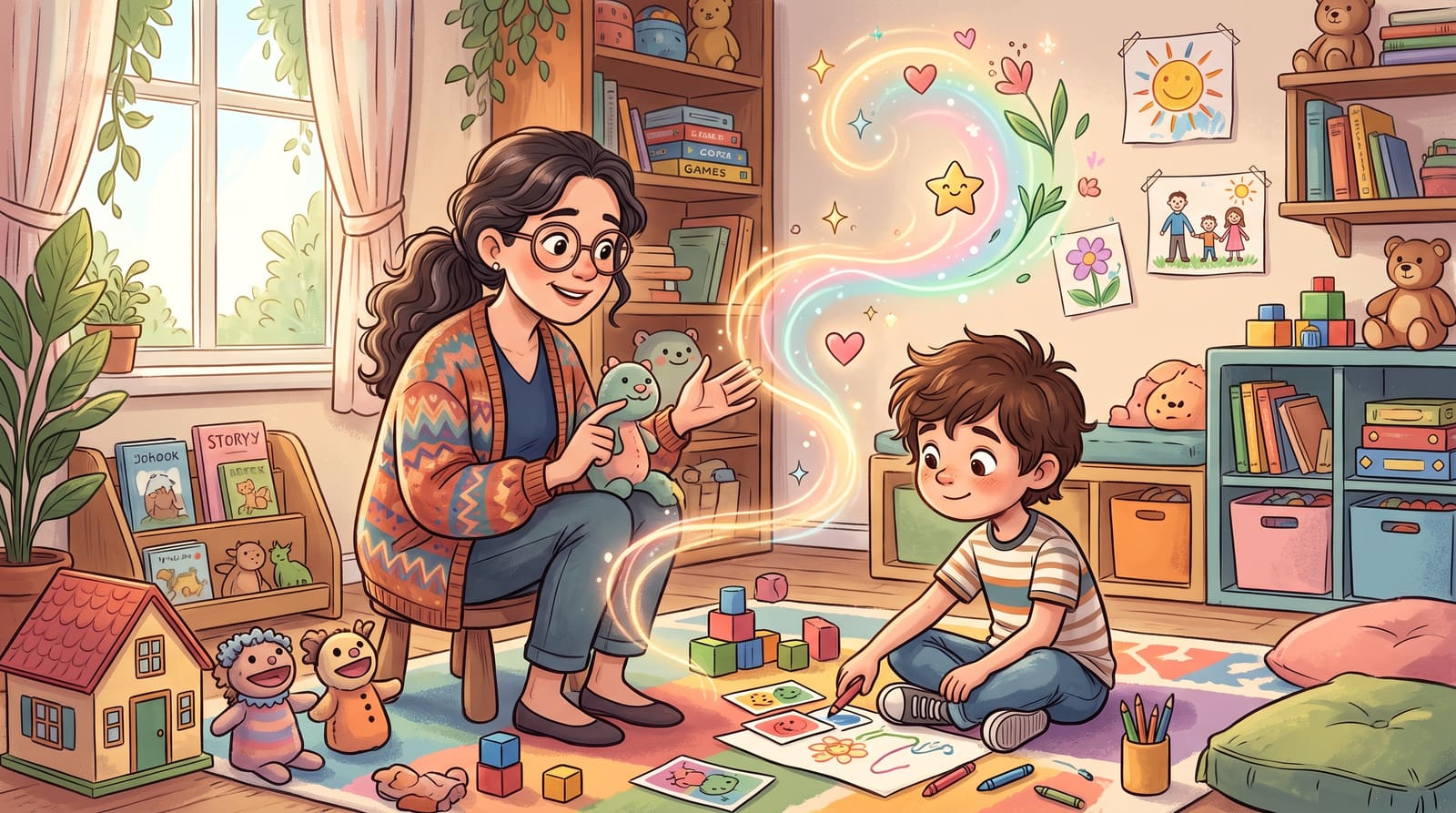
Topic Understanding
Children experience many emotions as they grow. They may feel excited about starting school, frustrated when something does not go their way, worried about making friends, or overwhelmed by changes at home. Learning to understand and manage these feelings is an important part of growing up, but children do not always have the words or skills to explain what they are experiencing.
Child therapy can help children understand their emotions, develop coping skills, build healthier relationships, and navigate difficult experiences. It can also help parents and caregivers better understand their child's needs and learn practical ways to provide support.
Emotional development does not look the same for every child. Some children express their feelings openly, while others become quiet, withdraw, or communicate distress through changes in behavior. Understanding these differences can help caregivers recognize when a child may need additional support.
This article explains how child therapy works, how play and other therapeutic activities can support emotional development, what parents can do at home, and when it may be helpful to seek professional guidance.
Key Highlights
- Emotional development helps children recognize feelings, communicate needs, manage frustration, and build relationships.
- Child therapy provides age-appropriate ways for children to explore emotions and learn coping skills.
- Play may help younger children communicate experiences they find difficult to describe with words, although the most appropriate treatment depends on the child's needs.
- Parents and caregivers often play an important role in supporting progress outside therapy sessions.
- When emotional or behavioral difficulties persist or interfere with everyday life, a qualified mental health professional can help determine what support may be appropriate.
What Is Emotional Development in Children?
Emotional development is the process through which children gradually learn to recognize, express, understand, and manage their emotions. It also includes developing empathy, building relationships, tolerating frustration, and responding to challenging situations in increasingly flexible ways.
These skills develop over time. A toddler who becomes upset when a toy is taken away will not respond in the same way as an older child who can explain why they feel frustrated. Children also differ in temperament, communication style, developmental needs, and the experiences that shape their emotional responses.
Healthy emotional development does not mean a child is happy all the time or never becomes angry, anxious, or upset. It means they gradually gain skills to experience emotions, express them safely, and recover from difficult moments with appropriate support.
Important parts of emotional development include:
- Recognizing emotions: Identifying feelings such as happiness, sadness, anger, fear, disappointment, and excitement.
- Expressing feelings: Communicating emotions and needs in ways other people can understand.
- Emotional regulation: Learning strategies to manage intense feelings without becoming overwhelmed.
- Empathy: Beginning to understand how other people may feel.
- Problem-solving: Finding ways to handle disagreements, disappointments, and everyday challenges.
- Resilience: Gradually learning to adapt to changes and recover from setbacks.
- Relationship skills: Building trust, communicating needs, and navigating friendships and family relationships.
These skills do not develop in a straight line. Children may manage one situation confidently but struggle with another, particularly during transitions, stressful periods, or changes in their environment.
How Does Child Therapy Support Emotional Development?
Child therapy is a form of mental health support tailored to a child's developmental level, experiences, and needs. Depending on the child's age and concerns, therapy may involve conversation, structured activities, play, skill-building exercises, caregiver participation, or a combination of approaches.
The goal is not to make a child stop having difficult feelings. Instead, therapy can help children understand what they feel, learn how to respond to those feelings, and develop skills that support their daily lives.
The CDC explains that psychological therapy can help children learn coping skills and improve functioning at home, at school, and in their communities. Treatment plans should be adapted to the child and family, with caregiver involvement adjusted to the child's developmental stage.
1. Helping Children Identify and Understand Emotions
Children sometimes know that something feels wrong but cannot explain exactly what it is.
A child might say, "I hate school," when the underlying concern is anxiety about making friends. Another child may become angry when asked to complete homework because they feel overwhelmed or afraid of making mistakes.
A child counselor may help the child explore these experiences in an age-appropriate way.
For example, a therapist might use an emotions chart, a story, drawing, or conversation to help a child distinguish between feeling frustrated, embarrassed, worried, or disappointed.
Learning to name an emotion can give a child a starting point for understanding what they need.
Parents can reinforce this skill by saying things such as:
- "It sounds like you felt disappointed when that happened."
- "You seem worried about tomorrow. Do you want to talk about it?"
- "It's okay to feel angry. Let's figure out what you can do with that feeling."
- "You don't have to explain everything right away. I'm here when you're ready."
The aim is to acknowledge the child's experience without assuming you already know exactly how they feel.
2. Developing Emotional Regulation Skills
Emotional regulation involves noticing and managing feelings in ways that help a child respond to a situation safely and effectively.
A young child may cry, shout, or throw a tantrum when overwhelmed. An older child might argue, shut down, avoid a difficult task, or become unusually irritable.
These behaviors can have different causes. A mental health professional can help explore what is happening rather than treating every emotional reaction as deliberate misbehavior.
Depending on the child's needs, therapy may introduce skills such as:
- Taking slow, comfortable breaths.
- Recognizing early signs of frustration.
- Taking a short break when emotions become intense.
- Using words to request help.
- Breaking a difficult task into smaller steps.
- Practicing problem-solving after a conflict.
- Identifying safe people to approach for support.
Children need opportunities to practice these skills when they are relatively calm, not only during a difficult moment.
For example, a parent might practice a simple calming routine with a child after school. Later, when the child becomes upset about homework, the routine may feel more familiar.
The purpose is not to eliminate every emotional reaction. It is to help the child gradually build a wider range of ways to respond.
3. Building Confidence and Self-Esteem
Children develop beliefs about themselves through their experiences, relationships, successes, setbacks, and the messages they receive from others.
Repeated criticism, bullying, academic struggles, family conflict, or difficulty fitting in may affect how a child views their abilities or worth. These experiences do not affect every child in the same way, but some children may begin to think they are incapable, unlikable, or unable to do anything right.
Therapy can offer a supportive setting where children explore these beliefs and practice responding to challenges more constructively.
For example, a child who says, "I'm bad at everything," might work on identifying what happened, separating a mistake from their overall identity, and finding a realistic next step.
Caregivers can support this process by recognizing effort and progress rather than focusing only on results.
Instead of saying, "You're the smartest kid in the class," you might say, "You kept working on that even when it was difficult."
Specific encouragement helps children recognize what they did and what they can learn from the experience.
4. Improving Communication and Relationships
Emotional development is closely connected with relationships.
Children need opportunities to learn how to express needs, listen to others, handle disagreements, and repair relationships after conflict.
A child who struggles to communicate may react physically, withdraw from peers, become unusually controlling during play, or have difficulty asking for help.
Therapy may help a child practice skills such as:
- Expressing disagreement respectfully.
- Asking for help when confused.
- Identifying personal boundaries.
- Recognizing another person's perspective.
- Managing disappointment when plans change.
- Handling conflict with siblings or friends.
- Communicating feelings without blaming others.
Parents and caregivers may also learn ways to model these skills at home.
For example, after a disagreement between siblings, an adult can help each child describe what happened, explain how they felt, listen to the other person's perspective, and consider a fair next step.
The goal is not to expect children to resolve every conflict independently. It is to give them guided opportunities to develop the skills they will need as they grow.
5. Supporting Children Through Change and Stress
Children may experience stress during transitions such as starting a new school, moving to another neighborhood, welcoming a new sibling, experiencing parental separation, losing a loved one, or adjusting to changes in family routines.
Even positive changes can create uncertainty.
A child might become clingier before starting school, develop new worries after a move, or become irritable when family circumstances change.
Therapy can provide a place to explore these feelings and identify what may help the child feel more supported.
Depending on the situation, support might include practicing how to handle an upcoming transition, identifying trusted adults, developing coping strategies, or helping caregivers respond consistently to the child's needs.
The purpose is not to prevent children from experiencing stress. It is to help them navigate challenges with support and build skills they can use in future situations.
What Is Play Therapy, and How Can It Help?
Play is a natural way for many children to explore their surroundings, practice social interactions, and communicate experiences. Because young children may not have the language or abstract reasoning skills of older children, play and other developmentally appropriate activities can sometimes help them express thoughts and feelings.
The American Academy of Pediatrics describes play as an important opportunity for children to develop social-emotional, cognitive, language, and self-regulation skills. Play can also support nurturing relationships between children and their caregivers.
Play therapy is a therapeutic approach in which play is used intentionally to help a child explore experiences, express feelings, or work toward specific therapeutic goals. It is different from simply allowing a child to play for entertainment.
Depending on the approach and the child's needs, a trained therapist may use toys, pretend play, art materials, stories, games, or structured activities.
What might play-based therapy look like?
Imagine a child who becomes very distressed whenever a parent leaves them at school.
The child may struggle to explain the worry directly. During an age-appropriate therapeutic activity, they might use toys or pretend scenarios to explore separation, safety, and reunion.
A therapist could use these activities to understand the child's perspective and help them practice ways of coping with transitions. Caregiver guidance may also be important so that strategies can be reinforced outside the session.
This is an illustrative example, not a guarantee that a particular activity will be appropriate or effective for every child.
Is play therapy right for every child?
No. The best approach depends on the child's age, developmental level, concerns, preferences, and treatment goals.
Research on psychological interventions for children supports some approaches more strongly than others for particular concerns. An evidence review found that cognitive behavioral therapy has promising evidence for certain internalizing symptoms, while the evidence for play-based approaches varies and remains limited for some outcomes.
For this reason, parents should ask a prospective provider about their training, the approach they recommend, the goals of treatment, and how progress will be assessed.
Do not assume that every child therapist offers play therapy or that play therapy is the right choice for every child.
What Types of Therapy May Be Used With Children?
There is no single therapeutic approach that fits every child. A qualified mental health professional can recommend an approach based on the child's needs and the available evidence.
Cognitive Behavioral Therapy (CBT)
Cognitive behavioral therapy helps children understand connections between thoughts, feelings, and behaviors. It may be used for concerns such as anxiety and depression, with activities adapted to the child's age and developmental abilities.
A child might learn to recognize an anxious thought, examine whether it accurately reflects the situation, and practice responding in a more helpful way.
The CDC identifies CBT as an approach that can help children address thoughts and emotional responses that affect behavior.
Behavior Therapy and Parent Training
Behavior therapy focuses on helping children and families build useful behaviors and reduce behaviors that interfere with daily life.
Parent training in behavior management teaches caregivers practical strategies for responding to challenging behavior, strengthening positive interactions, and helping children practice new skills.
This approach is particularly relevant for certain behavioral concerns and ADHD. For young children with ADHD, the CDC recommends parent training in behavior management as a first-line treatment approach.
Family-Based Approaches
Sometimes a child's difficulties are connected with family interactions, communication patterns, or a stressful change in the household.
Family-based work can help caregivers and children improve communication, understand each other's perspectives, and practice healthier ways of responding to conflict.
This does not mean parents are to blame for a child's emotional difficulties. Family involvement is often a way to build a stronger support system around the child.
Other Developmentally Appropriate Approaches
Depending on the child's needs and the clinician's training, therapy may involve structured skill-building, supportive conversation, caregiver-child activities, or other evidence-informed approaches.
The important question is not simply which type of therapy sounds best. It is whether the approach fits the child's concerns, developmental stage, and treatment goals.
How Can Parents Support Emotional Development at Home?
Therapy is only one part of a child's support system. Everyday interactions with parents and caregivers can also help children learn about emotions, relationships, and coping.
The American Academy of Pediatrics emphasizes the importance of nurturing relationships, age-appropriate expectations, predictable support, and opportunities for children to practice developing skills.
Here are several practical ways to support emotional development at home.
Make Space for Feelings
Children need to know that they can talk about difficult emotions without automatically being punished, criticized, or dismissed.
If your child says they are scared, try to understand the concern before reassuring them that there is nothing to worry about.
For example, you might say, "I can see that starting your new class feels scary. What part are you most worried about?"
You do not need to agree with every interpretation a child has. You can acknowledge the feeling while helping them understand the situation.
Create Predictable Routines
Regular routines around sleep, meals, school preparation, and family time can help children know what to expect.
Predictability does not require every day to follow a strict schedule. It means establishing enough consistency that a child can anticipate important parts of daily life.
If a change is coming, explain it in language appropriate to the child's age and give them time to ask questions.
Model Healthy Emotional Responses
Children learn by observing how adults handle frustration, disappointment, and conflict.
You might say, "I'm feeling frustrated, so I'm going to take a few breaths before I respond."
This demonstrates that emotions are normal and that people can choose how they respond to them.
It also shows children that adults are still learning and practicing emotional skills themselves.
Encourage Problem-Solving Without Taking Over
When children encounter a challenge, it can be tempting to solve it immediately.
Sometimes they need direct adult intervention, especially when safety is involved. In other situations, you can guide them through the process.
Try asking:
- What happened?
- How did that make you feel?
- What do you think you could try?
- Do you want help coming up with a plan?
- What might you do differently next time?
These questions encourage reflection while reminding the child that support is available.
Recognize Effort and Small Steps
Emotional development takes time. A child may not suddenly stop becoming upset, but they might begin asking for help before becoming overwhelmed.
Notice these small changes.
For example, you might say, "You were frustrated, but you told me what you needed instead of walking away. That was a helpful step."
Specific encouragement helps children recognize the skills they are developing.
How Can You Tell if a Child May Need Therapy?
Every child has difficult days. Occasional tantrums, worries, sadness, frustration, and disagreements can be part of growing up.
However, it may be worth seeking professional guidance when changes in a child's emotions or behavior persist, become more intense, or interfere with everyday activities.
Possible signs include:
- Frequent or intense emotional outbursts.
- Ongoing anxiety, fear, or excessive worry.
- Persistent sadness or irritability.
- Withdrawal from friends, family, or activities they previously enjoyed.
- Significant changes in sleep or appetite.
- Repeated difficulties at school or with friendships.
- Strong reactions to changes or separations.
- Behavior that creates ongoing problems at home, school, or in the community.
- Difficulty recovering from stressful experiences.
- Emotional distress that affects family routines or relationships.
These signs do not automatically mean a child has a mental health disorder. They are reasons to pay attention and consider whether additional support could help.
The National Institute of Mental Health recommends looking at how long concerns have lasted, how intense they are, and how much they interfere with a child's life. A health professional can help determine whether symptoms reflect a developmental phase, a response to stress, or a concern that may benefit from treatment.
If you are concerned about a child's development or behavior, you can also begin by talking with their pediatrician, who may recommend an evaluation or referral.
You do not have to wait until difficulties become severe to ask questions.
What Should Parents Expect During Child Therapy?
Parents may feel uncertain about what happens in therapy, particularly if their child is young or has difficulty explaining their feelings.
The process varies depending on the child's needs, age, treatment approach, and provider.
1. An Initial Conversation
The therapist may ask about the child's current concerns, developmental history, family circumstances, school experiences, relationships, and strengths.
Parents may be asked what they have noticed, when the concerns began, what seems to make them better or worse, and how the difficulties affect daily life.
The aim is to understand the child within the context of their environment rather than focusing on one behavior in isolation.
2. Understanding the Child's Needs
The therapist may work directly with the child, speak with caregivers, observe interactions, or use developmentally appropriate assessment methods.
The exact process depends on the child's age and circumstances.
A good assessment should help clarify the concerns being addressed and establish realistic goals.
3. Developing Goals Together
Goals should be specific enough to guide treatment but flexible enough to change as the child's needs become clearer.
For one child, a goal might be learning to communicate worries about school. For another, it might be improving frustration tolerance, handling peer conflict, or practicing coping strategies.
Progress does not always mean that difficult feelings disappear. It may mean that the child can express them more safely, recover more easily, or ask for help sooner.
4. Supporting Skills Outside Sessions
Children benefit when the skills they practice can be used in everyday life.
Depending on the treatment plan, the therapist may suggest activities or strategies for parents to try at home. Caregivers may also participate directly in sessions or receive guidance separately.
The CDC notes that caregiver involvement is important in children's mental health treatment, although the nature of that involvement varies by developmental age and treatment needs.
5. Reviewing Progress
Therapy is a process, and progress can look different for every child.
The therapist and family may review whether the original goals remain appropriate, which strategies are helping, and whether the plan needs to change.
If a child is not making expected progress, it is reasonable to discuss the concerns openly and explore whether a different approach, additional evaluation, or another form of support may be appropriate.
Choosing a Child Counselor: Questions Parents Can Ask
Finding the right provider involves more than selecting someone who works with children. You want to understand whether their training, approach, and services are a good fit for your family.
Consider asking:
- What ages do you work with?
- What experience or training do you have related to my child's concerns?
- What therapy approaches might be appropriate, and why?
- How will parents or caregivers participate?
- How do you establish goals and evaluate progress?
- What information will be shared with parents, and what privacy limits apply?
- How do you coordinate with pediatricians, schools, or other professionals when appropriate?
- What should we do if my child's symptoms worsen?
- What are the fees, insurance arrangements, and appointment options?
You can also ask how the therapist approaches cultural background, family values, disability, neurodivergence, and communication differences.
A child should feel respected and supported, while parents should have a clear understanding of the treatment process and how they can help.
How Riaz Counseling May Help Families Explore Support
When a child's emotional or behavioral difficulties begin affecting everyday life, it can be helpful to speak with a mental health professional about the available options.
Riaz Counseling provides mental health counseling services in the Houston area, including individual therapy, couples therapy, and family therapy. The practice has offices in Houston Galleria, Sugar Land, and The Woodlands, and offers online therapy for Texas residents.
If you are considering support for your child, contact Riaz Counseling to ask about current services, age eligibility, clinician experience, and whether the practice can meet your child's specific needs. Confirming these details before scheduling helps ensure that the recommended service is appropriate for your family.
You can visit the practice's contact page to learn about its consultation process and discuss next steps.
Seeking support does not mean you have failed as a parent. It means you are taking your child's emotional well-being seriously and looking for ways to help.
Frequently Asked Questions
What does child therapy help with?
Child therapy can help children develop coping skills, understand and communicate emotions, manage anxiety or behavioral difficulties, improve relationships, and navigate stressful experiences. The appropriate goals and approach depend on the child's individual needs.
At what age can a child start therapy?
There is no single age that applies to every child. Mental health support can be adapted for young children, school-aged children, and adolescents. For younger children, treatment often involves parents or caregivers more directly. A qualified provider can help determine which services are appropriate for a child's developmental stage.
Does play therapy help emotional development in children?
Play-based approaches can give some children a developmentally appropriate way to express experiences and explore feelings. However, evidence and suitability vary by concern and approach. Parents should ask about the therapist's training, treatment goals, and the evidence supporting the recommended method.
How do I know if my child needs therapy or is going through a phase?
Consider how long the concern has lasted, how intense it is, whether it is getting worse, and whether it affects school, friendships, family relationships, or daily routines. If you are unsure, a pediatrician or qualified mental health professional can help you understand what may be happening.
Should parents attend child therapy sessions?
Parent involvement depends on the child's age, concerns, and treatment approach. Younger children often need more direct caregiver participation, while older children may work more independently with a therapist. Even when sessions focus on the child, caregivers can be important partners in supporting progress outside therapy.
How long does child therapy take?
There is no fixed timeline. The length of treatment depends on the child's needs, the goals being addressed, the therapeutic approach, and how progress develops. A therapist can discuss an initial plan and review it with the family over time.
Can child therapy help with school-related anxiety?
Therapy may help children understand worries about school, develop coping skills, and practice responding to challenging situations. The therapist may also work with caregivers to identify helpful support at home and, when appropriate and with suitable permissions, coordinate with other adults involved in the child's care.
How can parents support emotional development at home?
Parents can support emotional development by listening without dismissing feelings, maintaining predictable routines, modeling healthy ways to manage frustration, encouraging problem-solving, and recognizing effort. Children also benefit from safe, nurturing relationships and opportunities for age-appropriate play and social interaction.
Conclusion
Emotional development is an ongoing process. Children gradually learn to understand their feelings, communicate their needs, handle frustration, build relationships, and respond to challenges. They need time, guidance, and supportive relationships to develop these skills.
Child therapy can provide additional support when a child is struggling with emotions, behavior, relationships, or stressful experiences. Through developmentally appropriate activities, coping strategies, and caregiver involvement, therapy may help children build skills they can use at home, at school, and in their relationships.
Parents do not need to have every answer before seeking help. If you notice persistent changes in your child's mood or behavior, consider speaking with a pediatrician or qualified mental health professional.
Supporting a child's emotional development begins with listening, understanding, and responding with care. Asking for professional guidance when needed can be another meaningful way to support a child's well-being as they grow.
Mental Health Disclaimer
This article is for general educational purposes and is not a substitute for professional assessment, diagnosis, or treatment. Children's emotional and behavioral changes can have many causes. If you are concerned about your child's development or mental health, consult a qualified health professional who can help determine appropriate next steps.
If a child is in immediate danger or may seriously harm themselves or someone else, seek urgent professional or emergency assistance.
Suggested Internal Links
- Riaz Counseling Home — introduces the practice and its counseling services.
- Riaz Counseling Services — helps readers review current service options.
- Riaz Counseling Locations — provides information about the Houston-area offices and online therapy.
- Riaz Counseling Contact Page — lets families ask about service availability, age eligibility, and next steps.
Editorial note: Before publishing, confirm whether Riaz Counseling currently offers child-specific therapy and play therapy, the ages served, and which clinicians provide those services. The article intentionally directs families to confirm these details rather than assuming availability.
Sources Used
Centers for Disease Control and Prevention (CDC), Treating Children's Mental Health with Therapy — how therapy works, caregiver involvement, and evidence-based approaches.
National Institute of Mental Health (NIMH), Children and Mental Health: Is This Just a Stage? — signs of potential concerns and how child mental health treatment is assessed.
American Academy of Pediatrics (AAP), The Power of Play: A Pediatric Role in Enhancing Development in Young Children — play and social-emotional development.
American Academy of Pediatrics (AAP), Framework for Approaching Healthy Mental and Emotional Development in Pediatrics — developmentally appropriate support and caregiver-child relationships.
Evidence review, Psychological interventions for children with emotional and behavioral difficulties aged 5–12 years — evidence and limitations across therapeutic approaches.
CDC, Parent Training in Behavior Management — parent training and behavioral treatment for young children with ADHD.
Riaz Counseling, Official Website and Locations — current counseling services, office locations, and online therapy information.
If you feel that you or someone you know may benefit from therapy, please reach out to our office for a FREE 15-minute consultation: LINK.