Topic Understanding
Anxiety can make ordinary situations feel overwhelming. You might spend hours worrying about something that has not happened, avoid situations that make you uncomfortable, or find it difficult to quiet your thoughts even when everything seems fine.
When anxiety begins affecting your relationships, work, education, sleep, or everyday activities, understanding how to manage it can make an important difference.
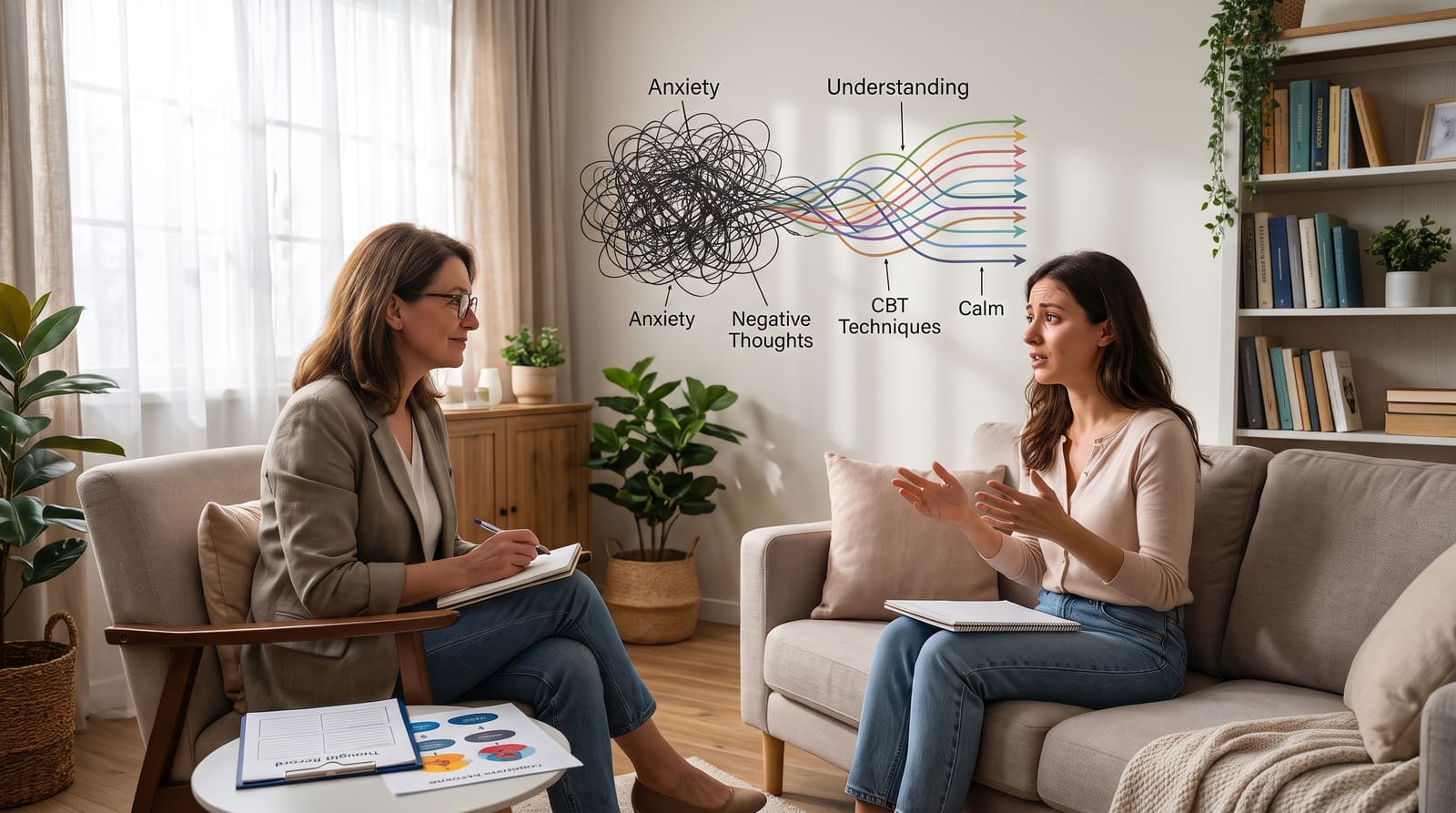
Cognitive behavioral therapy (CBT) is an evidence-based form of psychotherapy that can help people recognize unhelpful thinking patterns, understand how their behaviors influence anxiety, and develop healthier ways to respond to challenging situations. It is commonly used to treat anxiety disorders and can be adapted to different concerns and individual needs.
This article explains how CBT for anxiety works, which techniques therapists may use, what to expect during treatment, and how to explore anxiety therapy through Riaz Counseling.
Key Highlights
- CBT helps people understand the connection between thoughts, emotions, physical sensations, and behaviors.
- Cognitive restructuring, exposure therapy, behavioral strategies, and problem-solving are common components of anxiety CBT treatment.
- CBT does not require you to eliminate every anxious thought. It helps you develop more balanced responses and reduce patterns that keep anxiety going.
- Therapy is collaborative and may include practising skills between appointments.
- Riaz Counseling offers individual therapy for anxiety and lists Cognitive Behavioral Therapy among its therapeutic approaches.
What Is Cognitive Behavioral Therapy (CBT)?
Cognitive behavioral therapy is a structured form of psychotherapy that focuses on the relationship between how people think, feel, and behave.
The basic idea is that thoughts, emotions, physical reactions, and actions can influence one another.
For example, imagine you have to give a presentation at work.
You might think:
"I am going to make a mistake, and everyone will think I am incompetent."
That thought may lead to nervousness, a racing heartbeat, and difficulty concentrating. You might then avoid practising, consider calling in sick, or repeatedly ask coworkers whether your presentation is good enough.
Avoiding the situation may provide temporary relief, but it can also make the fear feel more difficult to face the next time.
CBT helps you examine this pattern and practise responding differently.
Instead of automatically accepting the thought that everyone will judge you, you might learn to ask:
- What evidence supports this prediction?
- Am I assuming the worst possible outcome?
- Have I handled difficult presentations before?
- What would I tell a friend who had this concern?
- What is one realistic step I can take to prepare?
The goal is not to replace every negative thought with a positive one. It is to develop a more balanced and realistic perspective while changing behaviors that may be reinforcing anxiety.
The National Institute of Mental Health (NIMH) describes CBT as an approach that helps people recognize inaccurate or harmful automatic thoughts, understand how those thoughts affect emotions and behavior, and change unhelpful behavioral patterns.
How Does CBT Help With Anxiety?
CBT can help with anxiety by addressing the thinking and behavioral patterns that contribute to ongoing fear and worry.
A 2024 review published in The American Journal of Psychiatry describes CBT as a first-line psychological intervention for anxiety disorders. It identifies psychoeducation, cognitive restructuring, exposure therapy, and relapse prevention as important components.
The exact treatment plan depends on the type of anxiety, the person's symptoms, and their goals.
Here are some ways CBT may help.
1. Recognizing Anxious Thought Patterns
Anxiety can make uncertain situations feel dangerous.
For example:
- "If I make a mistake, my career will be over."
- "If someone does not respond to my message, they must be upset with me."
- "If I feel nervous, something bad is going to happen."
- "I cannot handle an uncomfortable conversation."
These thoughts may happen automatically, without much conscious consideration.
In CBT, a therapist can help you recognize patterns such as:
Catastrophizing: Assuming the worst possible outcome will happen.
Mind reading: Believing you know what another person is thinking without enough evidence.
All-or-nothing thinking: Seeing a situation as either completely successful or completely unsuccessful.
Overestimating danger: Assuming that something harmful is more likely to happen than the available evidence suggests.
Recognizing these patterns can create an opportunity to pause before reacting.
2. Challenging Unhelpful Thoughts
After identifying an anxious thought, CBT may involve examining whether it is accurate, balanced, and supported by evidence.
Consider this example:
Situation: You send an email to your manager and do not receive a response for several hours.
Anxious thought: "I must have said something wrong. My manager is unhappy with me."
Emotional response: Worry, tension, and difficulty concentrating.
Alternative perspective: "I do not know why my manager has not responded. They may be busy or handling something else. I can wait for more information before assuming something is wrong."
This does not mean pretending that problems never happen.
It means separating what you know from what you fear might happen.
A therapist may help you practise this process through guided questions, thought records, and behavioral experiments.
3. Reducing Avoidance Behaviors
Avoidance is one of the most important patterns CBT may address when working with anxiety.
Imagine someone who feels anxious about driving on highways.
They might begin by avoiding one difficult route. Over time, they may avoid driving during busy hours, taking longer trips, or traveling to unfamiliar places.
Avoidance can reduce anxiety temporarily, but it may also prevent the person from learning that they can manage the situation.
CBT may use gradual exposure to help people approach feared situations in a planned and supportive way.
The process is individualized. A therapist may help someone identify specific fears, arrange them from less challenging to more challenging, and develop appropriate steps for practising new responses.
Exposure is not about forcing someone into a frightening situation or ignoring genuine danger. It is a structured therapeutic approach that should be appropriate to the person's circumstances.
NIMH identifies exposure therapy as a CBT method used for anxiety disorders, helping people gradually face feared situations, thoughts, or sensations in a supportive setting.
4. Developing Practical Coping and Problem-Solving Skills
Anxiety can make it difficult to decide what to do next.
You might repeatedly think about a problem without taking action, or feel overwhelmed by several responsibilities at once.
CBT can help you separate practical problems from worries about uncertain outcomes.
For example:
| Situation | Helpful CBT-oriented response |
|---|---|
| You are worried about an upcoming exam. | Break studying into smaller, manageable tasks. |
| You are anxious about a difficult conversation. | Identify what you want to communicate and practise how to say it. |
| You keep worrying about an uncertain outcome. | Separate known facts from predictions and identify what is within your control. |
| You avoid a task because it feels overwhelming. | Identify a manageable first step and build from there. |
These strategies are not intended to make every situation easy. They can help you respond more deliberately rather than allowing anxiety to determine every decision.
Common CBT Techniques for Anxiety
CBT is not one single exercise. Therapists may use different techniques depending on the person's needs, the type of anxiety, and treatment goals.
Some common anxiety CBT techniques include the following.
Cognitive Restructuring
Cognitive restructuring involves identifying and examining unhelpful thoughts.
A therapist may help you consider:
- What happened?
- What did I immediately think?
- What emotions followed?
- What evidence supports my interpretation?
- What information might I be overlooking?
- Is there another reasonable way to understand the situation?
Over time, this practice may help you recognize anxious thinking before it becomes overwhelming.
Exposure Therapy
Exposure therapy involves gradually approaching feared situations, objects, thoughts, or sensations in a planned way.
For example, someone with social anxiety might work with a therapist to identify manageable social situations and practise approaching them progressively.
The purpose is to develop a different relationship with fear and reduce reliance on avoidance.
Exposure should be tailored to the concern being treated. It is not appropriate to approach genuinely dangerous situations or use exposure exercises without considering relevant clinical factors.
Behavioral Experiments
Behavioral experiments allow people to test predictions rather than treating them as facts.
For example, someone may believe:
"If I ask a question during a meeting, everyone will think I am unintelligent."
With guidance from a therapist, they might plan a manageable experiment to examine that prediction.
Afterward, they can reflect on what actually happened, what they learned, and whether their original belief needs to be reconsidered.
Relaxation and Physical Regulation Skills
Anxiety can involve physical reactions such as muscle tension, rapid breathing, and restlessness.
Depending on the person's needs, CBT may incorporate strategies such as:
- Slow, comfortable breathing
- Progressive muscle relaxation
- Mindfulness exercises
- Recognizing early signs of physical tension
- Practising ways to respond to stressful situations
These techniques may support anxiety management, although they are not a replacement for the other parts of treatment when those are needed.
Self-Monitoring and Thought Records
A thought record is a simple way to notice connections between situations, thoughts, emotions, and actions.
For example:
| Reflection | Example |
|---|---|
| Situation | I have an upcoming job interview. |
| Automatic thought | I will probably embarrass myself. |
| Feeling | Nervous and worried. |
| Evidence | I have prepared for the interview and have relevant experience. |
| Balanced thought | I may feel nervous, but I can still answer questions and communicate my experience. |
| Next step | Practise answering a few common interview questions. |
A thought record is not about proving that your anxiety is wrong. It is a way to understand your reactions and consider a more balanced response.
What Types of Anxiety Can CBT Help With?
CBT is used in treatment for several anxiety-related conditions. However, the specific techniques and treatment plan vary.
Generalized Anxiety Disorder (GAD)
People with generalized anxiety disorder may experience persistent, excessive worry about different areas of life, such as health, finances, family, relationships, work, or everyday responsibilities.
CBT may help people identify worry patterns, examine beliefs about uncertainty, develop problem-solving skills, and reduce behaviors that maintain excessive worry.
The National Institute for Health and Care Excellence (NICE) includes CBT among the recommended psychological treatment options for adults with generalized anxiety disorder when more intensive treatment is appropriate.
Social Anxiety
Social anxiety can involve an intense fear of being judged, embarrassed, rejected, or negatively evaluated.
Someone might avoid speaking in meetings, attending gatherings, meeting new people, or participating in classroom discussions.
CBT may address anxious predictions, self-focused attention, avoidance, and fear of negative evaluation. Exposure exercises and behavioral experiments may also be used.
Panic Disorder
Panic disorder involves recurrent panic attacks and ongoing concern or behavioral changes related to experiencing additional attacks.
A person might become afraid of physical sensations such as a racing heart, dizziness, or shortness of breath.
CBT for panic-related concerns may help people understand the relationship between physical sensations, anxious interpretations, and avoidance. Treatment can include carefully planned exercises that address fear of bodily sensations.
Specific Phobias
Specific phobias involve intense fear related to particular objects or situations, such as heights, flying, or certain animals.
Exposure-based CBT is an established treatment approach for many phobias. It can help people gradually approach the feared situation rather than relying entirely on avoidance.
Anxiety Related to Everyday Stress
Not all anxiety is a diagnosable disorder.
People may experience anxiety around career decisions, academic responsibilities, relationship difficulties, major life changes, or family concerns.
CBT-informed strategies can help people recognize unhelpful thinking patterns, manage stress, and approach challenging situations more effectively.
A mental health professional can help determine whether structured CBT, another therapy approach, or a combination of supports may be appropriate.
What Does a CBT Therapy Session Look Like?
CBT is generally collaborative and goal-oriented. You and your therapist work together to understand your concerns and identify practical ways to address them.
Although the structure varies, a session may include several parts.
1. Discussing What Has Been Happening
You may begin by talking about recent experiences, stressful situations, or moments when anxiety felt particularly difficult.
Your therapist may ask questions about:
- What triggered the anxiety?
- What thoughts appeared?
- What did you feel physically?
- How did you respond?
- What did you avoid or find difficult?
You do not need to arrive with everything organized. Part of therapy is working together to understand the patterns.
2. Identifying Treatment Goals
You and your therapist may identify specific goals.
For example:
- Feeling more comfortable participating in meetings
- Reducing excessive worry about everyday situations
- Managing anxiety around social interactions
- Returning to activities that have been avoided
- Developing healthier responses to uncertainty
Goals should be realistic and relevant to your circumstances.
3. Practising CBT Skills
Your therapist may introduce a technique, walk through an example, or help you practise a different response to an anxiety-provoking situation.
This might involve examining a thought, planning an exposure exercise, or developing a problem-solving strategy.
4. Practising Between Sessions
CBT often includes activities between appointments.
You might be asked to complete a thought record, observe a behavior pattern, practise a skill, or work toward a manageable goal.
These activities are not tests. They give you opportunities to apply what you discuss in therapy to everyday situations.
5. Reviewing Progress
You and your therapist can discuss what has been helpful, what remains difficult, and whether the treatment plan needs to change.
Progress may not be perfectly linear. Some situations may become easier while others continue to require attention.
The NHS describes CBT as involving discussion of difficult situations, examination of thoughts and behaviors, practice between sessions, and continued use of learned skills after treatment.
How Long Does CBT for Anxiety Take?
There is no single treatment length that applies to everyone.
The number and frequency of sessions depend on factors such as:
- The type of anxiety being addressed
- How long symptoms have been present
- The effect of anxiety on everyday functioning
- Whether other mental health concerns are involved
- The person's goals and preferences
- How treatment is progressing
For example, NICE recommends that high-intensity CBT for generalized anxiety disorder generally involves 12 to 15 weekly sessions, with fewer sessions when someone improves sooner and additional sessions when clinically needed. This is a guideline for a particular clinical context, not a fixed schedule for everyone receiving CBT.
Some people may benefit from a shorter course of structured support, while others may need longer-term treatment or a different approach.
Your therapist can discuss expectations and review progress with you throughout the process.
Can You Practise CBT Techniques on Your Own?
Some CBT principles can be practised independently, particularly when someone is learning to notice thoughts and behaviors.
For example, you can try:
Notice the situation: What happened before you felt anxious?
Identify the thought: What did you immediately tell yourself?
Name the feeling: Were you worried, embarrassed, afraid, or overwhelmed?
Examine the evidence: What do you know, and what are you assuming?
Consider a balanced response: What is another realistic way to understand the situation?
Choose a manageable action: What is one useful step you can take?
However, self-help exercises are not a substitute for individualized care when anxiety is persistent, severe, or interfering with daily life.
Some techniques, particularly exposure exercises, may need professional guidance. A therapist can help determine what is appropriate and how to approach it safely.
When Should You Consider Seeing an Anxiety Therapist?
Occasional anxiety is a common human experience. Feeling nervous before an important meeting, exam, or difficult conversation does not automatically mean you have an anxiety disorder.
However, professional support may be useful when anxiety becomes difficult to manage or begins limiting your life.
Consider speaking with a mental health professional if:
- You worry excessively and find it difficult to control your worries.
- You avoid places, people, or activities because of fear.
- Anxiety interferes with work, school, or relationships.
- You experience frequent panic symptoms.
- You have persistent sleep or concentration difficulties.
- You spend significant time seeking reassurance or checking things because of anxiety.
- Your usual coping strategies no longer feel sufficient.
You do not need to wait until anxiety becomes overwhelming to seek help.
A therapist can explore your experiences, help clarify what may be contributing to your anxiety, and discuss treatment options that fit your needs.
If anxiety symptoms are new, severe, or accompanied by concerning physical symptoms, a medical professional can also help assess whether a physical health issue may be contributing.
How to Find the Right CBT Anxiety Therapist
Finding a therapist is about more than choosing someone who offers a particular treatment approach.
A good fit can make it easier to communicate openly, ask questions, and work toward meaningful goals.
When looking for an anxiety therapist, consider:
Training and qualifications: Ask about the therapist's professional license, training, and experience with anxiety-related concerns.
Experience with your specific difficulty: Someone experiencing panic attacks may need a different treatment focus from someone dealing with social anxiety or persistent worry.
Therapeutic approach: Ask how the therapist uses CBT and whether the treatment plan includes techniques relevant to your concerns.
Comfort and communication: You should feel able to discuss difficult experiences without feeling judged.
Practical arrangements: Consider location, appointment availability, session fees, insurance, and whether in-person or online therapy is more suitable.
Progress reviews: Ask how you and your therapist will evaluate whether the approach is helping.
You can ask these questions during an initial consultation. You are allowed to understand the treatment process before deciding whether to begin.
How Riaz Counseling Can Help With Anxiety
Riaz Counseling provides individual therapy for people navigating anxiety, depression, stress, trauma, life transitions, and other mental health concerns.
The practice's individual therapy page lists Cognitive Behavioral Therapy (CBT) among its therapeutic approaches, alongside other options such as DBT, EMDR, Internal Family Systems (IFS), and trauma-informed care. The approach used depends on the client's needs and the therapist's clinical fit.
If you are considering CBT for anxiety, you can ask the practice about:
- Therapists who work with anxiety-related concerns
- Whether CBT may be appropriate for your situation
- Available in-person and online options
- Session fees and insurance verification
- The therapist's experience and approach
Riaz Counseling currently lists three Houston-area offices:
- Houston Galleria: 5353 W Alabama St, Suite 570, Houston, TX 77056
- Sugar Land: 1600 Hwy 6, Suite 130, Sugar Land, TX 77478
- The Woodlands: 2001 Timberloch Place, Suite 500, Spring, TX 77380
The practice also lists online therapy for people living throughout Texas.
Riaz Counseling offers a free 15-minute consultation, which can be an opportunity to discuss your concerns and ask whether a particular therapist or approach may be a good fit.
If anxiety has been making everyday life more difficult, reaching out to a qualified professional can be a useful first step toward understanding your options.
Frequently Asked Questions
1. Does CBT really work for anxiety?
CBT is an established, evidence-based psychological treatment for several anxiety disorders. Research supports its use, although individual results vary depending on the condition, treatment approach, and personal circumstances.
2. What are the most common CBT techniques for anxiety?
Common techniques include cognitive restructuring, exposure therapy, behavioral experiments, self-monitoring, and problem-solving strategies. A therapist selects techniques based on the person's symptoms and treatment goals.
3. Can CBT help with overthinking and excessive worrying?
CBT may help people recognize repetitive worry patterns, examine assumptions, develop more balanced thinking, and change behaviors that reinforce anxiety. It can be particularly relevant when worry is persistent and difficult to control.
4. Is CBT suitable for social anxiety?
Yes. CBT is commonly used to treat social anxiety. Treatment may include examining fears of judgment, changing avoidance patterns, practising behavioral experiments, and gradually approaching social situations with appropriate support.
5. How many CBT sessions are needed for anxiety?
The number of sessions varies. It depends on the type and severity of anxiety, treatment goals, personal circumstances, and progress. A therapist can discuss an appropriate treatment plan after an assessment.
6. Can CBT be done online?
Yes. CBT can be delivered through in-person or virtual therapy, depending on the provider and the person's needs. The NIH notes that psychotherapy, including CBT, can be effective when delivered in person or virtually.
7. What should I expect during my first CBT session?
Your therapist will generally ask about your concerns, symptoms, relevant experiences, and goals. You can discuss what you hope to change, ask questions about CBT, and explore whether the approach feels appropriate.
8. Does Riaz Counseling offer CBT for anxiety?
Riaz Counseling lists CBT among the approaches used in its individual therapy services and identifies anxiety as one of the concerns it supports. You can contact the practice to ask which therapists currently offer CBT and whether their experience matches your needs.
Conclusion
Anxiety can influence how you think, feel, behave, and approach everyday situations. When worry and avoidance begin limiting your choices, understanding the patterns behind them can be an important step toward change.
Cognitive behavioral therapy offers a structured way to recognize unhelpful thoughts, examine anxious predictions, develop practical coping strategies, and gradually approach situations that have become difficult.
You do not have to manage every concern alone or wait until anxiety becomes unbearable before seeking support. If you are considering CBT for anxiety, speaking with a qualified mental health professional can help you understand your options and decide what approach may be right for you.
Riaz Counseling offers individual therapy for anxiety and lists CBT among its therapeutic approaches. Learning more about the available services and speaking with a therapist can be a practical place to begin.
Mental Health Disclaimer
This article is for general educational purposes and is not a substitute for professional mental health or medical advice, diagnosis, or treatment. Anxiety symptoms can have different causes, and a qualified professional can help determine what may be contributing to your experience.
If you are in immediate danger or experiencing a mental health crisis in the United States, call 911 for an emergency or call or text 988 for the Suicide & Crisis Lifeline.
Suggested Internal Links
- Individual Therapy at Riaz Counseling — Link from the sections discussing CBT and individual anxiety treatment.
- Riaz Counseling Locations — Link from the section about finding in-person therapy in the Houston area.
- Online Therapy in Texas — Link from the section about virtual CBT and online counseling.
- Meet the Riaz Counseling Therapists — Link from the section about choosing an anxiety therapist.
- Contact Riaz Counseling — Link from the closing call to action.
Sources Used
Clinical and research sources
- Trent, E. S., & Storch, E. A. (2024). Cognitive Behavioral Therapy for Anxiety Disorders. PubMed.
- National Institute of Mental Health. Psychotherapies.
- National Institutes of Health. Anxiety Disorders.
- National Institute for Health and Care Excellence. Generalised Anxiety Disorder and Panic Disorder in Adults: Management.
- National Health Service. Cognitive Behavioural Therapy (CBT).
- Clinical Practice Guidelines for Cognitive-Behavioral Therapies in Anxiety Disorders and Obsessive-Compulsive and Related Disorders.
- American Psychological Association. What Is Cognitive Behavioral Therapy?
Riaz Counseling sources
If you feel that you or someone you know may benefit from therapy, please reach out to our office for a FREE 15-minute consultation: LINK.