Topic Understanding
Healthy communication is an important part of a strong relationship, but even couples who care deeply about each other can struggle to communicate effectively. A simple disagreement about household responsibilities, finances, parenting, or time together can become an argument when one partner feels unheard and the other feels criticized.
Over time, these interactions can create frustration, emotional distance, and misunderstandings. Partners may find themselves repeating the same arguments without resolving the underlying issue.
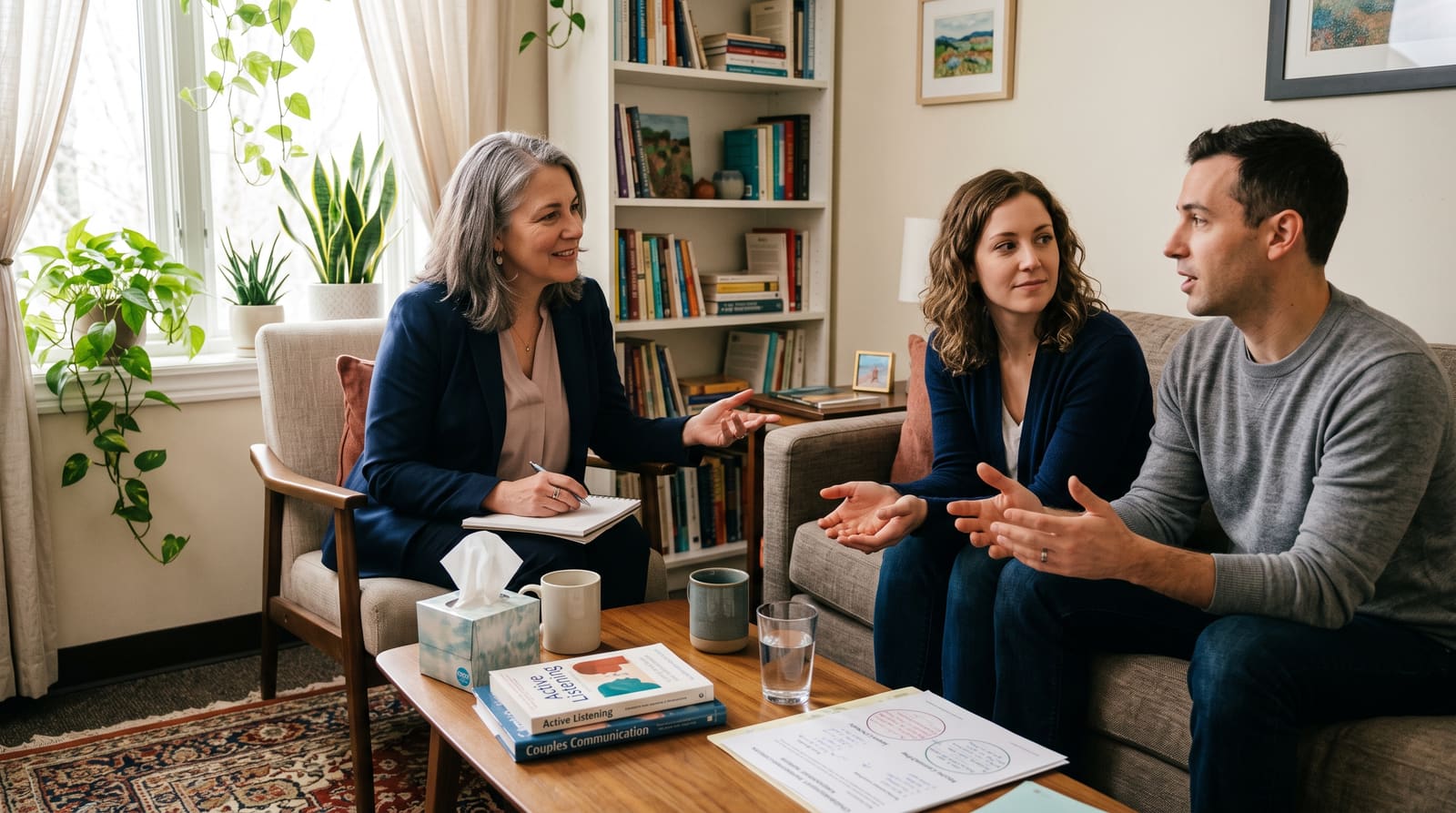
Couples counseling for communication helps partners understand these patterns, express their needs more clearly, listen with greater understanding, and work through disagreements in more constructive ways. Rather than deciding who is right or wrong, a couples therapist helps both partners explore what is happening between them and identify healthier ways to interact.
At Riaz Counseling, couples therapy is designed to help partners work on communication, trust, conflict, and connection. For couples in Houston and surrounding communities, counseling can offer a structured setting to discuss difficult issues and practice new ways of communicating.
Key Highlights
- Communication problems can develop when partners have different expectations, emotional needs, listening habits, or ways of handling conflict.
- Couples counseling can help partners identify recurring arguments, communicate more clearly, and understand each other's perspectives.
- Practical skills such as active listening, using “I” statements, taking breaks during heated disagreements, and making specific requests can support healthier conversations.
- Couples do not need to wait until their relationship is in crisis to seek relationship communication therapy.
- Riaz Counseling offers couples therapy for partners who want to strengthen communication, address conflict, and work toward greater understanding.
Why Communication Matters in a Relationship
Communication is more than exchanging information. It also involves expressing emotions, understanding each other's perspectives, discussing expectations, and working together when needs or opinions differ.
Partners may love each other and still have difficulty communicating because they learned different ways of handling disagreement or expressing affection. One person may prefer to discuss problems immediately, while the other needs time to process emotions before talking.
Neither preference automatically means someone is wrong. Problems can arise when partners interpret these differences negatively.
For example:
- One partner asks several questions because they want reassurance.
- The other partner experiences those questions as criticism and becomes defensive.
- The first partner interprets the defensiveness as a lack of care and pushes harder for an answer.
- The second partner withdraws from the conversation.
Both partners may want to feel understood, yet their reactions make understanding more difficult.
Research examining couples' communication has found associations between supportive communication and relationship satisfaction. A systematic review published in 2026 also found that the relationship between communication styles and relationship satisfaction is complex, reinforcing the importance of understanding how couples interact rather than relying on a single communication rule.
The goal is not to eliminate every disagreement. It is to learn how to handle disagreements without losing sight of each other's feelings, needs, and shared goals.
Common Communication Problems Couples Experience
Recognizing a communication pattern can be the first step toward changing it. Many couples experience one or more of the following difficulties.
1. Feeling unheard or misunderstood
One partner may explain a concern several times but feel that the other person is not taking it seriously.
For instance, someone might say, “I feel overwhelmed doing most of the housework.” Their partner might immediately respond, “I work all day too.”
Both experiences may be valid, but the conversation has shifted from understanding the concern to defending each person's contribution.
When this happens repeatedly, partners may stop sharing their feelings because they expect the conversation to become an argument.
2. Criticism and defensiveness
Criticism focuses on a partner's character rather than a specific behavior.
Compare these statements:
- “You never care about anyone but yourself.”
- “I felt hurt when our plans changed and I wasn't told.”
The first statement may lead the other person to defend themselves. The second communicates a specific experience that the couple can discuss.
Defensiveness can also make it difficult to acknowledge a partner's concern. A person may focus on proving that they did not intend to cause harm instead of recognizing the effect their behavior had.
Intent and impact can both matter. A partner may not have intended to hurt someone, but the hurt can still deserve attention.
3. Avoiding difficult conversations
Some couples avoid conflict because they want to preserve peace or prevent arguments from escalating.
Avoidance may help in the short term, particularly when emotions are high. However, when important issues remain unaddressed, frustration can accumulate.
Commonly avoided topics include money, intimacy, parenting, household responsibilities, family boundaries, and future plans.
A useful distinction is between taking a temporary break to calm down and repeatedly refusing to discuss an important concern. A healthy pause includes an intention to return to the conversation when both partners are better prepared.
4. Repeating the same arguments
Have you ever argued about a small issue and realized that the conversation was actually about something much bigger?
A disagreement about arriving late might reflect a deeper concern about reliability. An argument about phone use might be connected to feeling disconnected or unimportant.
The immediate issue may be real, but the emotions beneath it can help explain why the disagreement feels so significant.
Couples counseling can help partners explore these underlying concerns without assuming that every argument has the same cause.
5. Difficulty expressing emotional needs
People do not always know how to explain what they need from a relationship.
Someone who says, “You don't spend enough time with me,” may be trying to express loneliness or a desire for closeness. Another person who says, “You keep questioning everything I do,” may be trying to communicate a need for trust or independence.
Learning to identify the feeling and make a clear request can help turn a vague complaint into a conversation that both partners can work with.
How Couples Counseling Can Improve Communication
Couples counseling provides a structured environment in which partners can examine communication patterns, discuss sensitive concerns, and practice alternative ways of responding.
A couples therapist does not simply tell partners to stop arguing. Instead, therapy may help them understand why certain conversations become difficult and develop skills that fit their relationship.
Research on couple therapy has examined approaches such as behavioral, cognitive-behavioral, emotionally focused, and integrative behavioral therapies. Findings support several of these approaches to varying degrees, although the strength of evidence differs by treatment model and study. Individual outcomes depend on the couple's circumstances, treatment fit, and other factors.
1. Learning to listen without immediately reacting
Listening can be difficult when a conversation brings up hurt, frustration, or fear.
A partner may begin preparing a response before the other person has finished speaking. They might interrupt to correct a detail or explain why the other person is mistaken.
In therapy, couples may practice listening to understand before responding.
This can involve:
- Letting the other person finish their thought.
- Asking questions to clarify meaning.
- Reflecting what they heard.
- Acknowledging the other person's feelings without automatically agreeing with every interpretation.
- Checking whether they understood correctly.
For example, one partner might say:
“I hear that when I check my phone during dinner, you feel like we aren't spending meaningful time together. Is that what you mean?”
This does not require the partner to agree with every detail. It shows a willingness to understand the concern before defending their behavior.
2. Expressing feelings without blaming
A therapist may help partners replace broad accusations with specific descriptions of their experiences.
One useful approach is an “I” statement:
“I feel [emotion] when [specific situation] because [what it means to me]. Could we [specific request]?”
For example:
“I feel disconnected when we spend most evenings on our phones because I miss talking with you. Could we set aside some time to catch up after dinner?”
This approach is not a guarantee that the conversation will go smoothly. Tone, timing, and the willingness to listen also matter. However, it gives the other partner a clearer understanding of the concern and a practical request to respond to.
3. Recognizing recurring conflict patterns
Sometimes the main problem is not the original disagreement but what happens next.
One partner raises a concern, the other becomes defensive, and both begin reacting to each other's reactions.
A couples therapist may help the partners identify this cycle and consider how each person contributes to keeping it going.
For example:
- Partner A feels ignored and raises their voice.
- Partner B feels attacked and stops responding.
- Partner A interprets the silence as indifference and becomes more upset.
- Partner B withdraws further.
Understanding the cycle allows the couple to ask a different question: “How can we interrupt this pattern together?”
This is different from assigning equal blame for every interaction. Each partner's behavior and responsibility must be considered in context, particularly when one person's behavior is intimidating, controlling, or harmful.
4. Managing conflict more constructively
Healthy communication does not require partners to agree on everything. It does require finding ways to discuss differences without relying on insults, threats, intimidation, or repeated personal attacks.
In therapy, couples may work on identifying when a discussion is becoming unproductive, slowing down the conversation, and returning to the issue when both partners are ready.
A practical agreement might be:
“Either of us can request a break if we feel overwhelmed. Before stepping away, we'll say that we want to continue the conversation later, and we'll agree on a reasonable time to return to it.”
A break should not become a way to punish a partner or permanently avoid difficult topics. It works best when both people understand its purpose and follow through on returning to the conversation.
5. Understanding different emotional needs
Partners may differ in how they experience closeness, reassurance, independence, affection, or conflict.
One person may want to talk through emotions in detail. Another may prefer practical solutions. One partner may need reassurance after an argument, while the other needs quiet time before reconnecting.
Couples counseling can help partners discuss these differences without automatically interpreting them as rejection or a lack of love.
The goal is not to make both people identical. It is to help them understand their differences and find mutually respectful ways to respond.
6. Rebuilding trust through consistent communication
When trust has been damaged, conversations can become especially sensitive. A partner may ask for reassurance, while the other feels frustrated about repeatedly discussing the same event.
Depending on the circumstances, counseling may help couples clarify what rebuilding trust means to each person, identify boundaries, and discuss what consistency and accountability would look like.
Trust usually involves more than one conversation or apology. It may require sustained changes in behavior, honesty, and follow-through over time.
Couples therapy can provide support for this process, but it cannot guarantee reconciliation or require either partner to remain in a relationship.
Practical Communication Skills Couples Can Try at Home
Relationship communication therapy can help partners practice new skills, but small changes can also begin during everyday conversations.
Here are several techniques to consider.
Practice a short listening exercise
Choose a relatively low-stakes topic rather than starting with the most painful disagreement.
- One partner speaks for a few minutes about a concern or experience.
- The other partner listens without interrupting.
- The listener summarizes what they understood.
- The speaker clarifies anything that was misunderstood.
- Switch roles.
The listener's goal is not to solve the problem immediately. It is to understand what the other person is trying to communicate.
Make requests specific and realistic
Vague requests such as “Be more supportive” or “Communicate better” can be difficult to act on because partners may interpret them differently.
Try describing the behavior that would help.
Instead of:
“You need to help me more.”
Consider:
“Could you take responsibility for dinner on Tuesdays and Thursdays?”
Instead of:
“You never listen.”
Consider:
“Could we talk for ten minutes without our phones so I can explain what's been bothering me?”
Specific requests make it easier to discuss expectations and determine whether an agreement is working.
Choose the right time for important conversations
A conversation may be more difficult when either person is exhausted, rushing to leave, distracted, or already highly upset.
When possible, ask whether your partner has the time and emotional capacity to talk.
For example:
“There's something important I'd like us to discuss. Is tonight a good time, or would tomorrow work better?”
This does not mean every difficult conversation can be perfectly scheduled. It simply gives both people a chance to prepare and participate more thoughtfully.
Check assumptions before reacting
When a partner behaves in an unexpected way, it is easy to assign a meaning without checking whether it is accurate.
You might think:
“They didn't call because they don't care.”
A more useful starting point could be:
“I felt worried when I didn't hear from you. Can you tell me what happened?”
The goal is not to ignore repeated hurtful behavior or excuse broken agreements. It is to distinguish what you know from what you are assuming so the conversation can focus on the actual concern.
Schedule a regular relationship check-in
Some couples only discuss their relationship when something goes wrong. A brief, regular check-in can create space to address concerns before they build up.
You might ask each other:
- What has felt good between us this week?
- Is there anything we have been avoiding discussing?
- Is there something I did that hurt or frustrated you?
- What would help you feel more supported this week?
- Is there one thing we could do together to feel more connected?
Keep the conversation manageable. The purpose is to understand each other, not to review every mistake or settle every disagreement in one sitting.
What to Expect From Couples Counseling
It is normal to feel uncertain about attending counseling, especially if conversations about the relationship already feel difficult.
Couples therapy typically involves working with a therapist to understand concerns, identify goals, and explore ways to improve the relationship. At Riaz Counseling, the couples therapy service describes sessions as a structured process where both partners can discuss their perspectives and work on communication, trust, and connection.
Although the exact process varies, couples may experience several stages.
The first sessions: Understanding both perspectives
The therapist may ask what brought you to counseling, which problems feel most urgent, how disagreements typically unfold, and what each partner hopes will change.
You may be asked to describe both the challenges and the strengths in your relationship.
You do not need to arrive with a complete explanation of the problem. Part of the process is figuring out what has been happening and identifying the areas that deserve attention.
Setting goals together
Useful goals are specific enough to guide the work.
Examples include:
- Having difficult conversations without personal insults.
- Discussing finances with less defensiveness.
- Improving communication about parenting responsibilities.
- Expressing emotional needs more clearly.
- Learning to take breaks and return to disagreements constructively.
- Rebuilding trust after a breach of an agreement.
Progress can look different for each couple. Some partners may focus on improving their relationship, while others may need help understanding their options and deciding what comes next.
Practicing skills between sessions
A therapist may suggest exercises or conversations to try at home. These might involve listening, expressing appreciation, discussing expectations, or practicing a different response to a familiar conflict.
The purpose is to apply what you discuss in therapy to everyday situations.
It is also important to be honest with your therapist if an exercise feels unhelpful, overwhelming, or unsuitable. Counseling should be adapted to the needs and circumstances of the people involved.
When Should Couples Consider Relationship Communication Therapy?
You do not need to wait until you are considering separation to seek support.
Couples counseling may be worth considering when:
- You have the same argument repeatedly without reaching an understanding.
- One or both partners feel unheard or dismissed.
- Difficult conversations quickly turn into defensiveness or withdrawal.
- You struggle to discuss money, intimacy, parenting, or family boundaries.
- Stress from work, caregiving, or life transitions is affecting your relationship.
- You want to strengthen your communication before getting married.
- You are trying to rebuild trust after a significant disagreement or breach of trust.
- You want to understand whether your relationship goals and expectations are compatible.
Seeking help does not mean that your relationship has failed. It can be a way to address concerns thoughtfully rather than allowing them to remain unresolved.
What if one partner is reluctant to attend?
It is common for partners to have different feelings about counseling. One may be ready to seek help, while the other worries about being blamed, judged, or pressured to discuss personal matters.
It may help to explain that the purpose is not to prove who is wrong. Instead, counseling can provide a structured setting to understand the problem and explore possible next steps.
You can invite your partner to discuss what concerns them about attending. Avoid presenting therapy as a threat or using it as a way to force someone to agree with you.
If your partner remains unwilling to attend, individual therapy may still help you understand your own communication habits, clarify your needs, and consider how you want to respond to relationship challenges.
An important note about safety
Couples counseling is not appropriate for every relationship situation. If there is violence, coercive control, intimidation, or fear of retaliation, joint sessions may not be safe or suitable without specialized assessment.
If you are afraid of your partner or feel unsafe discussing relationship problems, consider speaking privately with a qualified professional who understands relationship abuse and safety planning. Immediate danger requires urgent assistance.
How Riaz Counseling Can Help Couples Improve Communication
Riaz Counseling offers couples therapy for partners who want to address communication difficulties, navigate conflict, rebuild trust, and strengthen their connection. Its couples therapy page describes approaches that may include the Gottman Method, Emotionally Focused Therapy (EFT), cognitive behavioral couples therapy, and attachment-based approaches. The most appropriate approach depends on the couple's concerns and the therapist's assessment.
Working with a couples therapist may help you and your partner:
- Understand recurring patterns of disagreement.
- Communicate needs and expectations more clearly.
- Practice listening and responding with greater understanding.
- Explore differences in emotional needs and relationship expectations.
- Develop more constructive ways to handle conflict.
- Identify goals for strengthening the relationship.
Riaz Counseling has offices in Houston Galleria, Sugar Land, and The Woodlands, and offers online therapy for people living in Texas. The practice also offers a free 15-minute consultation to help prospective clients explore whether its services may be a good fit.
If communication has become a recurring source of stress in your relationship, you can learn more about couples therapy at Riaz Counseling or contact the practice to discuss your needs.
Frequently Asked Questions
Can couples counseling really improve communication?
Couples counseling can help partners identify unhelpful communication patterns, practice listening skills, express concerns more clearly, and approach disagreements differently. Research on relationship education and couple therapy supports potential improvements in communication for some couples, although results vary and improvement is not guaranteed.
When should we see a couples therapist?
Consider counseling when disagreements repeatedly remain unresolved, communication feels increasingly difficult, trust has been damaged, or relationship stress is affecting your well-being. You can also seek support proactively before problems become more entrenched.
What happens during couples counseling?
A couples therapist generally helps partners discuss their concerns, understand recurring patterns, establish goals, and explore communication strategies. The process is tailored to the couple's circumstances, and the therapist may suggest exercises to practice between sessions.
Can couples counseling help if we argue all the time?
It may help you understand what keeps arguments going and develop alternative ways to handle conflict. However, the outcome depends on several factors, including each partner's circumstances, willingness to participate, and whether joint counseling is appropriate and safe.
What if my partner and I communicate in very different ways?
Differences in communication styles do not automatically mean a relationship cannot work. Counseling can help partners understand what each person needs, clarify expectations, and find mutually respectful ways to discuss problems.
Is couples counseling only for married couples?
No. Couples counseling may be appropriate for dating partners, engaged couples, married partners, and people in other committed relationships. It can address communication and relationship concerns regardless of marital status, depending on the service provider's scope and approach.
Can we attend couples counseling even if our relationship is not in crisis?
Yes. Couples may seek counseling to improve communication, prepare for marriage, navigate a major life change, or strengthen their relationship before concerns become more serious.
Does Riaz Counseling offer couples therapy in Houston?
Yes. Riaz Counseling lists couples therapy among its services and has Houston-area offices in Galleria, Sugar Land, and The Woodlands. Online therapy is also available to people living in Texas. Contact the practice to discuss current options and whether its services fit your needs.
Conclusion
Communication difficulties do not necessarily mean that two people are incompatible or that their relationship cannot improve. Sometimes, partners become caught in patterns of misunderstanding, defensiveness, avoidance, or withdrawal that make it difficult to express what they really need.
Couples counseling can help partners recognize these patterns, understand each other's perspectives, and practice more constructive ways of communicating. Skills such as active listening, specific requests, thoughtful pauses, and regular check-ins can also support healthier conversations in everyday life.
Improvement takes time, practice, and a willingness to understand what happens between you—not just what happens during an argument.
If you and your partner feel stuck in the same conversations, relationship communication therapy may be a helpful next step. With the right support, you can begin exploring ways to communicate more clearly, navigate disagreements more respectfully, and make informed decisions about your relationship.
Suggested Internal Links
- Couples Therapy at Riaz Counseling — https://www.riazcounseling.com/services/couples-therapy/
Link from sections discussing therapy, communication difficulties, and how to get support. - Riaz Counseling Locations — https://www.riazcounseling.com/locations/
Link from the local support section for readers exploring in-person or online options. - Riaz Counseling Contact Page — https://riazcounseling.com/contact/
Link from the consultation call to action. - Riaz Counseling Homepage — https://riazcounseling.com/
Link where readers want to explore the practice's broader services.
Sources Used
- Riaz Counseling — Couples Therapy: Current service information, therapy approaches, common relationship concerns, and consultation details.
- Blanchard et al., Journal of Family Psychology (2009), via PubMed: Meta-analysis examining relationship education and couples' communication skills.
- Systematic Review, Couple and Family Psychology: Research and Practice (2026): Review examining observed couple communication and relationship satisfaction.
- Empirically Supported Couple Therapy Models for Couple Relationship Distress (2026), via PubMed Central: Review of research support for several couple therapy models and the limitations of the evidence.
- Williams et al., via PubMed: Research examining communication changes following behavioral couples therapy.
- Riaz Counseling — Locations: Current Houston-area office locations and statewide online therapy information.
- Riaz Counseling — Contact: Current contact information and consultation details.
Editorial note: This article provides general educational information and is not a substitute for individualized relationship or mental health care. Therapy approaches and outcomes vary by couple and circumstance.
If you feel that you or someone you know may benefit from therapy, please reach out to our office for a FREE 15-minute consultation: LINK.