Introduction
Choosing a college, selecting a major, or deciding what kind of career you want can feel exciting—but it can also feel overwhelming. You may be asking yourself, What am I actually good at? What if I choose the wrong major? What career will give me a meaningful future? What if my interests change?
These questions are common, and you do not necessarily have to figure everything out at once.
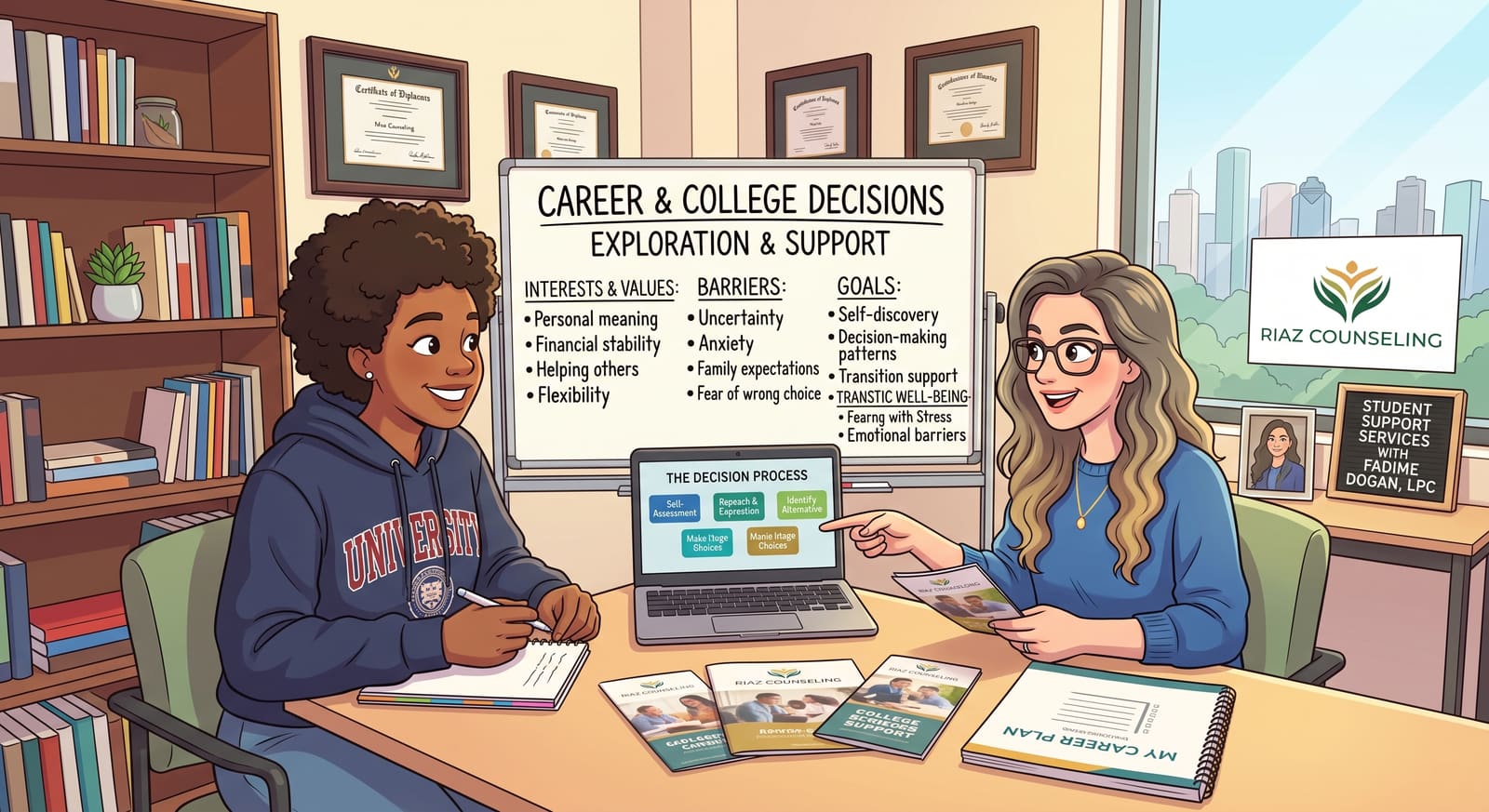
A career counseling therapist can provide a space to explore the emotional and personal side of major life decisions. Counseling can be particularly useful when uncertainty, anxiety, family expectations, perfectionism, or fear of making the wrong choice begins to make decision-making harder.
At Riaz Counseling, College & Career Guidance is one of the practice's listed specializations, with an emphasis on self-discovery and informed decision-making about the future. Fadime Dogan, LPC, is a fully licensed therapist at Riaz Counseling whose primary areas of focus include anxiety, stress, and depression. Her profile also lists individual, couples, family, and group therapy and approaches including ACT, Adlerian, attachment-based therapy, CBT, DBT, emotionally focused, existential, Jungian, multicultural, and person-centered approaches.
This article explains how therapy can fit into the college and career decision-making process, what questions you may want to consider, and when professional support may be helpful.
Key Highlights
- College and career decisions can involve more than academics; they can also bring anxiety, uncertainty, family pressure, and concerns about identity and the future.
- Career counseling can help people explore their interests, values, goals, concerns, and decision-making patterns rather than simply telling them which career to choose.
- You do not have to determine your entire professional future from one college major or one decision.
- A therapist can help with the emotional barriers surrounding a decision, while academic advisors and career centers can provide school-specific educational and career information.
- Riaz Counseling offers College & Career Guidance, and Fadime Dogan may be a potential therapy resource for people whose college or career decisions are connected with anxiety, stress, relationships, or other mental health concerns.
Why Can Choosing a Career Feel So Difficult?
Career decisions often involve uncertainty. You may have several interests but not know how they translate into a career. Or perhaps you have one clear goal but worry that you will fail.
For college students, the decision may involve choosing a major, deciding whether to change programs, preparing for graduate school, or figuring out what to do after graduation.
Research involving college students has found relationships between career stress, career exploration, career planning, and career indecision. This suggests that the process is not simply about finding a list of occupations—it can also involve how a person explores possibilities and responds to uncertainty.
Common concerns may include:
- "I have no idea what I want to do."
- "My parents expect me to choose a certain career."
- "Everyone else seems to know what they are doing."
- "What if I choose the wrong major?"
- "I am interested in too many things."
- "I am not confident enough to pursue what I actually want."
- "I know what I want, but I am afraid I will not succeed."
- "I already chose a major, but I am starting to regret it."
- "I feel like I am running out of time."
These concerns can become especially difficult when career decisions are connected with anxiety, low confidence, perfectionism, or pressure from other people.
You Do Not Have to Choose Your Entire Future at Once
One of the most stressful assumptions about college and career decisions is that one choice determines the rest of your life.
In reality, educational and professional paths can change. People may discover new interests, develop different skills, change industries, return to school, or take opportunities they did not originally anticipate.
The American Psychological Association notes that counseling psychology includes attention to educational and career development and considers how individuals interact with their environments and life circumstances.
This perspective can make career planning feel less like a single high-stakes decision and more like an ongoing process.
Instead of asking:
"What career am I supposed to have for the rest of my life?"
You might start with:
"What do I know about myself right now, and what direction would I like to explore next?"
That change in perspective can make a complicated decision more manageable.
What Is Career Counseling?
Career counseling is a process designed to help people explore career-related questions and make informed decisions.
It may involve looking at:
- Interests
- Strengths and abilities
- Personal values
- Goals
- Work preferences
- Educational options
- Career possibilities
- Concerns about the future
- Barriers to decision-making
- Confidence and self-efficacy
- Personal and family expectations
A career counseling therapist does not necessarily tell you, "You should become a teacher," "You should study business," or "You should attend this college."
Instead, counseling can help you understand why a particular choice feels right or wrong and what factors are influencing your decision.
Career development can involve self-assessment, exploration, and goal setting rather than simply selecting an occupation from a list. APA career-development resources similarly emphasize self-assessment, career exploration, and goal setting.
What Is College Decision Counseling?
College decision counseling can refer to support around the emotional and personal side of college-related decisions.
For a high school student, this might include questions such as:
- What type of college environment would fit me?
- How do I handle pressure from family?
- Am I choosing a school because I want it or because someone else expects it?
- Why am I so anxious about making this decision?
- What if I do not get into my first-choice school?
- How can I handle uncertainty about leaving home?
For a current college student, concerns may look different:
- Should I change my major?
- Do I actually enjoy what I am studying?
- Am I struggling academically because of stress or anxiety?
- Should I stay in this program?
- What should I do after graduation?
- Am I comparing myself too much with other students?
A therapist can help explore the emotional and psychological aspects of these questions. An academic advisor, admissions professional, or career center can provide institution-specific information about programs, requirements, credits, applications, and other educational details.
How Anxiety Can Affect Career Decisions
Career uncertainty does not automatically mean someone has an anxiety disorder. However, anxiety can make an already difficult decision feel even harder.
For example, someone may repeatedly research careers without feeling any closer to a decision. Another person may avoid researching options altogether because thinking about the future feels overwhelming.
Research has connected career indecision with factors such as career stress, uncertainty, negative affect, and choice anxiety.
The American Psychological Association has also highlighted research suggesting that certain career myths may be associated with greater anxiety around decisions about careers and academic majors. One example is the belief that choosing the "right" major is essential because a person will remain in the same career for life.
This does not mean that every difficult career decision requires therapy. But when anxiety begins interfering with everyday functioning, relationships, school, or the ability to make reasonable decisions, talking with a qualified mental health professional may be worth considering.
How Therapy May Help With Difficult Life Decisions
Therapy does not have to provide a single "correct" answer.
Instead, it can give you an opportunity to slow down and understand what is happening underneath the decision.
1. Separating Your Goals From Other People's Expectations
Family members, friends, teachers, and social media can all influence how you think about your future.
You might genuinely want one path while feeling pressure to choose another.
Therapy can provide a private setting to explore questions such as:
- What do I actually want?
- Which expectations are coming from other people?
- What values matter most to me?
- Am I avoiding a path because I do not want it—or because I am afraid of failing?
2. Understanding Fear of Making the Wrong Choice
Some people become stuck because they believe every decision must be perfect.
This can create a cycle:
Uncertainty → fear of making the wrong choice → overthinking → avoidance → more uncertainty
Working through that pattern may help you approach decisions more realistically.
3. Building Confidence in Decision-Making
Career decisions often require making choices without having complete information.
A therapist may help you recognize the difference between:
"I do not have enough information yet."
and
"I will never feel completely certain, so I cannot decide."
That distinction can be useful when uncertainty itself is keeping you stuck.
4. Exploring Identity and Values
A career is not only about salary or job title.
It may also connect with:
- Creativity
- Stability
- Helping others
- Independence
- Family
- Financial goals
- Intellectual interests
- Community
- Work-life balance
- Personal meaning
Exploring these values can help you understand what you are actually looking for in a future career.
5. Managing Stress During Major Transitions
College applications, changing majors, graduation, graduate school, internships, and entering the workforce can all represent significant transitions.
If these changes are accompanied by anxiety, depression, relationship difficulties, or persistent stress, therapy may provide broader emotional support while you navigate the decision.
How Fadime Dogan May Fit Into This Process
Fadime Dogan is a fully licensed therapist at Riaz Counseling. Her current profile identifies anxiety, stress, and depression as her primary areas of focus and lists experience with concerns including relationship issues, family conflict, grief, behavioral issues, trauma and PTSD, and other mental health concerns. Her therapeutic approaches include ACT, Adlerian, attachment-based therapy, CBT, DBT, emotionally focused, existential, Jungian, multicultural, and person-centered approaches.
These areas can be relevant when college or career decisions are accompanied by emotional difficulties.
For example, a student may know that they need to choose a major but feel unable to move forward because of overwhelming anxiety. Another person may be experiencing family conflict because their preferred career does not match their family's expectations.
In these situations, therapy can focus on the emotional and psychological challenges surrounding the decision.
Important: Fadime's current Riaz Counseling profile does not specifically identify career counseling as one of her individual specialties. Riaz Counseling does, however, list College & Career Guidance among its practice specializations.
If you are specifically looking for career counseling, college planning support, or help with a particular educational decision, a consultation can help determine which Riaz Counseling provider and service are the best fit for your needs.
Questions to Ask Yourself Before Choosing a Career
You do not need to answer all of these immediately. They are starting points for reflection.
What interests me?
Think beyond school subjects.
What topics do you naturally research? What activities make you lose track of time? What kinds of problems do you enjoy solving?
What kind of environment suits me?
Consider whether you prefer:
- Working independently or with a team
- Structured or flexible environments
- Predictable routines or variety
- Office, clinical, outdoor, technical, creative, or community settings
What matters most to me?
Would you prioritize:
- Financial stability?
- Flexibility?
- Helping people?
- Creativity?
- Leadership?
- Intellectual challenge?
- Work-life balance?
- Location?
There is no universal "right" answer.
What am I afraid of?
Sometimes the biggest obstacle is not a lack of information.
It may be fear.
Ask yourself:
"If I knew I could not fail, what would I be interested in exploring?"
Then ask a second question:
"What specifically makes that option feel risky?"
The answer may reveal something worth discussing with a counselor.
Practical College Planning Support: What You Can Do Now
Therapy can be one part of the process. You can also take practical steps outside the therapy room.
Make a short list of possibilities
Instead of trying to identify one perfect career, write down three to five possibilities.
Then research:
- Required education
- Typical work settings
- Skills needed
- Daily responsibilities
- Advancement possibilities
- Potential challenges
- Whether the work matches your values
Talk to people doing the work
If possible, speak with professionals in fields you are considering.
Ask what their typical day looks like, what they enjoy, what they find difficult, and what they wish they had known earlier.
Separate facts from assumptions
For example:
Assumption: "If I study this major, I will be stuck with one career."
Better question: "What careers do graduates from this program actually pursue?"
Getting specific information can reduce unnecessary uncertainty.
Give yourself permission to explore
Exploration is not failure.
You may discover that an option is not right for you. That information can be useful.
What If You Choose the Wrong Major?
Changing direction does not automatically mean that you made a bad decision.
Sometimes a person learns more about themselves after taking classes, completing an internship, or experiencing a particular work environment.
The more useful question may be:
"What did I learn from this experience, and what direction makes sense now?"
Career development is often an evolving process rather than a single permanent decision. Research on college students has examined career exploration and decision-making as processes that develop over time.
If changing direction is creating significant anxiety, guilt, family conflict, or emotional distress, a therapist may help you work through those concerns while you gather practical information about your options.
When Should You Consider Talking With a Therapist?
You may want to consider professional support if career or college decisions are contributing to:
- Persistent anxiety or overwhelming worry
- Difficulty concentrating
- Avoidance of important decisions
- Significant stress
- Low mood or loss of motivation
- Sleep disruption
- Frequent conflict with family members
- Feelings of being trapped or hopeless
- Excessive perfectionism or fear of failure
- Difficulty functioning at school, work, or home
You do not need to wait until a problem becomes severe to talk with a mental health professional.
At the same time, therapy is not a replacement for academic advising, college admissions guidance, financial counseling, or specialized career services. Depending on your situation, combining different forms of support may be the most useful approach.
What Can You Expect From Counseling?
Your first conversation may involve discussing what brought you to therapy and what you hope to understand or change.
You may talk about:
- Your current concerns
- School or work experiences
- Family expectations
- Relationships
- Anxiety or stress
- Your strengths and interests
- Previous decisions
- What you want your future to look like
You do not need to arrive with a perfectly defined goal.
Sometimes the first goal is simply to understand why you feel stuck.
From there, you and your therapist can determine what kind of support makes sense.
Finding Career and College Support in Houston
For people in the Houston area, finding a therapist who understands both emotional concerns and major life transitions can be an important part of getting support.
Riaz Counseling lists College & Career Guidance, Life Transitions, Depression & Anxiety, and Self-Esteem & Identity among its specializations. The practice has locations in Houston's Galleria area, Sugar Land, and The Woodlands, as well as online services across Texas.
Fadime Dogan currently serves clients through Riaz Counseling's Sugar Land and online offices and works with preteens, teens, adults, and older adults.
If you are unsure which provider or service is appropriate, a consultation can be a useful first step to discuss your concerns and determine fit.
Frequently Asked Questions
What does a career counseling therapist do?
A career counseling therapist can help you explore the personal and emotional factors involved in career decisions, such as values, confidence, anxiety, uncertainty, family expectations, and decision-making patterns. Career-specific practical guidance may also involve career centers, academic advisors, assessments, or other specialized resources.
Can therapy help me choose a college major?
Therapy can help you explore the emotional and personal side of choosing a major. A therapist may help you understand your values, interests, fears, expectations, and decision-making patterns. Academic advisors and college career services can provide additional information about specific programs and requirements.
What if I do not know what career I want?
You do not need to have a specific career in mind before seeking support. Counseling can provide space to explore interests, values, strengths, concerns, and possible directions while you gather more information.
Can anxiety make career decisions harder?
Yes. Research has linked career decision-making with factors such as career stress, uncertainty, negative affect, and choice anxiety. If anxiety is making it difficult to function or move forward, discussing it with a qualified mental health professional may be helpful.
Can a therapist tell me which career I should choose?
A therapist generally should not make the decision for you. The goal is usually to help you understand yourself, clarify your priorities, explore your options, and make decisions that are consistent with your circumstances and values.
Is changing my major a sign that I failed?
Not necessarily. Changing direction can be part of learning more about your interests, abilities, and goals. It is useful to look at the practical consequences of a change while also considering what you have learned from your previous choice.
Does Fadime Dogan provide career counseling?
Fadime Dogan's current Riaz Counseling profile lists anxiety, stress, and depression as her primary areas of focus and does not specifically list career counseling as an individual specialty. Riaz Counseling does list College & Career Guidance as a practice specialization. If you are interested in working with Fadime on concerns related to college or career decisions, a consultation can help determine whether her services are an appropriate fit.
A Career Decision Does Not Have to Be a Perfect Decision
Choosing a college, major, or career can feel like an enormous responsibility, especially when you believe you need to know exactly what you want before taking the next step.
You don't.
A more realistic goal is to understand yourself better, gather useful information, identify what matters to you, and make the best decision you can with the information available today.
For some people, that process is primarily educational or practical. For others, anxiety, stress, family expectations, self-doubt, or other emotional concerns become part of the decision.
In those situations, working with a mental health professional can provide a space to slow down, explore what is making the decision difficult, and move forward with greater clarity.
How Riaz Counseling Can Help
Riaz Counseling offers College & Career Guidance as part of its mental health services, along with support for anxiety, life transitions, self-esteem and identity, and other concerns that can affect major life decisions.
If you are considering college, changing your major, entering the workforce, or simply feeling uncertain about your direction, you can explore your options with a qualified professional and determine what type of support makes sense for you.
Mental health disclaimer: This article provides general educational information and is not a diagnosis or substitute for individualized mental health, medical, academic, or career advice. If career or college concerns are causing significant emotional distress or interfering with daily functioning, consider speaking with a qualified professional who can evaluate your individual situation.
Sources Used
American Psychological Association — Counseling Psychology: educational and career development within counseling psychology.
American Psychological Association — career development resources, including self-assessment, exploration, and goal setting.
American Psychological Association — college students' career-related anxiety and career myths.
PubMed — research examining career stress, career exploration, career planning, and career indecision among college students.
PubMed — longitudinal research examining ambiguity tolerance and career indecision.
PubMed — research on career exploration and career decision-making among college students.
Riaz Counseling — Fadime Dogan, LPC profile.
Riaz Counseling — current practice specializations, including College & Career Guidance.
If you feel that you or someone you know may benefit from therapy, please reach out to our office for a FREE 15-minute consultation: LINK.