Introduction
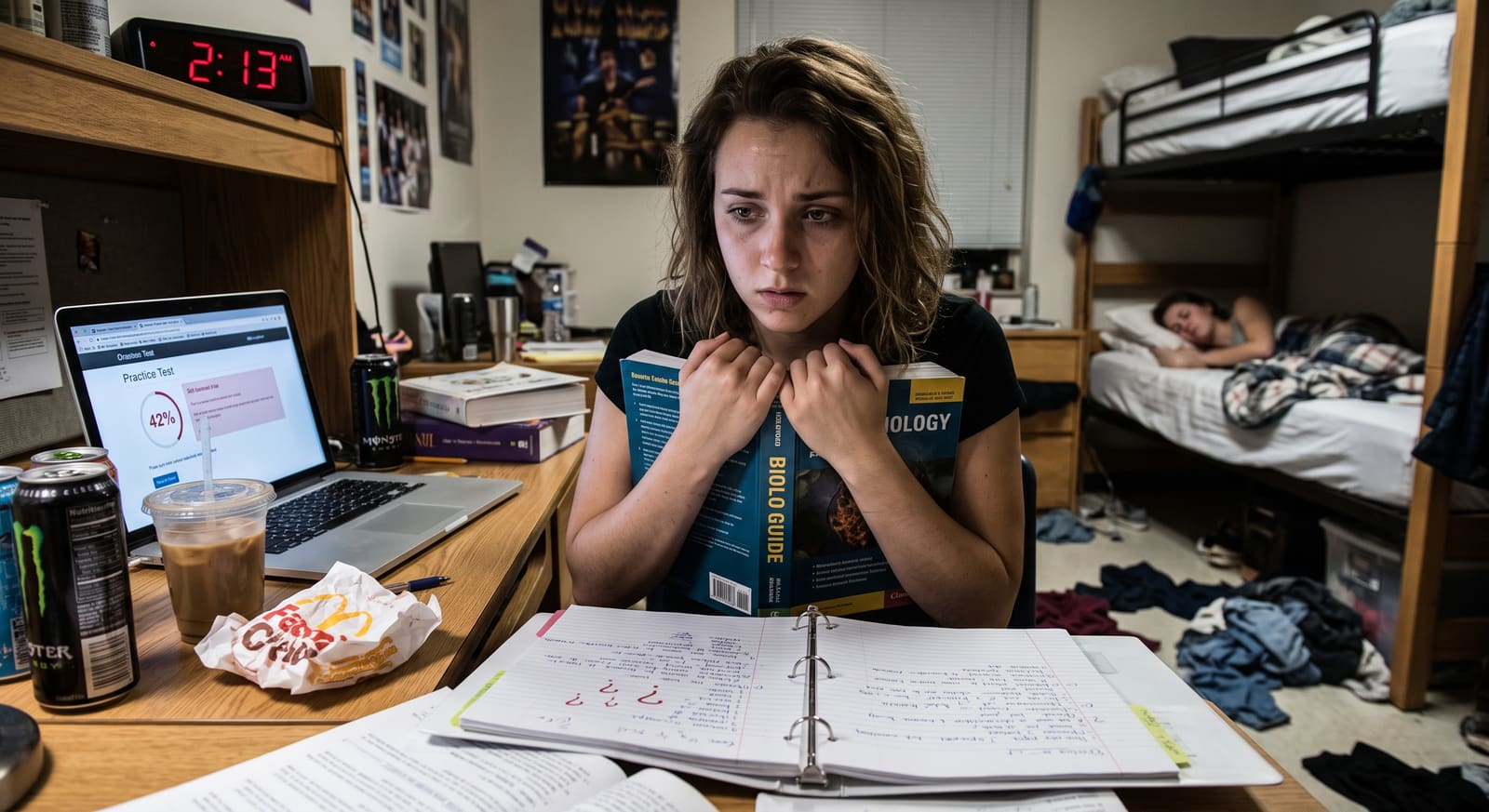
Studying for an exam can be difficult enough without the added pressure of worrying about the test itself. For some students, anxiety can make it harder to concentrate, remember information, start studying, or stay calm when an exam approaches.
This can create a frustrating cycle: you feel anxious about the test, avoid studying because it feels overwhelming, fall behind, and then feel even more anxious as the exam gets closer.
Improving study habits can help break that cycle, but study skills are only part of the picture. When anxiety is interfering with preparation or making it difficult to function during exams, addressing the anxiety itself may also be important.
This guide explains the connection between test anxiety and study habits, practical ways to study when you are anxious, and when professional mental health support may be worth considering.
Key Highlights
- Test anxiety can affect attention, thoughts, emotions, and behavior around exams.
- Better study habits can reduce some of the uncertainty and last-minute pressure that contribute to exam stress.
- Starting earlier, using active practice, breaking work into smaller tasks, and taking planned breaks can make studying more manageable.
- Coping with test anxiety involves more than simply telling yourself to "calm down."
- Research suggests that interventions for test anxiety can reduce anxiety, and some studies also report improvements in academic performance, although results vary and longer-term evidence is more limited.
- If anxiety consistently interferes with school, sleep, concentration, or everyday life, speaking with a qualified mental health professional may be appropriate.
What Is Test Anxiety?
Test anxiety refers to significant worry, tension, or distress connected to tests and other forms of academic evaluation.
Some students become nervous shortly before an exam. Others experience anxiety days or weeks beforehand.
Test anxiety can involve several different experiences.
Emotional symptoms
You might notice:
- Intense worry about failing
- Fear of disappointing parents, teachers, or yourself
- Irritability
- Feeling overwhelmed
- Dreading upcoming exams
- Feeling that your performance determines your worth
Physical symptoms
Anxiety can also produce physical sensations such as:
- Racing heartbeat
- Muscle tension
- Sweating
- Shaking
- Stomach discomfort
- Restlessness
- Difficulty sleeping
Thinking and concentration difficulties
Some students describe:
- Difficulty concentrating
- Repeatedly rereading the same material
- Forgetting information they previously knew
- Thinking about failure instead of the material
- "Going blank" during an exam
- Difficulty deciding what to study first
Test anxiety is not simply a lack of preparation. Research has found relationships between test anxiety and educational outcomes, although the relationship is complex and can vary between students and situations.
How Test Anxiety Can Interfere With Study Habits
Anxiety and study habits can influence each other.
Consider a student who has an important exam in two weeks.
At first, they think:
"I have plenty of time."
A few days pass. The exam gets closer, but starting feels uncomfortable because the student is afraid they will discover they do not understand the material.
They postpone studying.
Then the thought becomes:
"I've waited too long. I'll never learn all of this."
The anxiety increases, making it even harder to begin.
This is one reason effective studying is not necessarily about forcing yourself to study for longer hours. It can be about creating a system that makes starting easier and reduces avoidable last-minute pressure.
1. Start Earlier Instead of Waiting for Motivation
One of the simplest study tips for anxiety is to begin before the material feels urgent.
You do not need to study for hours every day.
Instead, create smaller study sessions well before the exam.
For example:
Instead of:
- "I need to study everything Saturday."
Try:
- Monday: Review one chapter
- Tuesday: Practice key concepts
- Wednesday: Review difficult areas
- Thursday: Complete practice questions
- Friday: Review mistakes
- Weekend: Take a practice test
The goal is to make studying a series of manageable tasks rather than one enormous assignment.
Research has also found associations between study management skills, including time management and test competence, and academic performance.
2. Replace "Study Everything" With Specific Goals
"Study biology" is not a very useful task.
It is too broad.
A more specific goal might be:
- Review chapters 3 and 4.
- Create 15 flashcards.
- Complete 20 practice questions.
- Explain three major concepts without looking at your notes.
- Review the questions you missed yesterday.
Specific goals make it easier to know when you have made progress.
They can also reduce the feeling that there is an endless amount of material to cover.
3. Use Active Study Methods
Simply reading notes repeatedly may feel productive, but studying should ideally involve actively working with the material.
Depending on the subject, active methods might include:
- Practice questions
- Flashcards
- Self-testing
- Explaining a concept out loud
- Creating your own questions
- Completing practice problems
- Teaching the concept to someone else
- Taking practice exams
Practice testing can also help you discover what you actually know rather than relying on the feeling that material looks familiar.
This distinction can be especially useful for anxious students because anxiety may encourage repeated checking and rereading without necessarily improving understanding.
4. Break Large Assignments Into Smaller Steps
When anxiety is high, "finish the entire study guide" can feel impossible.
Try reducing the task.
For example:
Instead of:
"Finish my chemistry review."
Try:
- Review formulas.
- Complete five practice problems.
- Check the answers.
- Mark the problems that caused difficulty.
- Review those concepts.
- Complete five more problems.
Each step provides a clear starting point.
If beginning is the hardest part, make the first task intentionally small.
You might tell yourself:
"I only need to study for 10 minutes."
Once you begin, you can decide whether to continue.
5. Create a Study Routine That You Can Actually Maintain
A complicated schedule is not automatically a better schedule.
Consider:
- What time of day can you concentrate best?
- Where are you least distracted?
- How long can you realistically focus?
- When do you need breaks?
- What other responsibilities do you have?
- Are you getting enough sleep?
A realistic routine may be more useful than an ideal schedule that you cannot maintain.
For example, a student might study for 40–50 minutes, take a short break, and then return to another focused session.
The exact timing does not need to be the same for everyone.
6. Don't Turn Breaks Into Another Source of Stress
Taking a break is not the same as wasting time.
If you study continuously while exhausted or overwhelmed, your ability to concentrate may decline.
Planned breaks can give you an opportunity to:
- Walk around
- Stretch
- Drink water
- Eat a meal or snack
- Step outside
- Briefly reset your attention
The goal is to return to studying rather than allowing a five-minute break to become an unplanned two-hour distraction.
7. Practice Under Conditions That Resemble the Exam
If your biggest fear is, "What if I freeze during the test?" practicing the material in a test-like format may help you identify where the difficulty occurs.
For example:
- Set a reasonable time limit.
- Put away your notes.
- Complete practice questions.
- Avoid checking every answer immediately.
- Review your mistakes afterward.
The purpose is not to create additional pressure.
It is to become more familiar with the process of retrieving information and working through questions.
Research on interventions for test anxiety has found support for several approaches, including behavioral interventions, while cognitive-behavioral and study-skills approaches have also shown promise. However, the evidence base is not equally strong for every approach or for long-term outcomes.
8. Pay Attention to the Thoughts Behind Study Stress
Sometimes the biggest obstacle is not the textbook.
It is the thought running through your mind while you are trying to study.
For example:
"If I fail this test, I'll never get into college."
or:
"Everyone else understands this except me."
or:
"If I don't get an A, I've failed."
These thoughts can increase emotional pressure and make studying feel threatening rather than manageable.
Try asking:
- Is this thought a fact or a prediction?
- Am I assuming the worst possible outcome?
- What would I say to a friend who was thinking this way?
- Can I focus on what I can do today rather than predicting the final result?
This does not mean pretending that academic performance does not matter.
It means separating realistic academic concerns from thoughts that make the situation feel impossible.
Cognitive behavioral therapy, or CBT, is one form of psychotherapy that can help people identify unhelpful thinking patterns and examine how thoughts, emotions, and behaviors interact.
9. Build Coping Skills for Moments of High Anxiety
Study habits can prepare you academically, but you may also need strategies for managing anxiety when it appears.
Depending on your needs, coping strategies might include:
- Slow, controlled breathing
- Brief mindfulness exercises
- Taking a short movement break
- Writing down distracting worries before returning to work
- Using encouraging but realistic self-talk
- Breaking the next task into one small step
- Maintaining regular sleep and meals
- Getting appropriate physical activity
Research has also examined exercise as an intervention for student test anxiety, with one meta-analysis finding that exercise interventions were associated with reduced test anxiety.
These strategies are not guaranteed to eliminate anxiety. They are tools that some students may find useful as part of a broader approach.
10. Protect Your Sleep Before an Exam
It can be tempting to sacrifice sleep to gain additional study time.
But staying up all night is not necessarily the best way to prepare.
Instead, try to avoid making the night before an exam your primary study period.
A better approach may be:
- Begin preparation earlier.
- Review important concepts rather than everything.
- Prepare what you need for the morning.
- Give yourself time to wind down.
- Maintain as consistent a sleep schedule as possible.
If anxiety repeatedly prevents you from sleeping, that is worth paying attention to rather than treating it as simply part of being a student.
What If You Study Hard and Still Feel Extremely Anxious?
This is an important question.
Sometimes students assume that anxiety exists only because they are not studying enough.
That is not always the case.
You can prepare thoroughly and still experience significant exam anxiety.
You might notice that:
- Anxiety starts weeks before an exam.
- You repeatedly avoid studying because you feel overwhelmed.
- You cannot concentrate despite having enough time.
- You experience intense physical anxiety before tests.
- You repeatedly think about failing.
- You lose sleep because of academic worries.
- You feel unable to function during exams.
- Anxiety affects areas of life beyond school.
In these situations, simply adding more study hours may not address the underlying problem.
Can Therapy Help With Test Anxiety?
For some students, professional counseling can be useful when anxiety is interfering with school or everyday life.
Therapy may focus on understanding the relationship between:
thoughts → emotions → behaviors
For example:
Fear of failing → anxiety → avoidance → less preparation → increased fear
A therapist may help a student identify this pattern and develop healthier ways to respond.
Depending on the individual's circumstances, therapy may include:
- Identifying anxiety triggers
- Exploring fear of failure or perfectionism
- Developing coping strategies
- Addressing avoidance and procrastination
- Practicing healthier thinking patterns
- Building problem-solving skills
- Developing strategies for managing academic stress
- Exploring other concerns that may be contributing to anxiety
NIMH notes that psychotherapy can address difficulties coping with situations at school, work, or home and may include strategies for managing stress and changing unhelpful thinking and behavior patterns.
Importantly, therapy is not a substitute for learning the material.
If a student needs tutoring, academic advising, disability accommodations, or other educational support, those resources may also be appropriate.
Does Therapy Improve Academic Performance?
It is important to be careful with this question.
Research does suggest that interventions for test anxiety can reduce anxiety, and a 2019 meta-analysis of 44 randomized controlled trials involving 2,209 university students found improvements in academic performance alongside reductions in test anxiety. However, the researchers also noted limitations in the evidence, including limited longer-term support for some approaches.
Other research has produced more mixed findings depending on the student population and intervention. For example, a review of test-anxiety interventions among U.S. medical students did not find improved examination scores in the included studies.
So therapy should not be presented as a guaranteed way to raise grades.
A more appropriate goal is to help a student understand and manage the factors that may be interfering with their well-being and ability to function.
A Simple Study-and-Anxiety Plan
If you are not sure where to start, try this basic framework.
Step 1: Identify the exam
Write down:
Exam: ____________________
Date: ____________________
Topics: ___________________
Step 2: Divide the material
Break the material into smaller sections.
Avoid putting "study everything" on your list.
Step 3: Choose active methods
For each topic, decide whether you will:
- Practice questions
- Use flashcards
- Explain the material
- Complete problems
- Take a practice test
Step 4: Schedule realistic sessions
Decide when you will study and how long each session will last.
Step 5: Track difficult areas
Keep a list of concepts you do not understand.
This prevents you from spending unnecessary time repeatedly reviewing material you already know.
Step 6: Include recovery time
Schedule meals, sleep, movement, and breaks.
Step 7: Notice your anxiety
At the end of each study session, ask:
"Was my biggest problem today the material, or was it anxiety about the material?"
That distinction can tell you what kind of support you may need next.
Common Mistakes Students Make When Studying With Anxiety
Mistake 1: Waiting until you feel calm to start
You may not always feel motivated or calm before beginning.
Sometimes starting with a very small task is more realistic.
Mistake 2: Studying for extremely long periods
More hours do not automatically mean better learning.
Quality, consistency, and appropriate study methods matter too.
Mistake 3: Rereading everything
Repeated reading can create a sense of familiarity without showing whether you can actually recall or apply the information.
Mistake 4: Avoiding practice tests because they are uncomfortable
If practice testing triggers anxiety, avoiding it completely may leave you less familiar with the testing experience.
You can gradually introduce practice questions in manageable amounts.
Mistake 5: Treating anxiety as proof that you will fail
Feeling anxious does not automatically predict the result of your exam.
Anxiety is an experience—not a grade.
When Should a Student Consider Professional Support?
Consider talking with a qualified mental health professional if anxiety is becoming difficult to manage or is interfering with everyday functioning.
You may want additional support if:
- Academic anxiety is persistent or overwhelming.
- You regularly avoid schoolwork because of anxiety.
- Anxiety interferes with sleep.
- You experience intense physical symptoms around exams.
- You cannot concentrate despite having enough time to study.
- You experience significant distress before or during tests.
- School-related anxiety is affecting relationships or daily activities.
- You have tried reasonable coping strategies but continue to struggle.
A mental health professional can help determine whether what you are experiencing is primarily related to test anxiety, broader anxiety, academic stress, or another concern.
Finding Mental Health Support in Houston
Students and families in Houston have different options when seeking professional support.
Riaz Counseling provides individual therapy and other counseling services, including support related to anxiety, stress, life transitions, and other mental health concerns.
The practice has a Houston Galleria location at 5353 W Alabama St, Suite 570, as well as locations in Sugar Land and The Woodlands. Riaz Counseling also offers telehealth services for people living in Texas.
When choosing a therapist, consider questions such as:
- Does the therapist work with students or adolescents?
- Does their experience fit the concerns I want to address?
- Do I feel comfortable communicating with them?
- Are they available in person or virtually?
- What should I expect during the first appointment?
- What are the costs and insurance options?
Finding the right fit matters. You do not need to choose a therapist simply because they are the first person you find.
What Can You Expect From Therapy?
If you have never attended therapy, you may worry that you will not know what to say.
You do not need to arrive with a perfect explanation.
An initial session may involve discussing:
- What has been happening
- What concerns you most
- How anxiety affects school or daily life
- Important personal or family circumstances
- Previous experiences with counseling
- What you would like to change
- Goals for therapy
Future sessions depend on your needs and the approach used by your therapist.
Some sessions may focus on understanding anxiety. Others may involve coping strategies, thinking patterns, emotional regulation, stress management, or practical goals.
The process is generally collaborative rather than a situation where you are expected to have all the answers before you arrive.
Frequently Asked Questions
Is test anxiety the same as normal exam stress?
No. Some nervousness before an exam is common. Test anxiety becomes more concerning when the distress is intense, persistent, or interferes with preparation, concentration, performance, sleep, or everyday functioning.
Can better study habits reduce test anxiety?
Better study habits may reduce some sources of academic stress, particularly last-minute pressure and uncertainty about preparation. However, study habits do not necessarily address every cause of anxiety. Some students may benefit from addressing both study skills and anxiety.
What are the best study tips for anxiety?
Useful strategies may include starting earlier, breaking material into smaller tasks, using active recall and practice questions, scheduling breaks, protecting sleep, and creating a realistic study routine.
Why do I study better at home but panic during the actual exam?
Studying and taking an exam involve different demands. During an exam, time pressure, evaluation, uncertainty, and fear of consequences may increase anxiety. If this happens consistently, discussing the pattern with a counselor may help you understand what is contributing to it.
Can therapy help with exam anxiety?
Therapy can help some people understand and manage anxiety related to academic performance. Depending on the person's needs, counseling may address anxious thoughts, avoidance, coping skills, stress, perfectionism, and other factors contributing to distress. Research supports several psychological approaches for reducing test anxiety, although outcomes vary.
Should I see a therapist if my grades are good but I still feel anxious?
You do not need to have poor grades to deserve support. If anxiety is causing significant distress, interfering with sleep or daily life, or making school feel overwhelming, speaking with a mental health professional may still be worthwhile.
What if I think my anxiety is caused by a learning difficulty?
A therapist can help you explore emotional and behavioral concerns, but academic or learning difficulties may also require evaluation through your school, university, or another qualified professional. It can be useful to address both academic and emotional needs rather than assuming one explains everything.
A Final Thought for Students
Improving study habits is not about becoming a perfect student.
It is about creating a system that makes learning more manageable while recognizing that anxiety can sometimes make even simple tasks feel much harder.
Start small.
Break the material into manageable pieces. Practice actively. Give yourself time to prepare. Take care of your basic needs. And if anxiety continues to interfere with your ability to study, sleep, attend school, or take exams, consider reaching out for professional support.
You do not have to figure out the entire problem at once.
A Note About Mental Health Information
This article provides general educational information and is not a diagnosis or a substitute for individualized mental health, medical, academic, or educational advice. Test anxiety can look different from person to person, and appropriate support depends on individual circumstances.
If you are experiencing a mental health emergency or are in immediate danger, contact local emergency services or an appropriate crisis resource rather than relying on information in an online article.
How Riaz Counseling May Help
If academic stress or anxiety has become difficult to manage, speaking with a qualified mental health professional may provide an opportunity to understand what is contributing to the problem and explore appropriate coping and treatment options.
Riaz Counseling offers individual therapy for concerns including anxiety, stress, life transitions, and other mental health challenges.
You can learn more about the practice's therapy services and determine whether professional support is appropriate for your situation.
Sources Used
- National Institute of Mental Health (NIMH), psychotherapy and anxiety resources.
- PubMed — meta-analysis of interventions for test-anxious university students.
- PubMed — 30-year meta-analytic review of test anxiety, educational outcomes, predictors, and correlates.
- PubMed — systematic review of methods used to identify levels of test anxiety among university students.
- PubMed — systematic review and meta-analysis of exercise interventions for student test anxiety.
- Riaz Counseling — current therapy services and Houston-area locations.
If you feel that you or someone you know may benefit from therapy, please reach out to our office for a FREE 15-minute consultation: LINK.