Topic Understanding
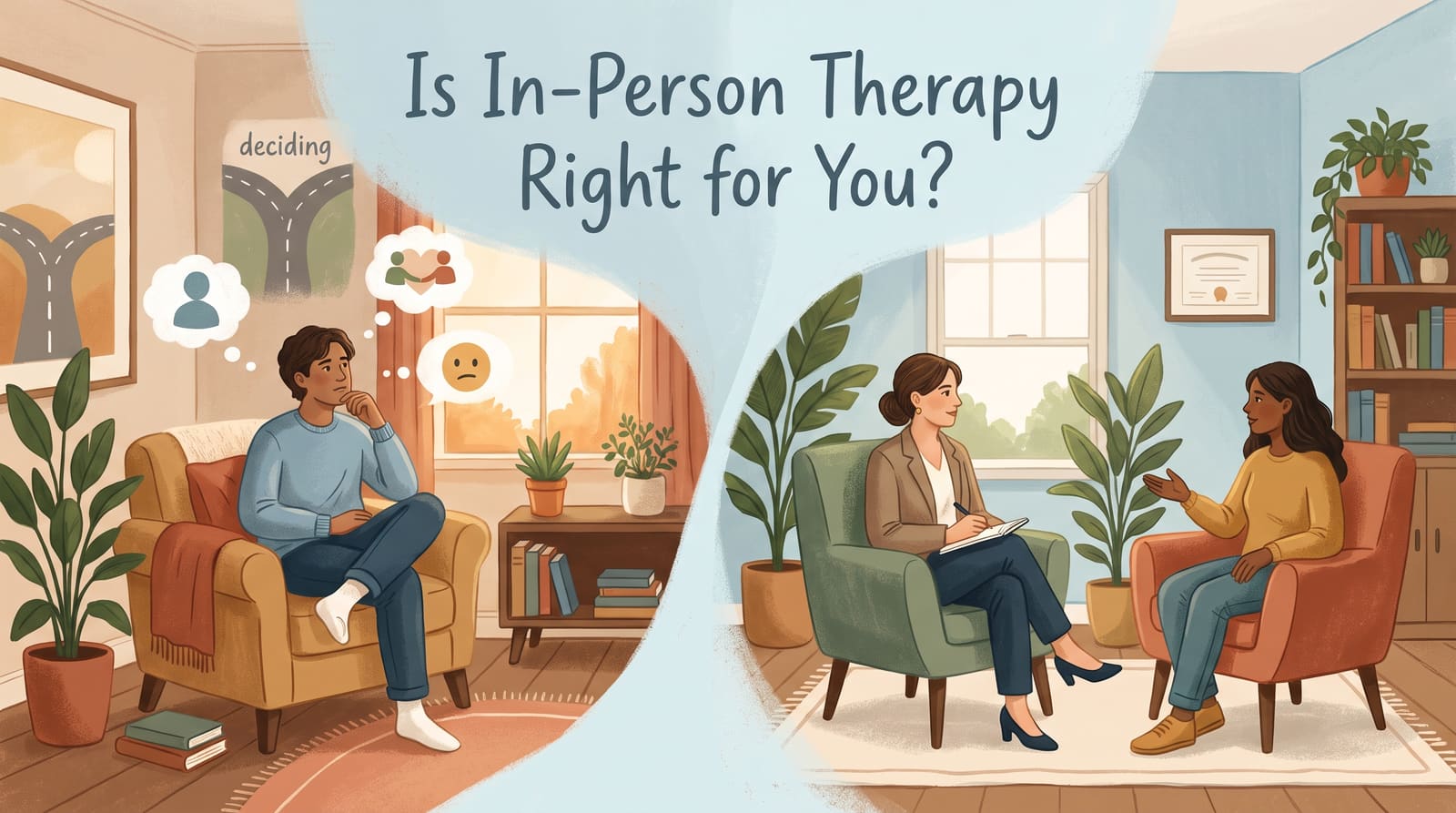
Choosing to start therapy is an important decision. But once you decide to seek support, another question often comes up: Should you meet with a therapist in person, or would online therapy be a better fit?
Both options can provide opportunities to discuss personal challenges, understand emotional patterns, and work toward meaningful changes. However, the experience of attending therapy in an office can feel different from connecting with a therapist through a video call.
For some people, face-to-face therapy offers a dedicated space away from everyday responsibilities. Others prefer online sessions because they are easier to fit into a busy schedule or allow them to attend from home.
Understanding the benefits of in-person therapy, its practical considerations, and the differences between therapy options can help you make a decision that feels right for your circumstances.
This article explores what in-person counseling involves, who may prefer it, how it compares with online therapy, and what to consider when choosing a therapist. It also explains how Riaz Counseling provides in-person therapy in the Houston area.
Key Highlights
- In-person therapy allows you to meet with a therapist in a dedicated professional setting.
- Some people appreciate face-to-face interaction, a consistent appointment routine, and separation from their home or work environment.
- Research does not support the idea that in-person therapy is universally more effective than online therapy. Outcomes depend on the treatment, individual needs, and circumstances.
- Your privacy, schedule, transportation, comfort, accessibility, and treatment goals should all influence your decision.
- Riaz Counseling offers in-person counseling at its Houston Galleria, Sugar Land, and The Woodlands offices, along with online therapy throughout Texas.
What Is In-Person Therapy?
In-person therapy, also called face-to-face therapy or in-person counseling, is a form of mental health treatment in which you and your therapist meet physically in the same professional setting.
Rather than connecting through a video platform, you travel to a counseling office and meet with your therapist for a scheduled session.
During these appointments, you may discuss:
- Anxiety, stress, or persistent worry
- Depression and changes in mood
- Relationship or family concerns
- Grief and difficult life experiences
- Trauma and emotional challenges
- Personal growth and self-esteem
- Major life transitions
- Coping strategies and emotional regulation
The specific topics depend on your needs and the therapist's areas of training and experience.
In-person sessions generally provide a dedicated environment for conversations that may feel difficult to have elsewhere. You can step away from your usual surroundings and focus on what you want to discuss.
However, attending therapy in an office does not automatically make the process more effective. The quality of the therapeutic relationship, the appropriateness of the treatment approach, and your ability to participate are important considerations.
What Are the Benefits of In-Person Therapy?
The benefits of in-person therapy are not identical for everyone. Some people prefer the structure and environment of an office appointment, while others feel more comfortable receiving support remotely.
Here are several reasons someone might choose face-to-face counseling.
1. A Dedicated Space to Focus on Yourself
Everyday environments can make it difficult to concentrate on personal concerns.
At home, you might be thinking about work, household responsibilities, family members, or unfinished tasks. At work, you may feel pressure to remain productive or avoid discussing personal matters.
An in-person therapy appointment creates a separate space where you can focus on your emotional well-being.
For example, someone managing work-related stress may find it helpful to leave the office, travel to a counseling appointment, and spend time discussing their experiences without simultaneously managing work responsibilities.
This separation may make it easier to establish a consistent routine around personal care.
2. Face-to-Face Communication
Some people naturally prefer communicating in person.
Being physically present with a therapist may feel more familiar or comfortable than speaking through a screen. You can have a direct conversation without needing to manage video settings, internet connections, or other technology.
Face-to-face communication may also feel more natural for people who find it difficult to express personal emotions through digital conversations.
However, communication preferences vary. Many people develop meaningful and productive therapeutic relationships through video sessions as well.
The most important consideration is whether you feel comfortable communicating openly with your therapist.
3. A Clearer Boundary Between Therapy and Everyday Life
One practical benefit of visiting a counseling office is the opportunity to create a boundary between therapy and your regular environment.
When therapy takes place at home, it may be easy to move immediately from a personal conversation back into household tasks, work, or family responsibilities.
An office appointment creates a physical transition.
For example, you might schedule a session after work, attend your appointment, and take a few minutes afterward to reflect before returning home.
This routine may help some people treat therapy as a dedicated commitment rather than another task squeezed into the day.
4. A Consistent Appointment Routine
Consistency can be an important part of engaging in therapy.
For some people, having a scheduled appointment at a physical location makes it easier to establish a regular routine.
You might choose the same day and time each week, plan transportation in advance, and reserve that period specifically for your mental health.
This structure can be helpful if you struggle to protect personal time or tend to prioritize other responsibilities.
That said, online therapy can also provide consistent appointments. The best format is the one that allows you to participate reliably.
5. A Setting That Feels Comfortable for Personal Conversations
Not everyone feels comfortable discussing emotional concerns from home.
You may live with family members, roommates, or children. You might have limited privacy or feel uncomfortable discussing sensitive topics where others could overhear.
For some individuals, a counseling office provides a more suitable environment for private conversations.
Others may feel more comfortable at home, particularly if traveling to an unfamiliar location causes anxiety or discomfort.
Think about where you can speak openly without worrying about interruptions or being overheard.
6. An Opportunity to Step Away From Daily Stressors
Traveling to a therapy appointment can create a transition between everyday responsibilities and time spent focusing on yourself.
For example, someone experiencing relationship stress may spend much of the day managing family responsibilities. A scheduled office appointment can provide an opportunity to pause, reflect, and discuss those experiences with a professional.
This does not mean that traveling to therapy is necessary for emotional progress. It simply means that some people find the transition helpful.
Is In-Person Therapy Better Than Online Therapy?
No. In-person therapy is not automatically better than online therapy.
Both formats can be appropriate ways to receive professional mental health support. The best choice depends on the individual, the treatment being provided, the therapist's capabilities, and practical circumstances.
Research has examined whether therapy delivered remotely produces different outcomes from face-to-face treatment.
A 2024 systematic review and meta-analysis published in the Canadian Medical Association Journal included 54 randomized controlled trials involving 5,463 participants. It found moderate-certainty evidence of little to no difference in the effectiveness of therapist-guided remote and in-person cognitive behavioral therapy across the conditions studied.
A separate 2025 systematic review examining digital and face-to-face systemic psychotherapy found that the available research was heterogeneous and did not establish that either delivery format was generally superior. The authors noted that more research was needed.
These findings are important because they challenge the assumption that meeting a therapist physically is always more effective.
Instead, consider which format allows you to:
- Communicate comfortably.
- Attend appointments consistently.
- Maintain appropriate privacy.
- Participate actively in sessions.
- Access the treatment you need.
- Build a trusting relationship with your therapist.
In-Person Therapy vs. Online Therapy
| Consideration | In-Person Therapy | Online Therapy |
|---|---|---|
| Setting | A professional counseling office | A private location chosen by you |
| Travel | Requires transportation | No commute to an office |
| Privacy | Office setting provides a dedicated space | You need to arrange a private environment |
| Routine | Travel and appointments may create structure | Easier to fit around some schedules |
| Communication | Face-to-face interaction | Video-based communication |
| Accessibility | May be difficult with transportation or mobility barriers | Can reduce some travel barriers |
| Personal preference | Suitable for people who prefer meeting physically | Suitable for people comfortable with virtual sessions |
Neither option is right for everyone. Your circumstances and treatment needs should guide the decision.
Who Might Benefit From In-Person Counseling?
In-person counseling may be a good fit if you recognize yourself in some of the following situations.
You Prefer Face-to-Face Conversations
If you find it easier to express yourself when speaking with someone in person, an office-based appointment may feel more natural.
You may prefer direct interaction and feel more comfortable having personal conversations without a screen between you and your therapist.
You Need a Private Space Away From Home
If your living environment is busy or lacks privacy, an office may provide a more appropriate setting for discussing sensitive concerns.
This can be especially relevant for people who share their home with family members or roommates.
You Want a More Structured Routine
Some people benefit from having a specific place and time reserved for therapy.
If you find it difficult to separate work, family, and personal responsibilities, traveling to an appointment may help you establish a clearer routine.
You Feel Distracted During Video Calls
Online sessions require you to manage your surroundings, internet connection, device, and other possible interruptions.
If you frequently lose focus during video conversations, meeting in person may feel more comfortable.
You Want to Explore Available Local Counseling Services
If you live or work near a counseling office, in-person therapy may be a convenient option.
For example, someone living in Houston, Sugar Land, or The Woodlands may prefer to attend appointments close to home or work rather than arranging a virtual session.
When Might Online Therapy Be a Better Fit?
In-person therapy is not always the most practical option.
Online therapy may be worth considering if:
- You have a demanding work or school schedule.
- Traveling to an office is difficult.
- You live far from a counseling practice.
- You have mobility or transportation limitations.
- You feel more comfortable speaking from a familiar environment.
- You have a private space where you can participate without interruptions.
- You want to reduce the time spent commuting.
The American Psychological Association notes that online therapy can offer convenience and improve access for people who have difficulty traveling or reaching a psychologist's office.
However, online therapy still requires an appropriate private environment, reliable technology, and a format that fits your clinical needs.
Some types of treatment or circumstances may require additional considerations. A qualified mental health professional can help determine whether remote or in-person care is appropriate.
How to Decide Which Therapy Option Is Right for You
Choosing between in-person and online therapy does not need to be complicated.
Start by thinking about what would make it easiest for you to participate consistently and communicate openly.
Here are six questions worth considering.
1. Where Do I Feel Most Comfortable Talking?
Think about where you feel most comfortable discussing personal experiences.
Would you prefer a professional counseling office, or would you feel more relaxed speaking from home?
There is no universal answer. Your comfort matters because therapy often involves discussing sensitive experiences.
2. Can I Maintain Privacy?
Consider whether you can speak freely without worrying about someone overhearing your conversation.
If you live with other people, do you have a private room for online sessions?
If not, an office appointment may offer a more suitable environment.
3. How Much Time Can I Commit?
Consider your work schedule, family responsibilities, transportation, and other commitments.
An office appointment may require additional travel time. Online therapy may make scheduling easier, but you still need to protect time for the session.
Choose an option that is realistic for your routine.
4. What Type of Support Am I Looking For?
Think about your concerns and the type of therapy you are considering.
For example, someone seeking support for anxiety, depression, relationship concerns, or life transitions may have different preferences and treatment considerations.
Ask the therapist whether they offer the type of care you need and whether it is available in person, online, or both.
5. Do I Feel Comfortable With the Therapist?
The relationship between you and your therapist matters.
You should have an opportunity to ask questions, discuss your goals, understand the therapist's approach, and decide whether you feel comfortable continuing.
The National Institute of Mental Health recommends considering a therapist's qualifications, experience, treatment approach, and ability to establish a comfortable working relationship.
6. What Will Help Me Attend Consistently?
The best therapy format is not necessarily the one that sounds most appealing initially.
It is also the one you can realistically maintain.
If traveling across Houston during busy traffic makes weekly appointments difficult, online therapy may be more practical.
If working from home makes it difficult to find privacy, an office appointment may be a better fit.
Your decision should reflect your actual circumstances rather than what you think therapy is supposed to look like.
What Should You Expect During Your First In-Person Therapy Session?
It is normal to feel uncertain before your first appointment.
You may wonder what you will be asked, how much personal information you should share, or whether you need to prepare something in advance.
You generally do not need to have everything figured out before meeting your therapist.
Although the exact process varies, an initial session may involve the following.
Discussing What Brought You to Therapy
Your therapist may ask what led you to seek support.
You could talk about anxiety, depression, relationship difficulties, stress, grief, family concerns, or another personal challenge.
You do not have to explain everything perfectly. It is okay to start with what feels most important.
Exploring Your Background
Depending on your concerns, your therapist may ask about relevant experiences, relationships, family circumstances, work, school, and previous mental health support.
These questions help provide context for understanding what you are experiencing.
You can ask why a question is relevant if you are unsure.
Identifying Your Goals
You and your therapist may discuss what you hope to gain from therapy.
Your goals might include:
- Understanding emotional patterns.
- Developing healthier coping strategies.
- Managing anxiety or stress.
- Improving communication.
- Working through grief.
- Strengthening relationships.
- Building self-confidence.
- Navigating a major life transition.
Goals can change as therapy progresses.
Discussing the Therapy Approach
Your therapist should be able to explain the general approach they recommend and why it may be appropriate for your concerns.
You can ask about the expected process, how progress may be reviewed, and what happens if the approach does not feel helpful.
The first appointment is also an opportunity for you to decide whether the therapist feels like a good fit.
How to Choose the Right In-Person Therapist
Choosing a therapist involves more than finding an office nearby.
You should consider the professional's qualifications, experience, approach, and ability to work with your particular concerns.
The National Institute of Mental Health recommends asking potential therapists about their credentials, specialties, treatment methods, goals, and how progress will be evaluated.
Here are some questions you can ask before starting.
About qualifications and experience:
- What are your professional credentials?
- Are you licensed or practicing under supervision?
- Do you have experience working with concerns similar to mine?
- Do you work with my age group or situation?
About the therapy process:
- What therapeutic approaches do you use?
- What might the first few sessions involve?
- How will we establish treatment goals?
- How will we discuss progress?
About practical arrangements:
- Where are your in-person appointments held?
- What are the session fees?
- Do you accept my insurance plan?
- What are your scheduling options?
- Is online therapy available if I cannot attend in person?
About comfort and communication:
- What happens if I feel uncomfortable discussing something?
- How is confidentiality handled?
- Can I ask questions about the treatment approach?
- What should I do if I feel the therapist is not the right fit?
A good therapist should be willing to explain the process and answer reasonable questions.
How Riaz Counseling Supports People Seeking In-Person Therapy
For people looking for face-to-face therapy in the Houston area, Riaz Counseling offers in-person counseling through three office locations. The practice also provides online therapy for people living throughout Texas.
Riaz Counseling provides support for concerns that may include anxiety, depression, stress, trauma, relationship difficulties, grief, and life transitions.
The practice's current service and specialization information can help prospective clients explore the types of support available and determine whether the practice may be a suitable starting point.
Houston Galleria Office
Address:
5353 W Alabama St, Suite 570
Houston, TX 77056
This office may be convenient for people in the Galleria, Uptown, River Oaks, and surrounding Houston communities.
Sugar Land Office
Address:
1600 Hwy 6, Suite 130
Sugar Land, TX 77478
This location may be convenient for people living or working in Sugar Land and nearby communities.
The Woodlands Office
Address:
2001 Timberloch Place, Suite 500
Spring, TX 77380
This office serves people in The Woodlands, Spring, Conroe, and surrounding areas.
Online Therapy Throughout Texas
If visiting an office is not practical, Riaz Counseling also lists online therapy for people living in Texas. This gives prospective clients another option when considering how to receive support.
If you are unsure which format is appropriate, you can contact the practice to discuss your needs, therapist fit, and available appointment options.
Considering in-person counseling? Riaz Counseling offers a free 15-minute consultation through its contact page, where you can take an initial step toward discussing your needs and exploring whether the practice is a good fit.
Frequently Asked Questions
1. What are the main benefits of in-person therapy?
Some people appreciate the dedicated professional setting, face-to-face communication, separation from everyday distractions, and structured appointment routine. These benefits depend on individual preferences and circumstances.
2. Is in-person therapy more effective than online therapy?
Not necessarily. Research comparing therapist-guided remote and in-person cognitive behavioral therapy has found little to no difference in effectiveness across the conditions studied. The best format depends on your needs, treatment approach, privacy, access, and personal preferences.
3. Who should consider face-to-face therapy?
Face-to-face therapy may suit people who prefer direct interaction, want a dedicated space outside their home, have difficulty maintaining privacy during video sessions, or find office appointments easier to incorporate into their routine.
4. What happens during an in-person counseling session?
You generally meet with your therapist to discuss your concerns, experiences, feelings, and goals. Depending on your needs, sessions may involve exploring thought patterns, discussing relationships, developing coping strategies, or reviewing progress.
5. How do I know if a therapist is right for me?
Consider the therapist's credentials, experience, treatment approach, and familiarity with your concerns. Just as importantly, notice whether you feel respected, comfortable asking questions, and able to communicate openly.
6. Can I switch from online therapy to in-person therapy?
It may be possible, depending on the practice, therapist, and appointment availability. If your needs or preferences change, discuss the options with your therapist or counseling practice.
7. Does Riaz Counseling offer in-person therapy in Houston?
Yes. Riaz Counseling lists in-person services at its Houston Galleria, Sugar Land, and The Woodlands offices. It also offers online therapy for people living throughout Texas. Contact the practice to confirm current availability and the services offered at each location.
Conclusion: Choose the Therapy Setting That Supports Your Needs
Deciding whether in-person therapy is right for you is a personal choice.
Some people appreciate meeting face-to-face, having a dedicated space for emotional conversations, and creating a consistent appointment routine. Others find online therapy more practical because it reduces travel and makes professional support easier to access.
Neither option is automatically better for everyone.
Instead of focusing only on the format, consider the bigger picture: Do you feel comfortable with the therapist? Can you attend consistently? Does the treatment approach fit your needs? Can you communicate openly and maintain appropriate privacy?
If you are considering counseling in Houston, Riaz Counseling offers in-person therapy at its Galleria, Sugar Land, and The Woodlands offices, as well as online therapy throughout Texas.
Taking time to explore your options can help you make a more informed decision and find a setting where you feel comfortable working toward your mental health goals.
Suggested Internal Links
- Individual Therapy at Riaz Counseling — https://riazcounseling.com/services/individual-therapy/
Relevant for readers exploring individual counseling and professional support. - Riaz Counseling Locations — https://www.riazcounseling.com/locations/
Helps readers compare the practice's Houston-area offices and online therapy option. - Riaz Counseling Specializations — https://riazcounseling.com/specializations/
Useful for readers exploring areas such as anxiety, depression, life transitions, and other concerns. - Riaz Counseling Contact Page — https://riazcounseling.com/contact/
Provides a next step for readers interested in discussing therapy options or scheduling a consultation.
Sources Used
National Institute of Mental Health (NIMH): Psychotherapies — guidance on choosing a therapist, professional qualifications, treatment approaches, and therapeutic rapport.
American Psychological Association (APA): What You Need to Know Before Choosing Online Therapy — considerations involving convenience, accessibility, and privacy.
Canadian Medical Association Journal / PubMed (2024): Therapist-Guided Remote Versus In-Person Cognitive Behavioural Therapy — systematic review and meta-analysis of 54 randomized controlled trials.
Interactive Journal of Medical Research / PubMed (2025): Comparing Digital Versus Face-to-Face Delivery of Systemic Psychotherapy Interventions — systematic review and meta-analysis.
Riaz Counseling: Official Locations Page — current office addresses and online therapy information.
Riaz Counseling: Official About Page — current services, specializations, locations, and consultation information.
Riaz Counseling: Official Contact Page — consultation and contact information.
If you feel that you or someone you know may benefit from therapy, please reach out to our office for a FREE 15-minute consultation: LINK.