Topic Understanding
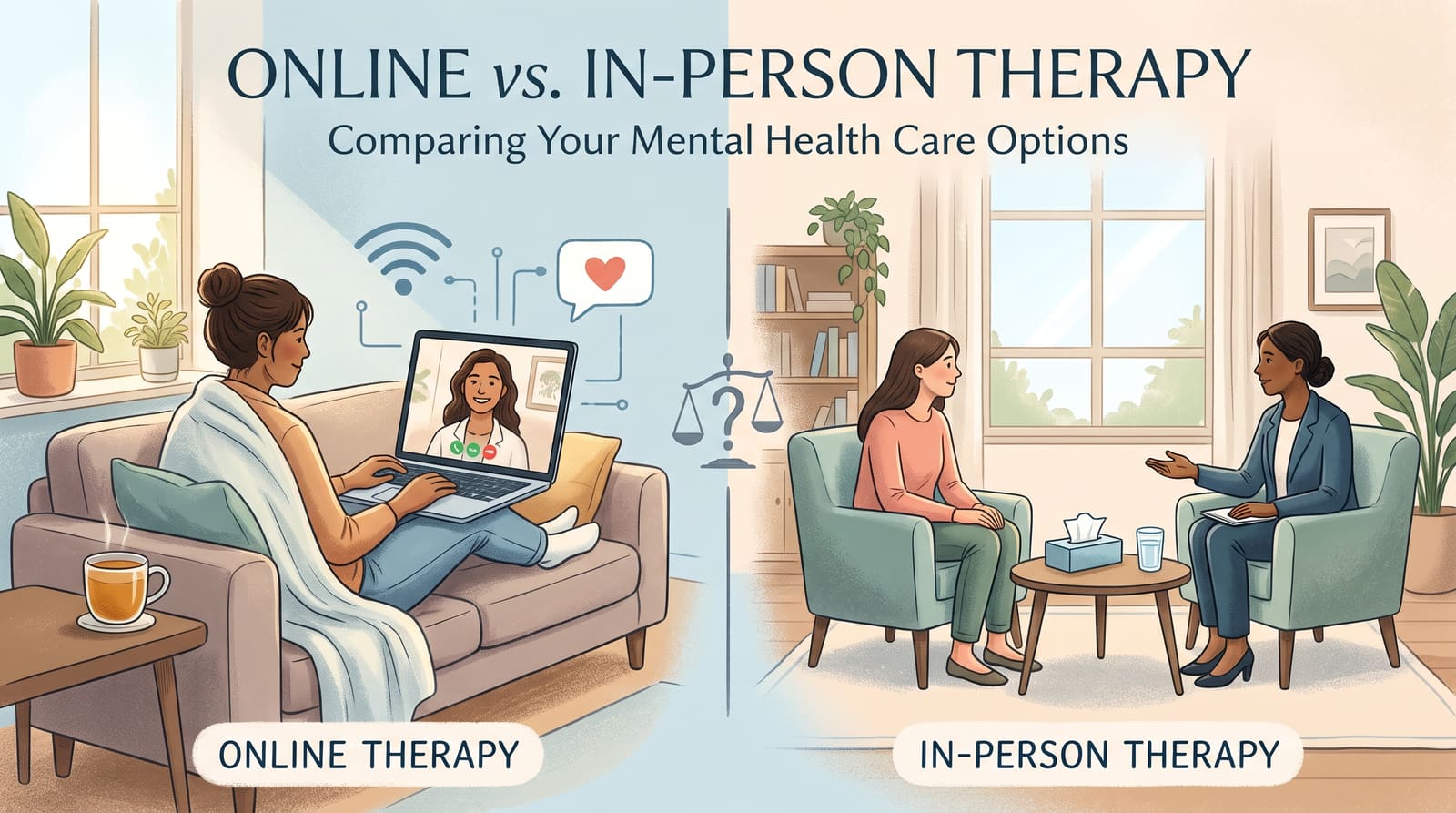
Choosing to start therapy is an important decision. But once you decide to seek support, another question often comes up: Should you choose online therapy or in-person counseling?
Both options allow you to work with a mental health professional, discuss personal concerns, and develop strategies for managing emotional or behavioral challenges. However, the experience of attending a virtual session from home can be different from visiting a therapist's office.
When comparing online vs. in-person therapy, it helps to understand more than convenience. Privacy, personal comfort, technology, travel, scheduling, the type of support you need, and your relationship with your therapist can all influence which format works best.
The good news is that you do not necessarily have to choose between effective care and convenience. Research suggests that therapist-guided online cognitive behavioral therapy can produce outcomes similar to in-person CBT for several conditions. Still, the most appropriate format depends on the individual and the services being provided.
This guide explains the differences between virtual therapy and face-to-face counseling, their potential benefits and limitations, and what to consider when choosing mental health services. It also explains how Riaz Counseling offers both options for people in the Houston area and throughout Texas.
Key Highlights
- Online therapy allows you to meet with a therapist remotely, usually through a secure video platform, while in-person counseling takes place at a professional office.
- Research suggests that therapist-guided online CBT can be similarly effective to in-person CBT for several conditions, although findings should not be generalized to every therapy approach or situation.
- Virtual therapy may be more convenient for people with transportation, scheduling, or geographic challenges.
- Face-to-face counseling may appeal to people who prefer a dedicated office environment and fewer technology-related distractions.
- The best choice depends on your preferences, privacy, clinical needs, access, and the therapist's ability to provide appropriate care in that format.
What Is the Difference Between Online Therapy and In-Person Counseling?
The main difference is where and how you meet with your therapist.
Online therapy is mental health counseling delivered remotely through technology. Many appointments take place through live video sessions, allowing clients and therapists to communicate without being in the same physical location.
In-person counseling takes place in a professional office where the client and therapist meet face-to-face.
Both formats can involve discussing emotional concerns, identifying patterns, setting goals, learning coping strategies, and working through personal challenges.
The therapeutic approach does not automatically change simply because the appointment takes place online. For example, a therapist may use cognitive behavioral therapy (CBT) in either format when it is appropriate for the client and the therapist is qualified to provide it.
However, some exercises, assessments, or interventions may need to be adapted depending on the format.
Online Therapy vs. In-Person Counseling: A Quick Comparison
| Consideration | Online Therapy | In-Person Counseling |
|---|---|---|
| Session location | A private location chosen by the client | A professional therapy office |
| Travel | No commute to an office | Requires transportation |
| Convenience | Can fit around some work, school, and family schedules | Requires planning around travel and appointments |
| Privacy | Requires a private space and secure technology | Takes place in a professional office |
| Interaction | Usually through video or another remote format | Direct face-to-face interaction |
| Technology | Requires a suitable device and reliable internet | Does not depend on a video connection |
| Routine | Can be easier to schedule around daily responsibilities | Traveling to an office may create a clear separation from everyday activities |
| Personal preference | Suitable for people comfortable with virtual communication | Suitable for people who prefer meeting in person |
Neither format is automatically better. The comparison is about finding an option that supports meaningful participation and fits your circumstances.
What Does Research Say About Online vs. In-Person Therapy?
One of the most common concerns about virtual therapy is whether it is as effective as traditional face-to-face counseling.
Research provides encouraging evidence, particularly for certain forms of psychotherapy.
A 2024 systematic review and meta-analysis published in the Canadian Medical Association Journal examined 54 randomized controlled trials involving 5,463 participants. The researchers compared therapist-guided remote cognitive behavioral therapy with in-person CBT.
The review found moderate-certainty evidence of little to no difference in effectiveness between the two formats for the primary outcomes studied. The research included conditions such as anxiety-related disorders, depressive symptoms, and insomnia, among others.
A separate systematic review and meta-analysis published in Telemedicine and e-Health examined remote and face-to-face psychological interventions for anxiety and depression. It also found no statistically significant difference between the formats in the included studies, although the number of studies was limited.
What does this mean for someone considering therapy?
It means that online counseling should not automatically be viewed as an inferior option.
For many people, therapist-guided virtual treatment can provide meaningful access to psychological support. However, research findings about particular treatments cannot establish that every online therapy service is appropriate for every condition or person.
The therapist's qualifications, treatment approach, clinical judgment, therapeutic relationship, and the client's circumstances remain important.
A useful question is not simply:
"Is online therapy as good as in-person therapy?"
Instead, consider:
"Can I participate comfortably and consistently in this format, and is it appropriate for the kind of support I need?"
Potential Benefits of Online Therapy
Virtual therapy has changed how many people access mental health services. It can make appointments more practical for individuals whose schedules, locations, or responsibilities make regular office visits difficult.
Here are some potential advantages.
1. Convenience and Flexibility
One of the most recognizable benefits of online therapy is the ability to attend sessions without traveling to an office.
This may be useful if you:
- Have a demanding work schedule.
- Are balancing school and family responsibilities.
- Have limited transportation.
- Live far from a suitable counseling office.
- Have difficulty fitting appointments into your daily routine.
- Prefer attending sessions from a familiar location.
For example, someone working full-time in Houston may find it easier to attend a virtual appointment during an appropriate break or from home rather than arranging additional travel.
Scheduling options depend on the practice and individual therapist, so it is important to confirm available appointment times.
2. Access to Therapy Across a Wider Geographic Area
In-person counseling usually requires you to travel to a specific office.
Online therapy can reduce that geographic limitation. Depending on licensing requirements and the therapist's authorization to provide services, clients may be able to access care while living farther away from a practice's physical locations.
For people living in Texas, this can be especially useful when finding a therapist who fits their preferences and needs.
Riaz Counseling currently lists virtual therapy for people living throughout Texas. Its online therapy service uses a HIPAA-compliant telehealth platform, according to the practice's website.
3. Attending Sessions in a Familiar Environment
Some people feel more comfortable discussing personal experiences from a familiar setting.
Being at home may reduce the stress associated with traveling to an unfamiliar office. It may also make it easier for someone to fit a session into an otherwise busy day.
However, familiarity does not always mean privacy.
If other people can hear your conversation or interrupt your appointment, it may be difficult to speak openly. Before choosing virtual therapy, consider whether you have a suitable private space.
4. Reduced Travel and Transportation Challenges
Travel can become a barrier to consistent appointments.
Traffic, parking, transportation costs, mobility limitations, and distance may make attending in-person counseling more difficult.
Online sessions remove the need to travel to the therapist's office. For some individuals, this can make it easier to maintain a regular appointment routine.
That convenience may be particularly valuable for people balancing work, caregiving, education, or other responsibilities.
5. More Options When Comparing Therapists
Online services may expand the range of therapists you can consider, provided they are authorized to serve clients in your location.
This can be helpful when you are looking for someone with experience in a particular concern or who offers a treatment approach that fits your needs.
However, do not choose a therapist based on availability alone. Confirm their qualifications, areas of practice, treatment options, and whether they are a good fit for your circumstances.
Potential Benefits of In-Person Counseling
Although virtual therapy offers convenience, some people prefer the experience of attending counseling in a professional office.
Face-to-face counseling can provide a dedicated setting for personal conversations and may help people establish a clear boundary between therapy and everyday responsibilities.
1. A Dedicated Space for Mental Health
For some people, it is difficult to separate personal responsibilities from emotional concerns when attending therapy at home.
A professional office can create a distinct environment where the focus is on discussing personal challenges and working toward goals.
For example, a parent who spends most of the day managing household responsibilities may appreciate having a separate place to attend therapy without interruptions.
2. Direct Face-to-Face Interaction
Some individuals feel more comfortable communicating with another person in the same room.
They may prefer natural conversation without a screen, internet connection, camera, or audio settings.
Face-to-face interaction can also make certain activities easier to conduct when a particular intervention benefits from being physically present.
However, the quality of communication and therapeutic connection depends on many factors. Meeting in person does not automatically guarantee a stronger relationship or better outcome.
3. Fewer Technology-Related Distractions
Virtual sessions depend on technology.
An unstable internet connection, microphone problem, device notification, or unexpected interruption can affect the appointment.
In-person counseling removes many of these technology-related concerns.
Clients may still experience other distractions, such as traffic or office-related interruptions, but the session itself does not depend on a video connection.
4. A Clear Separation Between Daily Life and Therapy
Traveling to an appointment can create a transition between everyday responsibilities and the time set aside for counseling.
Some people appreciate having time before and after a session to prepare emotionally, reflect, or return to their normal routine.
For others, travel creates unnecessary stress.
The value of this separation depends on the individual. It is one reason personal preference matters when choosing a format.
5. A Better Fit for Certain Clinical or Practical Needs
Some concerns may require more direct assessment, coordination, or support than a standard virtual appointment can provide.
A therapist may determine that in-person care, another service, or a higher level of support is more appropriate based on the person's circumstances.
This does not mean online therapy is unsuitable for all complex concerns. Rather, the format should be selected with professional guidance when clinical needs are more involved.
When Might Online Therapy Be the Better Choice?
Online therapy may be a practical option when you have a suitable private space, reliable technology, and a preference for remote appointments.
It may be worth considering if:
- You live far from a counseling office.
- You have limited transportation.
- Your work or school schedule makes travel difficult.
- You feel comfortable communicating through video.
- You want to reduce time spent commuting.
- You have caregiving responsibilities.
- You are looking for a therapist who provides services remotely in your state.
Example: A university student living in a Texas city far from a counseling office may prefer virtual therapy because it allows them to attend sessions without traveling long distances.
Another example is a working professional who wants to attend counseling after work but finds it difficult to reach an office before closing.
In these situations, online therapy may make regular participation more manageable.
When Might In-Person Counseling Be the Better Choice?
In-person therapy may be a better fit if you prefer a professional office environment or find virtual communication uncomfortable.
Consider face-to-face counseling if:
- You prefer talking with someone in person.
- You have difficulty finding privacy at home.
- Your internet connection is unreliable.
- You find video conversations distracting.
- You want a dedicated space outside your home.
- Your therapist recommends in-person care based on your needs.
- The service you need requires an in-person appointment.
Example: Someone who shares a small apartment with family members may struggle to discuss sensitive topics privately through video. Attending an office appointment may give them more confidence that their conversation will remain private.
Another person may simply feel more engaged when speaking with a therapist face-to-face.
Neither preference needs to be justified. Feeling comfortable enough to participate openly is an important consideration.
Does Online Therapy Work for Anxiety and Depression?
Online therapy can be an option for people seeking support for anxiety and depression.
Research comparing remote and face-to-face CBT has found similar outcomes for several conditions, including anxiety-related disorders and depressive symptoms. However, results vary across studies and should not be interpreted as proof that every virtual treatment is appropriate for every person.
A therapist may use approaches such as cognitive behavioral therapy to help clients:
- Recognize unhelpful thought patterns.
- Understand how thoughts, emotions, and behaviors interact.
- Develop practical coping strategies.
- Address avoidance behaviors.
- Work toward realistic personal goals.
- Build skills for managing everyday challenges.
The suitability of online treatment depends on the person's needs, the therapist's clinical judgment, and whether the chosen approach can be delivered appropriately through the available technology.
If symptoms are severe, rapidly worsening, or involve immediate safety concerns, a routine virtual appointment may not provide the level of support needed. A qualified professional can help determine the appropriate next step.
Privacy and Confidentiality: What Should You Consider?
Privacy matters in both online and in-person counseling.
In-person sessions take place in a professional setting, while online sessions require additional attention to the environment and technology used by the client.
The U.S. Department of Health and Human Services recommends that telebehavioral health providers discuss privacy with patients and encourage them to attend sessions from a private location. It also identifies practical precautions such as using headphones and avoiding public Wi-Fi.
Tips for maintaining privacy during virtual therapy
Before your appointment:
- Choose a quiet room where other people are unlikely to interrupt.
- Use headphones if appropriate.
- Make sure your device is password-protected.
- Use a private internet connection rather than public Wi-Fi when possible.
- Close unnecessary applications and notifications.
- Tell your therapist if someone else may be able to hear the session.
- Ask how the practice handles telehealth privacy and communication.
A secure telehealth platform is important, but privacy also depends on the environment where you attend the appointment.
If you cannot find a private location at home, consider whether in-person counseling would be more comfortable.
What About Technology Problems During Online Therapy?
Technology can make therapy more accessible, but it can also create occasional difficulties.
You may experience:
- Internet interruptions.
- Audio or video delays.
- Difficulty accessing the appointment link.
- Device compatibility problems.
- Unexpected interruptions from other people.
- Discomfort with video communication.
Before beginning virtual therapy, ask the practice what technology is required and what happens if a connection fails.
It is also helpful to know whether there is an agreed-upon backup method for communicating if the video appointment is interrupted.
For telebehavioral health, emergency planning is another important consideration. HHS guidance recommends that providers establish procedures for responding to emergencies during remote sessions, including confirming the client's location and identifying appropriate local emergency resources.
How to Choose Between Online and In-Person Therapy
If you are unsure which format to choose, start by considering your everyday circumstances rather than trying to identify a universally correct answer.
The following questions can help you make a more informed decision.
1. Where Can I Speak Openly?
Think about where you feel most comfortable discussing personal experiences.
If your home is quiet and private, virtual therapy may work well.
If other people are regularly present, an office may provide a more suitable environment.
2. What Fits My Schedule?
Consider the time required for the appointment, including travel.
Would you be able to attend an office regularly? Or would virtual sessions make it easier to maintain appointments around work, school, and family responsibilities?
Choose a format that is realistic over time.
3. How Comfortable Am I With Video Conversations?
Some people communicate naturally through video. Others find it difficult to maintain attention or express themselves through a screen.
Think about your previous experiences with virtual conversations.
You can also ask a therapist what a typical online session involves before making a decision.
4. What Type of Support Am I Looking For?
Different mental health concerns may require different approaches.
Ask whether the therapist offers the type of service you need and whether it can be provided effectively in your preferred format.
For example, you may be looking for individual therapy, couples counseling, trauma-focused treatment, or support with anxiety.
Do not assume that every therapist offers every service or that every treatment is available online.
5. Can I Attend Consistently?
Consistency matters when building a working relationship with a therapist.
Consider which option makes it easier for you to attend appointments regularly.
A convenient format that you can maintain may be more practical than a preferred format that creates repeated scheduling or transportation problems.
6. What Does the Therapist Recommend?
If you are uncertain, discuss your preferences and concerns with the practice.
A therapist can help you understand whether online or in-person counseling is appropriate based on your needs, treatment goals, and available services.
You do not need to make the decision without guidance.
Can You Switch Between Online and In-Person Therapy?
Sometimes, yes.
Some practices offer both formats, allowing clients to discuss whether changing the appointment format is possible.
For example, someone might initially choose online therapy because of a busy work schedule but later prefer in-person appointments after their routine changes.
Another person might begin with face-to-face counseling and eventually find virtual sessions more practical.
However, switching depends on the practice's policies, therapist availability, clinical suitability, and the services offered.
If you are considering changing formats, discuss it with your therapist rather than assuming that every appointment can automatically be moved online or in person.
Choosing Mental Health Services in Houston, Texas
For people living in Houston and surrounding communities, the choice between virtual and face-to-face counseling may also depend on location.
Travel time, work commitments, traffic, and access to an appropriate therapist can all influence the decision.
Riaz Counseling currently lists three offices in the Houston area:
Houston Galleria
5353 W Alabama St, Suite 570
Houston, TX 77056
Sugar Land
1600 Hwy 6, Suite 130
Sugar Land, TX 77478
The Woodlands
2001 Timberloch Place, Suite 500
Spring, TX 77380
The practice also lists online therapy for people living throughout Texas.
When comparing local counseling options, consider more than the office location. Ask about the therapist's qualifications, experience with your concerns, appointment format, fees, insurance arrangements, and availability.
The right service should fit both your practical circumstances and your mental health needs.
How Riaz Counseling Offers Online and In-Person Therapy
Riaz Counseling provides mental health counseling services through its Houston-area offices and online therapy for people living in Texas.
Its location information lists in-person services in Houston Galleria, Sugar Land, and The Woodlands, along with virtual therapy through a telehealth platform.
Depending on the therapist and service, people exploring counseling may be able to discuss concerns such as:
- Anxiety and stress
- Depression
- Relationship concerns
- Family and parenting challenges
- Trauma-related concerns
- Grief and loss
- Life transitions
- Self-esteem and identity
The appropriate therapist and treatment format depend on the individual's needs and the services available.
What should you ask before scheduling?
If you are considering Riaz Counseling or another mental health practice, it may help to ask:
- Do you offer both online and in-person appointments?
- Which therapists work with my particular concerns?
- Is the therapist authorized to provide online services where I live?
- What technology do I need for a virtual session?
- What are the fees and payment options?
- Does the practice accept my insurance plan?
- Can I discuss changing appointment formats if my circumstances change?
- What should I expect during the first appointment?
Riaz Counseling lists a free 15-minute consultation for people interested in discussing therapy options. You can contact the practice to ask about therapist fit, appointment formats, and current availability.
Frequently Asked Questions
1. Is online therapy as effective as in-person therapy?
For some treatments and conditions, research suggests that online therapy can produce outcomes similar to in-person treatment. A 2024 systematic review of 54 randomized controlled trials found little to no difference between therapist-guided remote and in-person CBT across the primary outcomes studied. However, results should not be generalized to every treatment or individual.
2. Is face-to-face counseling better than virtual therapy?
Not necessarily. Face-to-face counseling may suit people who prefer a professional office environment, while online therapy may be more practical for those who value flexibility or have difficulty traveling. The best option depends on personal preferences, privacy, access, clinical needs, and therapist recommendations.
3. What are the disadvantages of online therapy?
Online therapy depends on suitable technology and a private environment. Internet interruptions, device problems, distractions, and difficulty finding a confidential space may affect the experience. Some services or clinical situations may also require in-person assessment or support.
4. Can I attend online therapy from anywhere in Texas?
That depends on the therapist's authorization, the practice's service area, and applicable licensing requirements. Riaz Counseling currently lists online therapy for people living throughout Texas. Confirm your eligibility and appointment options directly with the practice.
5. Do I need a private room for online counseling?
A private space is strongly recommended so you can speak openly without worrying about being overheard. If possible, use headphones, a password-protected device, and a private internet connection. If privacy at home is difficult, in-person counseling may be worth considering.
6. Can I change from online therapy to in-person counseling?
This may be possible if the practice offers both formats and the therapist has appropriate availability. Discuss the change with your therapist or the practice so they can confirm whether it is suitable for your needs.
7. Does Riaz Counseling offer both online and in-person therapy?
Yes. Riaz Counseling lists in-person services at its Houston Galleria, Sugar Land, and The Woodlands offices, as well as online therapy for people living throughout Texas. Contact the practice to confirm the current availability of the service and therapist you are considering.
Conclusion: Choose the Therapy Format That Fits Your Needs
Comparing online and in-person therapy is not about deciding which format is universally superior. It is about understanding what each option offers and identifying the setting in which you can participate comfortably and consistently.
Online therapy may provide flexibility, reduce travel, and expand access to counseling. In-person counseling may offer a dedicated professional environment and the face-to-face interaction some people prefer.
Research supports the effectiveness of certain forms of remote therapy, including therapist-guided online CBT, but individual needs and clinical circumstances still matter.
If you are considering therapy, take time to think about your schedule, privacy, communication preferences, and the kind of support you need. You can also ask a qualified mental health professional to help you compare your options.
Riaz Counseling offers both in-person counseling in the Houston area and online therapy for people living in Texas. Exploring those options can be a practical first step toward finding mental health support that fits your life.
You do not have to choose the format that works for everyone else. You can start by choosing the one that makes it possible for you to take the next step.
Mental Health Disclaimer
This article is intended for general educational purposes and does not replace professional mental health advice, diagnosis, or treatment. Online and in-person therapy may not be appropriate for every person or situation. A qualified mental health professional can help determine which services and format are suitable for your needs.
If you are experiencing an immediate mental health emergency or are at risk of harming yourself or someone else, seek urgent assistance through local emergency services or an appropriate crisis service.
Suggested Internal Links
Riaz Counseling Locations — https://www.riazcounseling.com/locations/
Helps readers compare the practice's Houston-area offices and online therapy option.Online Therapy in Texas — https://riazcounseling.com/locations/online-therapy-texas/
Relevant for readers interested in virtual counseling throughout Texas.Benefits of Choosing In-Person Therapy at Riaz Counseling — https://riazcounseling.com/blog/benefits-of-choosing-in-person-therapy-at-riaz-counseling/
Provides additional information for readers considering face-to-face counseling.What to Expect During Your First In-Person Therapy Session — https://riazcounseling.com/blog/what-to-expect-during-your-first-in-person-therapy-session/
Helps readers understand what an office-based therapy appointment may involve.Individual Therapy at Riaz Counseling — https://riazcounseling.com/services/individual-therapy/
Provides information about individual counseling services.Contact Riaz Counseling — https://riazcounseling.com/contact/
Gives readers a next step for asking about consultation and appointment options.If you feel that you or someone you know may benefit from therapy, please reach out to our office for a FREE 15-minute consultation: LINK.
Sources Used
- Zandieh et al. (2024), Therapist-guided remote versus in-person cognitive behavioural therapy: A systematic review and meta-analysis of randomized controlled trials, Canadian Medical Association Journal.
- Machado Cecagno et al. (2025), Efficacy of Remote Psychological Interventions for Patients with Anxiety and Depression Symptoms: Systematic Review and Meta-Analysis, Telemedicine and e-Health.
- U.S. Department of Health and Human Services, Telehealth.HHS.gov, Protecting Patients' Privacy.
- U.S. Department of Health and Human Services, Telehealth.HHS.gov, Creating an Emergency Plan for Telebehavioral Health.
- Riaz Counseling, Our Locations.
- Riaz Counseling, Online Therapy in Texas.
- Riaz Counseling, Contact Us.