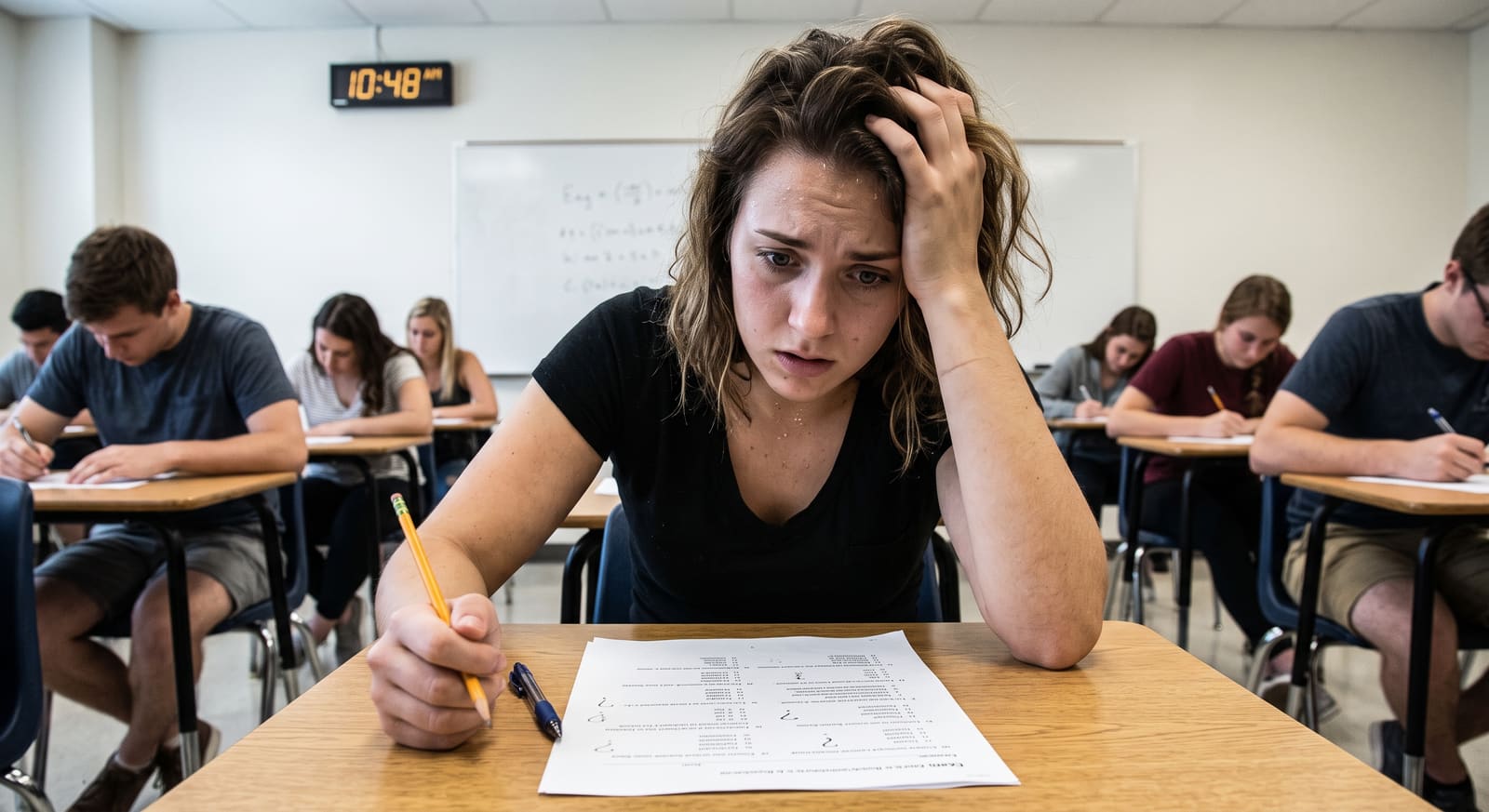
Introduction
A little nervousness before an exam is normal. For some students, however, test anxiety becomes strong enough to interfere with studying, concentration, sleep, confidence, or the ability to demonstrate what they know.
You might understand the material while studying but suddenly feel overwhelmed when you sit down for an exam. You may procrastinate because thinking about the test makes you anxious, then feel even more stressed because you have less time to prepare.
This can create a frustrating cycle:
Worry → avoidance or ineffective studying → feeling unprepared → more anxiety → difficulty performing → more worry about the next exam.
The good news is that test anxiety can be addressed from more than one direction. Better study habits can reduce some of the uncertainty that fuels exam stress, while therapy may help when anxiety, perfectionism, fear of failure, negative self-talk, or other emotional concerns are getting in the way.
Research supports interventions for test anxiety, although results vary and no single strategy works for every student. A meta-analysis of randomized controlled trials involving university students found that interventions reduced test anxiety overall, with some evidence that academic performance can improve as well. The researchers also noted limitations in the available evidence.
Key Highlights
- Test anxiety can involve emotional, physical, and cognitive reactions to exams.
- Poor preparation can contribute to anxiety, but strong study habits do not always eliminate test anxiety.
- Spreading study sessions over time and practicing with exam-like questions can be more useful than relying on last-minute cramming.
- Therapy can help students explore anxiety, perfectionism, fear of failure, avoidance, and unhelpful thought patterns.
- Cognitive behavioral and behavioral approaches are among the interventions that have been studied for test anxiety.
- Getting professional support does not mean a student is weak or incapable. It can be one part of learning how to manage academic pressure more effectively.
What Is Test Anxiety?
Test anxiety is a strong emotional response to exams or other forms of academic evaluation.
It can include several types of experiences.
Emotional symptoms
A student might feel:
- Nervous
- Overwhelmed
- Irritable
- Panicked
- Frustrated
- Afraid of failing
- Extremely worried about disappointing others
Physical symptoms
Anxiety can also affect the body. Some students experience:
- Racing heart
- Sweating
- Shaking
- Muscle tension
- Stomach discomfort
- Restlessness
- Difficulty sleeping before an exam
Cognitive symptoms
The mental side of test anxiety can be particularly frustrating.
A student may:
- Have trouble concentrating
- Overthink questions
- Have difficulty organizing thoughts
- Worry repeatedly about making mistakes
- Feel mentally "blank"
- Have difficulty recalling information under pressure
Not every student experiences all of these symptoms, and experiencing nervousness before an exam does not automatically mean someone has a mental health disorder.
How Is Test Anxiety Different From Normal Exam Stress?
Some stress before an important exam can be useful. It may encourage a student to prepare, attend class, review material, and take the assessment seriously.
The concern is when anxiety becomes so intense that it interferes with preparation, concentration, daily functioning, or academic participation.
For example:
Typical exam stress:
"I have a biology exam Friday, so I need to study tonight."
More disruptive anxiety:
"I have a biology exam Friday. I can't stop thinking about failing, I keep avoiding my notes because they make me anxious, and I can't sleep."
The difference is not simply whether anxiety exists.
The more useful question is:
Is the anxiety helping me prepare, or is it making preparation and performance harder?
Why Does Test Anxiety Happen?
There is rarely one cause.
Research has identified relationships between test anxiety and factors such as perceived test difficulty, high-stakes consequences, self-esteem, and academic performance. A large meta-analysis covering 238 studies found that test anxiety was negatively associated with several educational performance outcomes, although the size of these relationships varied.
For an individual student, contributing factors may include:
Fear of Failure
A student may view one exam as a judgment of their intelligence, future, or worth.
Instead of:
"I did poorly on this test."
The thought becomes:
"If I fail this test, I'm a failure."
That kind of thinking can make an ordinary academic challenge feel much more threatening.
Perfectionism
Students who expect themselves to perform perfectly may experience intense anxiety when they cannot guarantee a perfect result.
A single mistake can feel unacceptable.
High Academic Pressure
Pressure may come from:
- Parents
- Teachers
- Coaches
- Peers
- Scholarship requirements
- Competitive programs
- Personal expectations
- College admissions or career goals
Previous Difficult Experiences
A student who previously performed poorly despite studying may become anxious before the next exam.
The fear may be based on a real memory:
"What if it happens again?"
Difficulty With Preparation
Sometimes anxiety and study habits influence each other.
If a student procrastinates, crams, or struggles to organize coursework, they may feel unprepared. That feeling can increase anxiety.
At the same time, anxiety itself can make it harder to begin studying.
This creates a cycle that can be difficult to break without addressing both sides.
Test Anxiety and Study Habits: Why Preparation Matters
It is important not to assume that every academic struggle is caused by anxiety.
Sometimes students are simply underprepared.
The University of Texas at Dallas Student Counseling Center specifically recommends examining study and test-preparation habits when students experience test anxiety. Their guidance includes spreading study sessions over several days, reviewing course materials, using practice tests, and maintaining regular rest and nutrition.
Better preparation cannot guarantee that anxiety will disappear, but it can reduce one important source of uncertainty.
Healthy Study Habits That Can Reduce Exam Stress
1. Start Earlier Than You Think You Need To
Cramming can create unnecessary pressure.
Instead of attempting to learn everything the night before, divide the material into smaller sections.
For example:
Monday: Chapters 1–2
Tuesday: Chapters 3–4
Wednesday: Practice questions
Thursday: Review difficult areas
Friday: Exam
The exact schedule should fit your workload, but the principle is simple:
Distribute the work instead of concentrating it into one stressful session.
2. Use Active Study Methods
Reading the same page repeatedly can create the feeling that you know the material without testing whether you can actually recall it.
Try:
- Practice questions
- Flashcards
- Explaining a concept aloud
- Solving problems without looking at the answer
- Teaching the material to someone else
- Practice exams
The goal is to make your brain retrieve information rather than simply recognize it.
3. Recreate Exam Conditions
If possible, practice answering questions with a time limit.
Put away your notes.
Set a timer.
Complete the practice questions as though they were part of the real exam.
This can help make the testing experience less unfamiliar.
University counseling guidance similarly recommends practice tests under exam-like conditions.
4. Break Large Tasks Into Smaller Ones
"Study for chemistry" is vague.
"Complete 15 practice problems from Chapter 4" is specific.
Breaking work into smaller tasks can make studying feel more manageable.
5. Build Breaks Into Your Schedule
Studying for hours without stopping is not always the most productive approach.
Plan reasonable breaks so that studying does not become one long period of exhaustion.
6. Protect Your Sleep
Pulling an all-nighter may feel like an efficient way to gain more study time, but exhaustion can make the next day more difficult.
A consistent sleep routine is one of the practical recommendations commonly included in university test-anxiety guidance.
7. Ask for Academic Help When You Need It
Sometimes the most effective response to test anxiety is academic rather than therapeutic.
Consider talking with:
- Your instructor
- Teaching assistant
- Academic advisor
- Tutor
- Study group
- School or university learning center
You do not have to solve an academic problem entirely by yourself.
What If You Study Hard and Still Feel Extremely Anxious?
This is an important distinction.
If you are well prepared but still experience intense anxiety, studying more may not solve the underlying problem.
You might know the material but still think:
"What if I forget everything?"
"What if everyone else does better?"
"What if one bad grade ruins my future?"
"I have to get an A."
In situations like this, the issue may involve anxiety, perfectionism, fear of evaluation, or another emotional factor rather than simply a lack of preparation.
That is where test anxiety therapy may be worth considering.
How Can Therapy Help With Test Anxiety?
Therapy does not guarantee better grades, and a therapist cannot eliminate every source of academic pressure.
Instead, therapy can help students understand their anxiety and develop healthier ways to respond to it.
A therapist may help you:
Identify Anxiety Triggers
You might discover that the anxiety begins:
- The night before an exam
- When you receive a test date
- When you begin studying
- When you compare yourself with classmates
- When you think about grades
- When your parents ask about your performance
- When you imagine disappointing someone
Knowing the trigger can make it easier to develop a targeted response.
Examine Unhelpful Thinking Patterns
A student may automatically interpret a difficult test as a threat to their identity.
Therapy can help examine thoughts such as:
"If I don't get an A, I have failed."
"Everyone will think I'm stupid."
"I cannot make a single mistake."
"If I don't get into this program, my future is over."
The goal is not to replace every negative thought with unrealistic positivity.
It is to develop thinking that is more balanced, accurate, and useful.
Address Avoidance and Procrastination
Avoiding study material can temporarily reduce anxiety.
Unfortunately, the relief may not last.
If you repeatedly avoid studying because it makes you anxious, the approaching exam can become even more intimidating.
A therapist may help you understand this cycle and work toward more manageable ways of approaching uncomfortable tasks.
Develop Coping Strategies
Depending on the student and the therapist's approach, counseling may include strategies for managing anxiety before or during stressful situations.
These might include:
- Recognizing anxious thoughts
- Practicing relaxation skills
- Learning more helpful self-talk
- Breaking tasks into manageable steps
- Developing routines
- Practicing gradual exposure to anxiety-provoking situations
- Building confidence through preparation and realistic goals
Different therapeutic approaches may be appropriate for different students.
Address Perfectionism
Perfectionism can make academic success feel like a requirement rather than a goal.
A therapist may help a student explore questions such as:
"What would happen if I performed well without being perfect?"
"What does this grade actually mean?"
"Would I judge a friend as harshly as I judge myself?"
The objective is not to lower academic standards unnecessarily.
It is to develop standards that are ambitious without becoming psychologically overwhelming.
Can Therapy Actually Improve Academic Performance?
Research suggests that interventions for test anxiety can reduce anxiety and may improve academic outcomes, but the evidence should be interpreted carefully.
A meta-analysis of 44 randomized controlled trials involving 2,209 university students found that interventions were better than control conditions for reducing test anxiety and improving academic performance at post-treatment. The researchers also identified limitations, including evidence of publication bias and weaknesses in reporting quality.
Other research has produced more mixed findings. For example, a study of medical students found that once knowledge level was taken into account, test anxiety did not independently predict exam performance, although higher trait test anxiety was associated with smaller gains in knowledge during the preparation period.
This is why it is better to say:
Treating test anxiety may help a student function more effectively, but therapy should not be presented as a guaranteed way to raise grades.
Academic performance depends on many factors, including preparation, learning, health, course difficulty, resources, and the particular assessment.
What Might a Therapy Session for Test Anxiety Look Like?
You do not need to arrive at therapy knowing exactly what is wrong.
You might begin by saying:
"I study, but when I take an exam, I panic and feel like I can't remember anything."
The therapist may ask about:
- When the anxiety began
- What happens before an exam
- Your study routine
- Your sleep
- Your thoughts about grades
- Previous academic experiences
- Family or peer expectations
- How anxiety affects daily life
- What you would like to change
From there, you and the therapist can work toward realistic goals.
For one student, the goal might be reducing procrastination.
For another, it might be managing perfectionism.
For someone else, the focus might be anxiety that extends beyond school.
There is no single therapy plan for every student.
When Should a Student Consider Counseling for Test Anxiety?
Consider talking with a mental health professional if test-related anxiety:
- Is persistent or increasingly difficult to manage
- Causes significant distress
- Interferes with studying
- Leads to repeated avoidance or procrastination
- Disrupts sleep
- Makes it difficult to attend classes or exams
- Causes intense physical anxiety symptoms
- Extends beyond academic situations
- Is affecting relationships or everyday functioning
- Continues despite reasonable preparation and study efforts
You do not need to wait until your grades become severely affected.
A student can seek support because they want to understand their anxiety and develop healthier ways of managing academic pressure.
How Parents and Caregivers Can Support an Anxious Student
Parents and caregivers can unintentionally increase academic pressure even when they are trying to help.
Instead of repeatedly asking:
"What grade did you get?"
consider asking:
"How did you feel about the exam?"
or:
"What part was hardest for you?"
It can also help to communicate that academic performance matters without making a student's grade feel like a measure of their worth.
Useful support might include:
- Helping establish a realistic routine
- Encouraging sleep and breaks
- Helping identify academic resources
- Listening without immediately judging
- Recognizing effort and progress
- Encouraging professional support when appropriate
Students generally benefit from knowing that they can discuss difficulties without automatically being treated as though they have failed.
A Simple Study-and-Anxiety Plan
If an exam is approaching, consider this framework.
Step 1: Identify What You Need to Learn
Make a list of topics rather than thinking about the entire course at once.
Step 2: Estimate the Time Available
Look at the days remaining before the exam.
Step 3: Divide the Material
Assign manageable sections to each study session.
Step 4: Practice Retrieval
Use questions, problems, flashcards, or practice tests rather than only rereading.
Step 5: Identify Your Hardest Topics
Spend additional time on the material you actually struggle with.
Step 6: Practice Under Pressure
Complete at least some practice questions with a realistic time limit.
Step 7: Plan Your Night Before
Avoid turning the final evening into an emergency study session.
Gather what you need, review key concepts, and give yourself time to rest.
Step 8: Have a Plan for Anxiety
If you become anxious during the exam, pause briefly, take a slow breath, reread the question, and move forward one step at a time.
If you become stuck on a question, it may be more useful to move on and return later rather than spending the entire exam period fighting with one problem.
Common Misconceptions About Test Anxiety
"Test anxiety just means I didn't study enough."
Not always.
Poor preparation can contribute to anxiety, but students can experience significant anxiety even when they are well prepared.
"The only solution is to study harder."
More studying is not necessarily the answer when anxiety, perfectionism, avoidance, or fear of failure is interfering with learning.
"If I need therapy, I must have a serious mental illness."
No.
Students may seek counseling for academic stress, life transitions, relationships, anxiety, confidence, or many other concerns. Seeking support does not automatically mean you have a mental health diagnosis.
"Being nervous means I will fail."
Not necessarily.
Test anxiety and academic performance are related in research, but the relationship is not absolute. Individual performance depends on many factors.
"Therapy will make me stop caring about school."
The goal is not to eliminate healthy motivation.
It is to help you manage anxiety so that academic goals do not become overwhelming.
Finding a Therapist for Test Anxiety in Houston
If you are searching for a therapist for test anxiety in Houston, consider whether the professional works with students, anxiety, life transitions, perfectionism, or related concerns.
You may also want to ask:
- Does the therapist work with teenagers or college students?
- Can they help with anxiety and academic stress?
- Do they use an approach that feels comfortable to me?
- Would I prefer in-person or online sessions?
- Do I feel heard and respected during the initial conversation?
The right fit can matter. You should feel comfortable discussing academic pressure and other concerns without feeling judged.
How Riaz Counseling Can Help Students
Riaz Counseling provides individual therapy and lists Parenting & Teens, College & Career Guidance, Anxiety, Life Transitions, Self-Esteem & Identity, and related areas among its specializations.
For students and families in the Houston area, Riaz Counseling has locations in the Galleria, Sugar Land, and The Woodlands, with online therapy available statewide in Texas.
If test anxiety is becoming difficult to manage, a therapist can help you explore whether anxiety, study patterns, perfectionism, fear of failure, or another concern may be contributing.
Therapy does not replace academic resources. In many cases, the most useful approach is a combination of appropriate academic support, healthy study habits, and mental health support when needed.
Frequently Asked Questions
What is test anxiety?
Test anxiety is a strong emotional response to exams or academic evaluation. It can involve worry, physical symptoms, difficulty concentrating, negative thoughts, and fear of failure. Experiencing some nervousness before a test is common and does not automatically mean someone has a disorder.
Can therapy help with test anxiety?
Yes. Research suggests that interventions can reduce test anxiety, and some studies have found improvements in academic performance as well. However, results vary, and therapy should not be viewed as a guaranteed way to improve grades.
What type of therapy is used for test anxiety?
Several approaches have been studied. Cognitive behavioral and behavioral interventions have evidence supporting their use with test anxiety, while study-skills interventions may also be useful for some students. The appropriate approach depends on the student's concerns and circumstances.
How can I reduce anxiety before an exam?
Start preparing early, divide the material into manageable sections, use active study methods, practice with exam-like questions, maintain a reasonable sleep routine, and develop a plan for handling anxiety during the exam. University counseling resources commonly recommend avoiding last-minute cramming and using practice tests.
Why do I get anxious even when I studied?
Preparation does not always remove anxiety. Fear of failure, perfectionism, previous negative experiences, high expectations, or anxiety that extends beyond academics can continue to affect how you feel even when you know the material.
Should I see a therapist for test anxiety?
Consider professional support if test anxiety is persistent, significantly distressing, interfering with studying or exams, disrupting sleep, or affecting other areas of your life. You do not need to wait for your grades to decline before seeking help.
Can a therapist help with procrastination and study habits?
A therapist may help you understand emotional or behavioral factors that contribute to procrastination, such as anxiety, avoidance, perfectionism, or fear of failure. Academic advisors, tutors, and learning centers can also provide direct help with study techniques and course-specific challenges.
Does test anxiety mean I am not smart enough?
No. Anxiety during an exam does not determine intelligence or potential. Academic performance is influenced by many factors, and experiencing test anxiety is not evidence that a student lacks ability.
The Goal Is Not to Eliminate Every Feeling of Stress
Exams are meant to evaluate learning, so it is understandable to feel some pressure.
The goal is not necessarily to feel completely calm before every test.
Instead, the goal can be to reach a point where anxiety is manageable enough that you can prepare, think, and demonstrate what you know.
Healthy study habits can reduce avoidable stress. Academic support can help with difficult coursework. And when anxiety itself becomes a significant obstacle, test anxiety therapy may provide another form of support.
If you are a student in Houston struggling with anxiety around exams, you do not have to decide on your own whether the problem is your study habits, academic pressure, anxiety, or some combination.
A qualified mental health professional can help you understand what may be contributing and determine what type of support makes sense for you.
Mental Health Disclaimer
This article is for general educational purposes and does not diagnose or treat test anxiety or any other mental health condition. Academic stress and anxiety can affect students differently, and appropriate support depends on individual circumstances. A qualified mental health professional can help determine whether counseling may be appropriate.
If a student is experiencing an immediate mental health crisis or thoughts of suicide or self-harm, seek immediate help rather than relying on this article. In the United States, call or text 988 for the Suicide & Crisis Lifeline, or call 911 in a life-threatening emergency.
Suggested Internal Links
Use the relevant existing Riaz Counseling pages rather than creating new URLs that may not exist:
- Individual Therapy — for students seeking one-on-one mental health support.
- Anxiety-related services — directly relevant to students experiencing significant anxiety.
- Parenting & Teens — particularly relevant for parents seeking support for adolescents.
- College & Career Guidance — highly relevant to students dealing with academic and career-related pressure.
- Life Transitions — useful for students adjusting to college, a new school, graduation, or another major transition.
- Self-Esteem & Identity — relevant when academic performance becomes closely connected to self-worth.
- Locations — for students and families looking for in-person services in the Houston area.
- Online Therapy — for Texas residents who prefer remote counseling.
Riaz Counseling's current website identifies College & Career Guidance, Parenting & Teens, Anxiety, Life Transitions, and Self-Esteem & Identity among its areas of specialization.
Sources Used
- von der Embse et al., Journal of Affective Disorders / PubMed (2018) — meta-analysis of 238 studies examining test anxiety, academic outcomes, and related factors.
- Soares & Woods / PubMed (2019) — meta-analysis of randomized controlled trials examining interventions for test-anxious university students.
- Cassady et al., Behavioral Sciences / PubMed (2025) — systematic review examining methods used to assess levels of test anxiety among university students.
- University of Texas at Dallas Student Counseling Center — practical guidance on study preparation, practice tests, sleep, and managing test anxiety.
- University of Iowa University Counseling Service — practical guidance on study organization and managing test-related anxiety.
- Riaz Counseling — Services — current therapy services and areas of support.
- Riaz Counseling — About — current specializations including Parenting & Teens, College & Career Guidance, Anxiety, Life Transitions, and Self-Esteem & Identity.
- Riaz Counseling — Locations — current Houston-area offices and statewide Texas telehealth information.
If you feel that you or someone you know may benefit from therapy, please reach out to our office for a FREE 15-minute consultation: LINK.