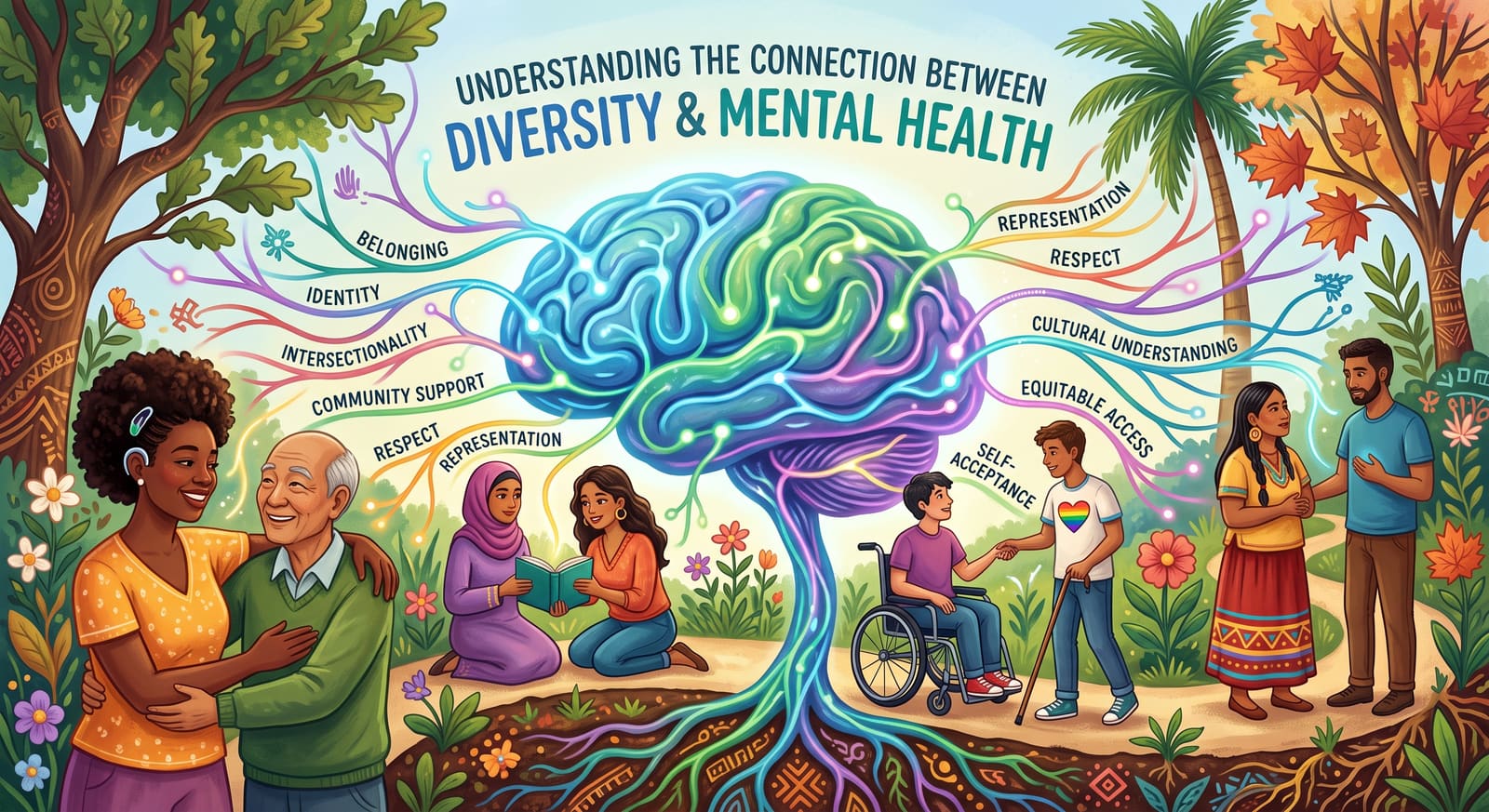
Topic Understanding
Mental health does not exist separately from a person's culture, identity, relationships, community, and everyday environment. Race and ethnicity, language, religion, gender, sexual orientation, disability, socioeconomic circumstances, immigration experiences, age, and other aspects of identity can shape how people experience stress, seek support, understand mental health, and interact with healthcare systems.
This does not mean that being part of a diverse community causes mental health problems. Rather, the circumstances surrounding a person's identity can influence mental health in different ways. Supportive relationships, cultural connection, belonging, and community can be protective, while discrimination, exclusion, financial hardship, isolation, or barriers to appropriate care can contribute to psychological distress.
Understanding the connection between diversity and mental health can help individuals, families, workplaces, and healthcare providers approach mental health with greater awareness and compassion.
Key Highlights
- Diversity itself is not a mental health risk. Mental health is influenced by many individual, social, economic, and environmental factors.
- Discrimination, racism, stigma, social exclusion, and unequal access to resources can negatively affect mental health.
- Culture can influence how people understand emotional distress, express symptoms, seek help, and communicate with healthcare professionals.
- Mental health care can be more responsive when therapists consider a person's cultural background, values, language, identity, and lived experiences.
- You do not have to choose between your cultural identity and your mental health. Therapy can provide a space to explore how different parts of your identity affect your well-being.
What Does Diversity Mean in Mental Health?
When people hear the word diversity, they may immediately think about race or ethnicity. Those are important aspects of diversity, but diversity is much broader.
It can include:
- Race and ethnicity
- Nationality and immigration background
- Language
- Religion or spirituality
- Gender identity
- Sexual orientation
- Disability and neurodivergence
- Age and generation
- Socioeconomic background
- Family structure
- Education and occupational background
- Geographic or community background
- Cultural traditions and values
People can also belong to several of these groups at the same time.
For example, a young adult may be navigating cultural expectations from their family while also adjusting to college, financial pressure, religious expectations, or questions about identity. An immigrant parent may be balancing responsibilities in a new country while trying to maintain familiar traditions at home.
These experiences are highly individual. Two people who share the same racial, cultural, or religious background can still have very different mental health experiences.
That is why good mental health care should focus on the person rather than assumptions about the group they belong to.
How Are Diversity and Mental Health Connected?
Mental health is influenced by factors at multiple levels, including individual experiences, family relationships, communities, and broader social conditions. The CDC identifies factors such as discrimination, limited access to housing or healthcare, economic opportunity, social isolation, and other social conditions as factors that can influence mental health.
The World Health Organization similarly explains that social and economic environments can shape mental health and that social inequalities are associated with differences in mental health risk.
This means that understanding diversity in mental health requires looking beyond symptoms alone.
Consider someone who reports feeling persistently stressed.
A therapist might explore sleep, relationships, work, school, and coping strategies. But the conversation may also need to consider whether that person is experiencing discrimination, language barriers, family expectations, financial insecurity, cultural conflict, or social isolation.
These factors do not automatically explain someone's mental health. They are simply part of the broader context that may be relevant.
Cultural Diversity Can Influence How Mental Health Is Understood
Culture can influence how people understand emotions and psychological distress.
For some individuals, discussing anxiety or depression openly may be encouraged. For others, mental health concerns may be viewed primarily through family, religious, spiritual, physical, or community perspectives.
Some people may feel comfortable using words such as "anxiety" or "depression." Others may describe the same experience through physical symptoms, exhaustion, difficulty sleeping, irritability, or feeling overwhelmed.
Neither approach automatically means that someone is more or less distressed.
Research has also highlighted that cultural and racial differences can influence how mental health concerns are expressed, recognized, assessed, and treated. NIMH research has specifically identified cultural background, race, ethnicity, and other factors as relevant considerations in understanding mental health and healthcare experiences.
This is one reason cultural awareness matters in mental health care.
How Discrimination Can Affect Mental Health
One of the clearest ways diversity and mental health can intersect is through discrimination.
Discrimination can occur in workplaces, schools, healthcare settings, neighborhoods, social environments, or personal relationships. It may involve race, ethnicity, religion, disability, gender, sexual orientation, socioeconomic status, immigration status, or other characteristics.
Experiencing discrimination does not mean someone will develop a mental health condition. However, repeated exposure to discrimination or exclusion can become an important source of stress.
The CDC identifies interpersonal and institutional discrimination among social factors that can increase the possibility of poor mental health.
The WHO's 2025 report on social determinants of health equity also describes structural discrimination as a factor associated with poorer mental health, increased stress, trauma-related symptoms, and barriers to healthcare and other resources.
What might this look like in everyday life?
A person might:
- Feel anxious before entering an environment where they have previously experienced discrimination.
- Constantly monitor how they speak or dress to avoid negative judgment.
- Feel pressure to represent an entire cultural group.
- Experience stress when family expectations conflict with broader social expectations.
- Avoid seeking professional help because they worry they will not be understood.
- Feel isolated after moving away from a familiar cultural or community environment.
These experiences deserve to be taken seriously without making assumptions about what the person should feel.
Mental Health and Inclusion
Inclusion is more than simply having diverse people present in the same environment.
A person can technically be included in a workplace, school, healthcare setting, or community while still feeling misunderstood, excluded, stereotyped, or unable to express themselves comfortably.
A more meaningful form of inclusion involves creating environments where people can participate without feeling that an important part of their identity must be hidden.
This can matter for mental health because supportive relationships and social connection are important protective factors, while discrimination, isolation, and lack of access to resources can contribute to poorer mental health.
For example, an inclusive workplace might make space for different communication styles, religious observances, accessibility needs, family responsibilities, and perspectives without expecting every employee to behave in exactly the same way.
In a therapy setting, inclusion may mean having the opportunity to talk about cultural identity, family expectations, religion, discrimination, or identity-related stress if those subjects are relevant to the client's concerns.
Why Culturally Responsive Mental Health Care Matters
A culturally responsive therapist does not need to know everything about every culture.
In fact, assuming that a therapist already understands someone's culture perfectly can create problems.
Instead, culturally responsive care involves curiosity, self-awareness, respect, and a willingness to understand the client's individual experience.
The therapist may ask questions such as:
- "How does your family understand what you're experiencing?"
- "Are there cultural or religious beliefs that are important for us to consider?"
- "Have you experienced discrimination related to this situation?"
- "What does getting better look like to you?"
- "Are there expectations from your family or community that are affecting this decision?"
- "Is there language or terminology that feels more comfortable for you?"
These questions help move the conversation away from assumptions.
The American Psychological Association describes cultural responsiveness as involving ongoing attention to how therapist and client cultural characteristics and values can affect the therapeutic relationship, assessment, and treatment.
Does Cultural Adaptation Make Therapy More Effective?
Research suggests that culturally adapted psychological interventions can be helpful for some populations, although the evidence is not uniform across every condition, community, or type of adaptation.
A 2021 systematic review and meta-analysis found evidence supporting culturally adapted psychotherapies for depression, while noting limitations in the available research.
Another systematic review found that adapted psychological interventions for ethnic minority populations were associated with symptom reduction compared with non-adapted active treatments, although the studies used different types of adaptations and further research is needed.
Research has examined adaptations involving factors such as:
- Language
- Examples and metaphors
- Family involvement
- Cultural values
- Treatment setting
- Communication style
- Understanding of symptoms
- Therapist-client cultural considerations
The important point is that cultural responsiveness does not mean giving everyone from the same background exactly the same type of therapy.
It means considering whether a person's cultural and social context is relevant to their goals and experience.
Diversity Does Not Mean Everyone From a Group Has the Same Mental Health Experience
One common misconception is that people from the same cultural or demographic group will have the same mental health needs.
They do not.
For example, two people from the same country may differ significantly in:
- Religious beliefs
- Family structure
- Financial circumstances
- Immigration history
- Sexual orientation
- Gender identity
- Disability status
- Education
- Language preference
- Personal experiences with discrimination
- Attitudes toward therapy
This is why labels can provide useful context but should never replace listening to the individual.
A culturally aware therapist should be careful not to turn cultural knowledge into stereotypes.
Diversity and Mental Health Care Access
The connection between diversity and mental health is also visible in access to care.
Someone may recognize that they need support but face barriers that make seeking therapy difficult.
Possible barriers include:
- Cost
- Insurance limitations
- Transportation
- Lack of nearby providers
- Language differences
- Limited mental health information
- Stigma
- Distrust based on previous experiences
- Family or community attitudes toward therapy
- Difficulty finding a provider who understands their background
- Concerns about confidentiality
NIMH has documented racial and ethnic disparities in mental health service use and has emphasized the importance of understanding differences in access and quality of care. More recent NIMH research continues to examine disparities in diagnosis, treatment, and healthcare access among racial and ethnic groups.
These differences should not be interpreted as evidence that one cultural group "cares more" about mental health than another. Access and utilization are influenced by many social, economic, cultural, and healthcare-system factors.
What Can Someone Do If Cultural Differences Are Affecting Their Mental Health?
If cultural or identity-related experiences are contributing to stress, you do not necessarily need to have a clear explanation before seeking support.
You can begin by noticing what is happening.
1. Identify the situation
Ask yourself:
"What is happening in my environment that is making this difficult?"
The answer might involve family conflict, workplace discrimination, social isolation, cultural expectations, identity questions, or another issue.
2. Separate expectations from personal values
Sometimes distress develops when personal goals and expectations from family, community, or society feel difficult to reconcile.
Consider:
- What do I genuinely value?
- What expectations am I carrying?
- Which expectations feel supportive?
- Which ones feel overwhelming?
- What would I choose if I felt less pressure?
This does not mean rejecting your culture or family. It means understanding your own relationship with those expectations.
3. Find supportive connections
Connection can come from family, friends, community organizations, faith communities, cultural groups, mentors, or other trusted people.
You do not need to navigate identity-related stress completely alone.
4. Look for culturally responsive professional support
If you decide to work with a therapist, it is reasonable to ask questions about cultural responsiveness.
For example:
"Are you comfortable discussing cultural or religious differences in therapy?"
"How do you approach situations where a client's family values differ from their personal goals?"
"Can we talk about experiences of discrimination if they are affecting my mental health?"
These questions can help you determine whether the therapist feels like a good fit.
When Can Therapy Be Helpful?
Therapy may be worth considering when cultural, identity, or social experiences are contributing to persistent emotional distress or interfering with daily life.
You might consider professional support if you are experiencing ongoing:
- Anxiety or excessive worry
- Low mood
- Difficulty coping with stress
- Family or relationship conflict
- Loneliness or isolation
- Identity-related distress
- Workplace or school stress
- Grief
- Trauma-related concerns
- Difficulty making important life decisions
- Problems with sleep or daily functioning
You do not need to wait until a problem becomes overwhelming to talk with a mental health professional.
Therapy can also be useful when you simply want a confidential place to understand yourself better and explore difficult experiences.
What Can You Talk About in Therapy?
There is no single correct way to discuss diversity in therapy.
Depending on your situation, you might talk about:
- Your cultural identity
- Family expectations
- Immigration or relocation
- Religion or spirituality
- Experiences of racism or discrimination
- Relationships across cultures
- Parenting differences
- Workplace experiences
- Gender or sexual identity
- Language and communication
- Feeling caught between cultures
- Belonging and community
- Self-esteem and identity
- Conflict between personal values and external expectations
A therapist's role is not to tell you which culture, identity, or set of values is "right."
The goal is to understand your experience and help you work toward healthier, meaningful goals.
How Riaz Counseling Approaches Diversity and Mental Health
For people in Houston and throughout Texas, finding a counseling practice that recognizes individual differences can be an important part of choosing care.
Riaz Counseling lists Minority Issues and LGBTQIA+ Issues among its areas of specialization, along with Depression & Anxiety, Life Transitions, Grief & Loss, Self-Esteem & Identity, and other areas of mental health support.
The practice provides individual therapy as a collaborative process in which clients can discuss concerns, establish goals, and work with a therapist in a confidential setting.
Riaz Counseling has offices in the Houston Galleria, Sugar Land, and The Woodlands, as well as online therapy for people living in Texas.
Explore Riaz Counseling's Specializations
Learn About Individual Therapy at Riaz Counseling
View Riaz Counseling Locations
Questions to Ask When Choosing a Therapist
Finding the right therapist can take some consideration. You may want to ask:
- Do I feel comfortable discussing my cultural or personal background with this therapist?
- Does the therapist listen without making assumptions about my identity?
- Can I discuss discrimination or identity-related stress if it becomes relevant?
- Does the therapist respect my values while helping me explore my own goals?
- Do I feel heard and understood during conversations?
- Does the therapist's approach fit the type of support I am looking for?
You do not have to find someone who shares every aspect of your background.
For many people, what matters most is finding a professional who listens carefully, respects differences, and is willing to understand the individual rather than relying on assumptions.
Common Misconceptions About Diversity and Mental Health
"Diversity causes mental health problems."
Not necessarily. Diversity itself is not a mental illness or a cause of mental illness. Mental health is influenced by a wide range of biological, psychological, social, and environmental factors.
"People from the same culture should respond to stress in the same way."
No. Cultural background can provide context, but individual experiences vary significantly.
"A culturally responsive therapist must share my identity."
Not necessarily. Shared identity can be meaningful for some clients, but cultural responsiveness also involves listening, humility, self-awareness, and respect.
"Talking about culture will make therapy more complicated."
It can actually provide useful context when culture is relevant to what a person is experiencing. The client should decide which parts of their identity are important to discuss.
"Mental health treatment should be exactly the same for everyone."
Evidence-based principles can be shared across populations, but how treatment is communicated and applied may need to account for the individual's circumstances, values, language, and cultural context. Research on culturally adapted interventions supports considering these factors while also recognizing that not every adaptation works equally well in every setting.
Frequently Asked Questions
How does diversity affect mental health?
Diversity itself does not cause poor mental health. However, a person's social and cultural circumstances can influence exposure to stress, discrimination, isolation, economic barriers, social support, and access to healthcare. These factors can affect mental health and well-being.
Why is cultural diversity important in mental health care?
Cultural background can influence how people understand mental health, communicate distress, make decisions about treatment, and interact with healthcare providers. Considering these factors can help make care more responsive to the individual. Research supports the use of culturally adapted psychological interventions in some populations, although results vary across studies and circumstances.
What is culturally responsive therapy?
Culturally responsive therapy considers the client's cultural background, values, identity, language, social environment, and lived experiences when these factors are relevant to their mental health goals. It does not mean assuming that everyone from a particular group thinks or behaves the same way.
Can discrimination affect mental health?
Yes. Research and public-health guidance identify interpersonal and institutional discrimination as social factors that can contribute to poorer mental health. Discrimination can also create barriers to healthcare and other resources.
Should I find a therapist who shares my cultural background?
Not necessarily. Some people prefer a therapist who shares an important part of their identity, while others prioritize listening skills, experience with a particular concern, therapeutic approach, or overall comfort. The most important consideration is whether the therapist can understand and respectfully work with your individual needs.
Can therapy help with cultural or identity-related stress?
Therapy may provide a confidential space to explore identity, family expectations, discrimination, relationships, cultural conflict, or other sources of distress. A qualified mental health professional can help determine whether therapy is appropriate for your particular situation.
What if my family has different views about mental health?
Family beliefs can strongly influence how people understand therapy and emotional difficulties. A therapist can help you explore those beliefs, understand your own values, communicate more effectively, and decide what kind of support fits your circumstances.
Where can I find culturally responsive therapy in Houston?
People seeking counseling in the Houston area can explore providers based on their concerns, preferences, therapeutic approach, and experience. Riaz Counseling offers individual therapy and lists Minority Issues and LGBTQIA+ Issues among its areas of specialization, with offices in the Houston area and online therapy available to Texas residents.
Conclusion
The connection between diversity and mental health is complex because people are influenced by much more than a single aspect of identity.
Culture, race, ethnicity, religion, gender, sexuality, disability, socioeconomic circumstances, immigration experiences, relationships, and community can all be relevant to how someone experiences the world. At the same time, these identities should never be used to make assumptions about an individual's mental health.
A more helpful approach is to ask:
What has this person experienced, what matters to them, what support do they have, and what do they need right now?
When mental health care makes room for those questions, people have greater opportunity to be understood as whole individuals rather than reduced to a label or demographic category.
If cultural, identity-related, relationship, or social experiences are affecting your emotional well-being, speaking with a qualified mental health professional can be one way to explore what is happening and identify appropriate support.
Mental Health Disclaimer
This article is intended for general educational purposes and is not a substitute for individualized medical or mental health advice, diagnosis, or treatment. Mental health experiences vary from person to person. If you are experiencing significant or worsening symptoms, consider speaking with a qualified healthcare or mental health professional. If you are in immediate danger or experiencing a mental health emergency, contact local emergency services or an appropriate crisis service.
Sources Used
National Institute of Mental Health (NIMH): mental illness statistics and research on racial and ethnic disparities in diagnosis and mental health treatment.
Centers for Disease Control and Prevention (CDC): mental health risk and protective factors and social determinants of health.
World Health Organization (WHO): social determinants of mental health and health equity.
PubMed systematic reviews and meta-analyses examining culturally adapted psychological interventions.
American Psychological Association (APA): culturally responsive psychotherapy and cultural humility.
Riaz Counseling: current services, specializations, individual therapy, locations, and practice information.
If you feel that you or someone you know may benefit from therapy, please reach out to our office for a FREE 15-minute consultation: LINK.