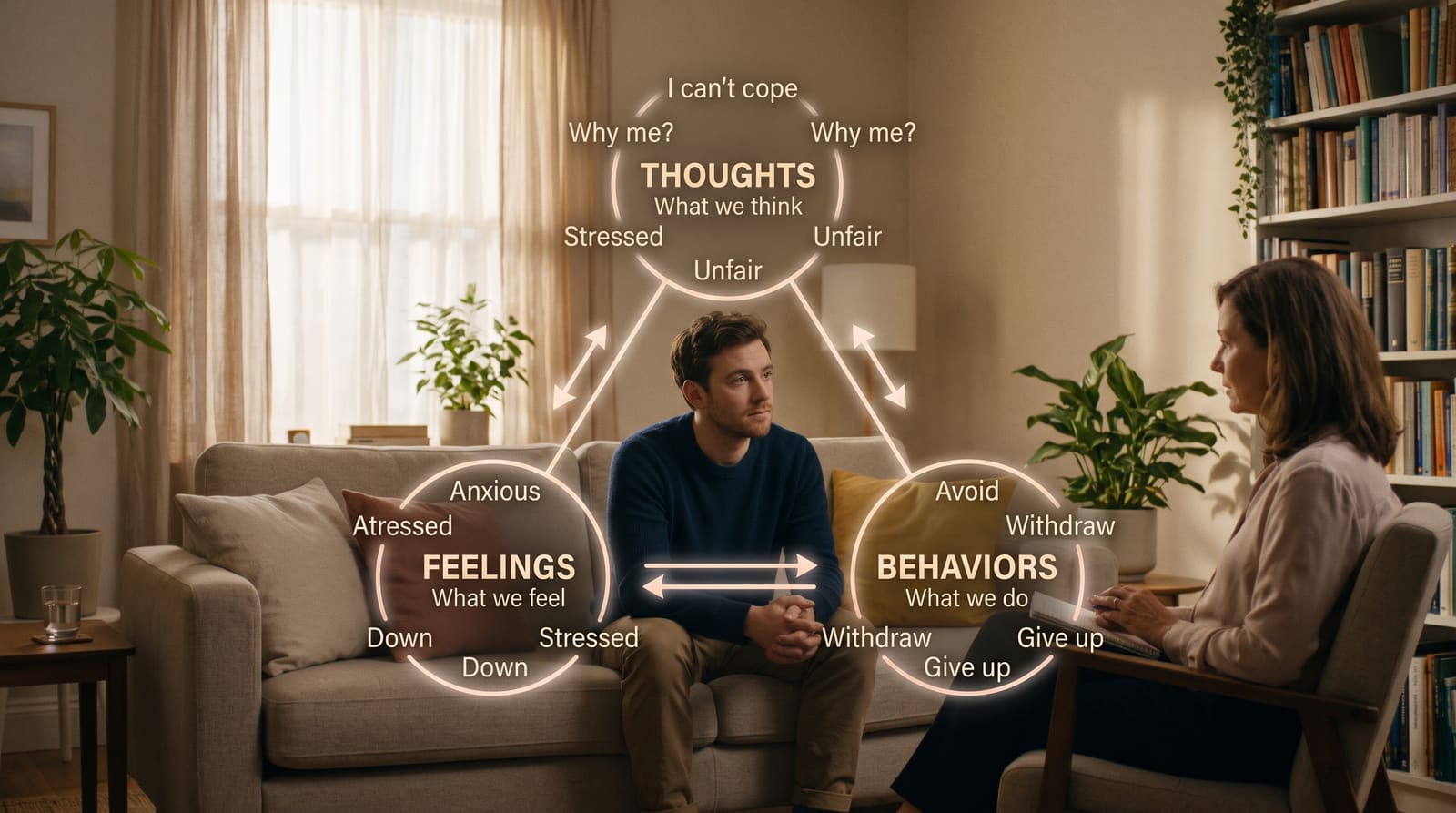
Topic Understanding
Cognitive Behavioral Therapy (CBT) is an evidence-based form of psychotherapy that helps people understand how their thoughts, feelings, and behaviors influence one another. It focuses on identifying unhelpful patterns and developing practical ways to respond to difficult situations.
CBT is commonly used to address concerns such as anxiety, depression, stress, and certain other mental health conditions. It is often structured around specific goals, with skills that people can practice both during therapy sessions and in everyday life. However, CBT is not a one-size-fits-all approach, and its suitability depends on a person's needs and circumstances.
This article explains what CBT involves, how a typical session works, which techniques a therapist may use, what benefits and limitations to understand, and how to explore CBT therapy through Riaz Counseling in the Houston area.
Key Highlights
- CBT explores the connection between thoughts, emotions, physical responses, and behaviors.
- It helps people recognize unhelpful thinking and behavior patterns and practice more constructive responses.
- CBT techniques may include thought records, cognitive restructuring, behavioral activation, problem-solving, and gradual exposure.
- Research supports CBT for several mental health concerns, including depression and anxiety disorders, although outcomes vary.
- A therapist can help determine whether CBT is an appropriate approach or whether another form of support may be a better fit.
What Is Cognitive Behavioral Therapy (CBT)?
Cognitive Behavioral Therapy is a structured form of talk therapy that focuses on the relationship between thoughts, emotions, and behaviors.
The basic idea behind CBT is that the way people interpret a situation can influence how they feel and respond to it.
For example, imagine a person who receives a short message from a friend:
"Can we talk later?"
The person might immediately think:
"I must have done something wrong."
That thought could lead to anxiety, worry, or embarrassment. They might avoid responding, repeatedly check their phone, or spend the rest of the day imagining a negative conversation.
But there may be other explanations. The friend could simply be busy or have something important to discuss.
CBT helps people recognize these automatic interpretations, examine whether they are supported by evidence, and consider alternative ways of understanding a situation.
It does not teach people to ignore difficult emotions or pretend that everything is positive. Instead, it encourages a more balanced understanding of experiences and helps people consider how their responses affect their well-being.
The Association for Behavioral and Cognitive Therapies describes CBT as an approach that addresses the connections among thoughts, emotions, and behaviors. It also emphasizes collaboration, practical skills, and active participation in therapy.
How Does Cognitive Behavioral Therapy Work?
CBT works by helping people identify patterns that may contribute to emotional distress and practice different ways of thinking and behaving.
A therapist and client work together to understand what happens in difficult situations. They may explore the thoughts that arise, the emotions and physical sensations that follow, and the behaviors that keep the problem going.
A simplified example looks like this:
Situation: A student receives a lower grade than expected.
Thought: "I'm not smart enough to succeed."
Emotion: Disappointment, anxiety, or shame.
Behavior: Avoiding assignments, procrastinating, or giving up on studying.
Possible result: Academic difficulties increase, reinforcing the original belief.
CBT helps the student examine the thought, identify what evidence supports or challenges it, and develop a more balanced response.
For example:
"I didn't get the grade I wanted, but that doesn't mean I cannot succeed. I can review what went wrong and change how I prepare for the next exam."
The situation has not changed, but the person's interpretation and possible response have.
The Connection Between Thoughts, Feelings, and Behaviors
CBT recognizes that thoughts, feelings, and behaviors influence one another.
| Component | What it means | Example |
|---|---|---|
| Thoughts | Interpretations or beliefs about a situation | "Everyone will judge me." |
| Feelings | Emotional responses to the situation | Anxiety or embarrassment |
| Physical responses | Bodily sensations connected with emotions | Tension, sweating, or a racing heart |
| Behaviors | Actions or reactions | Avoiding a meeting or social event |
These components can form repeating patterns.
For instance, someone who feels anxious about social situations may avoid gatherings. Avoidance might provide temporary relief, but it can also prevent the person from learning that some social situations are manageable.
A CBT therapist may help the person understand this cycle and explore gradual, appropriate ways to respond differently.
What Mental Health Concerns Can CBT Help With?
CBT is used in treatment for a range of mental health conditions. The approach and techniques depend on the concern being addressed, the person's circumstances, and the therapist's clinical judgment.
The National Health Service and American Psychological Association identify CBT as an established psychological treatment for several concerns, including depression and anxiety-related conditions.
Examples include:
1. Anxiety Disorders
Anxiety can involve persistent worry, fear, physical tension, and avoidance of situations that feel uncomfortable or threatening.
CBT may help people:
- Recognize anxious thought patterns.
- Examine assumptions about possible outcomes.
- Understand how avoidance affects anxiety.
- Develop coping and problem-solving skills.
- Practice approaching difficult situations gradually when appropriate.
For example, someone who worries excessively about making mistakes at work may assume that one imperfect presentation will damage their entire career.
A therapist may help them examine that prediction, consider more realistic possibilities, and practice responding to workplace challenges.
2. Depression
Depression can affect mood, motivation, concentration, sleep, and interest in activities.
Some people experiencing depression develop patterns of negative self-talk or withdraw from activities that previously gave them enjoyment or a sense of accomplishment.
CBT may help by:
- Identifying negative beliefs about oneself or the future.
- Examining thoughts that contribute to hopelessness.
- Developing manageable daily goals.
- Reintroducing meaningful activities.
- Practicing more balanced ways of interpreting setbacks.
Behavioral activation, an approach often used within CBT, focuses on gradually increasing engagement in meaningful or rewarding activities.
This can be especially useful when low motivation makes everyday responsibilities feel difficult.
3. Stress and Work-Related Challenges
Stress can affect how people think, communicate, and make decisions.
Someone experiencing workplace stress might think:
"If I make one mistake, my manager will think I'm incompetent."
This belief may increase pressure and make it harder to concentrate.
CBT can help people recognize unhelpful assumptions, develop practical problem-solving strategies, and respond to challenging situations more thoughtfully.
4. Social Anxiety
Social anxiety may involve intense fear of embarrassment, criticism, or negative judgment.
A person might avoid speaking in meetings, attending social gatherings, or starting conversations because they expect something uncomfortable to happen.
CBT may help them identify the thoughts behind those fears and gradually practice new ways of responding.
For some people, treatment may involve exposure-based exercises designed with a therapist. These exercises help people approach feared situations in a planned and manageable way.
5. Obsessive-Compulsive Disorder (OCD)
OCD can involve unwanted, recurring thoughts and repetitive behaviors or mental rituals that a person feels compelled to perform.
A specialized CBT approach called Exposure and Response Prevention (ERP) is commonly used for OCD.
ERP involves gradually facing situations that trigger obsessions while learning to resist compulsive responses, with appropriate professional guidance.
Not every general CBT session includes ERP. People seeking treatment for OCD should look for a clinician with appropriate training and experience in treating the condition.
6. Trauma-Related Concerns
Some CBT-based treatments are designed to help people experiencing trauma-related symptoms, including PTSD.
These approaches may address distressing beliefs, avoidance, and emotional responses connected with traumatic experiences.
Trauma treatment should be individualized. A therapist can help determine whether a particular CBT approach is suitable and whether another trauma-focused treatment may be more appropriate.
Common CBT Techniques Therapists May Use
CBT is not one single exercise or worksheet. It includes different techniques selected according to the person's goals and concerns.
Here are several common examples.
1. Cognitive Restructuring
Cognitive restructuring involves identifying unhelpful thoughts and examining whether they are accurate, balanced, or supported by available evidence.
For example:
Initial thought: "I always disappoint people."
A therapist might encourage questions such as:
- What happened that led me to think this?
- Is "always" an accurate description?
- Are there examples that do not fit this belief?
- Am I judging myself more harshly than I would judge someone else?
- What is a more balanced way to describe the situation?
A possible alternative might be:
"I made a mistake in this situation, but that does not mean I disappoint everyone."
The purpose is not to replace every negative thought with a positive one. It is to develop a more realistic and helpful perspective.
2. Thought Records
A thought record is a tool that helps people notice the relationship between situations, thoughts, emotions, and responses.
A simple example:
| Step | Example |
|---|---|
| Situation | A coworker does not respond to a message. |
| Automatic thought | "They are upset with me." |
| Emotion | Anxiety |
| Evidence supporting the thought | We had a disagreement yesterday. |
| Evidence against the thought | They are often busy and have not responded to other messages quickly either. |
| Balanced thought | "I don't know why they haven't responded yet. I can wait or follow up appropriately." |
A thought record can help slow down automatic reactions and create space for a more considered response.
3. Behavioral Activation
Behavioral activation focuses on increasing participation in meaningful activities, particularly when low mood or withdrawal makes it difficult to stay engaged.
For example, someone experiencing depression might stop exercising, meeting friends, or pursuing hobbies.
Rather than expecting motivation to return immediately, they may work with a therapist to plan small, manageable activities.
This could include:
- Taking a short walk.
- Preparing a meal.
- Calling a supportive friend.
- Completing one manageable household task.
- Returning to a favorite hobby for a few minutes.
The aim is to gradually rebuild activity and routine without creating unrealistic expectations.
4. Gradual Exposure
Exposure techniques may be used when avoidance is maintaining anxiety or fear.
A person who experiences social anxiety, for example, might work with a therapist to develop a gradual plan for approaching social situations.
The plan could begin with a manageable activity and progress according to the person's needs and readiness.
Exposure should be appropriately planned, especially when addressing trauma, OCD, phobias, or severe anxiety. It is not about forcing someone into overwhelming situations.
5. Problem-Solving
Sometimes distress is connected to a practical challenge that feels difficult to manage.
CBT may involve breaking a problem into smaller steps.
For example, a student who feels overwhelmed by several assignments might work through the following process:
- Identify everything that needs to be completed.
- Determine which tasks are most urgent.
- Break larger assignments into smaller steps.
- Create a realistic schedule.
- Review what worked and adjust the plan.
This approach can make problems feel more manageable and help reduce avoidance.
6. Relaxation and Coping Skills
Depending on the treatment plan, a therapist may introduce strategies for managing physical tension and emotional distress.
These might include breathing exercises, grounding techniques, or structured relaxation practices.
These skills can support emotional regulation, although they are not substitutes for addressing the underlying patterns contributing to a person's difficulties.
What Are the Benefits of CBT?
The benefits of CBT depend on the condition being treated, the person's goals, and the way therapy is delivered.
Some potential benefits include:
Greater Awareness of Thinking Patterns
CBT can help people recognize automatic thoughts and beliefs that may influence their emotional responses.
For example, someone might begin noticing that they regularly interpret neutral feedback as personal criticism.
Recognizing this pattern can create an opportunity to respond differently.
Practical Skills for Everyday Situations
CBT often focuses on skills that can be practiced outside the therapy room.
A person may learn how to challenge unhelpful thoughts, approach avoided situations, organize responsibilities, or respond to stress.
Improved Coping and Problem-Solving
CBT can help people develop structured ways to approach challenges instead of reacting automatically or feeling overwhelmed.
A Goal-Oriented Approach
Many CBT treatments involve specific goals that the therapist and client establish together.
Goals might include managing anxiety in social situations, reducing avoidance, improving daily routines, or responding differently to negative self-talk.
Skills That Can Continue After Therapy
People can continue using CBT strategies after their formal treatment ends.
However, maintaining progress may require ongoing practice, additional support, or further treatment depending on the person's circumstances.
What Does Research Say About CBT?
Research supports CBT as an effective treatment for several mental health conditions.
A large 2025 series of meta-analyses examined 375 trials involving nearly 33,000 adults. The researchers found that CBT was associated with reductions in symptoms across multiple mental health conditions, including depression, anxiety disorders, PTSD, and OCD.
The size of the observed effects varied by condition and comparison group. The researchers also noted limitations in the quality of the available evidence. This means the findings support CBT's usefulness but do not guarantee that every person will experience the same results.
A separate systematic review and network meta-analysis of 107 studies involving more than 15,000 participants found that different forms of CBT were associated with reductions in depression symptoms. The review also examined how results varied across treatment approaches and follow-up periods.
The overall evidence supports CBT as an important treatment option, but treatment decisions should still be individualized.
What Happens During a CBT Therapy Session?
A CBT session is usually collaborative and focused on concerns that matter to the client.
The exact structure depends on the therapist, the treatment approach, and the person's goals.
1. Understanding Your Concerns
The therapist may ask about what brought you to therapy, what you have been experiencing, and how those experiences affect your daily life.
You may discuss:
- Current stressors.
- Emotional or behavioral patterns.
- Relationships and work or school responsibilities.
- Previous experiences with therapy.
- What you would like to change.
You do not need to arrive with everything figured out. Part of the process is understanding your concerns together.
2. Establishing Goals
The therapist and client may identify specific goals for treatment.
For example, someone experiencing anxiety might want to:
- Feel more comfortable speaking in meetings.
- Reduce avoidance of social activities.
- Manage worry before important events.
- Develop healthier responses to uncertainty.
Goals can be adjusted as therapy progresses.
3. Exploring Thoughts and Behaviors
You may discuss a recent situation that caused emotional distress.
The therapist can help you explore what you were thinking, how you felt, and what you did in response.
This process can reveal patterns that are difficult to recognize when you are experiencing them.
4. Practicing CBT Techniques
Depending on your needs, the therapist may introduce a thought record, cognitive restructuring exercise, behavioral activation plan, or another CBT technique.
You may practice the skill during the session and discuss how to apply it outside therapy.
5. Reviewing Progress
Future sessions may include reviewing what you noticed or practiced between appointments.
If a technique was difficult or did not seem helpful, the therapist can work with you to understand why and consider adjustments.
Does CBT Involve Homework?
Often, yes.
CBT may include activities to practice between sessions. These are sometimes called homework or between-session exercises.
They are not school assignments or tests. They are opportunities to apply what you discuss in therapy to everyday situations.
Examples may include:
- Recording recurring thoughts.
- Practicing a coping strategy.
- Tracking mood or behavior patterns.
- Scheduling meaningful activities.
- Trying a manageable step toward a personal goal.
- Reflecting on a challenging situation.
The purpose is to help make therapy skills useful outside the session.
If an exercise feels overwhelming or unrealistic, tell your therapist. The activity can be adjusted to better fit your needs.
How Long Does CBT Take?
There is no single timeline for CBT.
Some treatment plans are relatively brief, while others involve more sessions or longer-term support.
The length of therapy can depend on:
- The concern being addressed.
- The severity and duration of symptoms.
- Whether more than one mental health concern is present.
- Personal goals.
- Progress during treatment.
- The specific CBT approach being used.
The NHS notes that the number of CBT sessions varies depending on the problem being treated. The Association for Behavioral and Cognitive Therapies also describes CBT as often being short-term, while emphasizing that treatment length depends on the individual and their needs.
A therapist can discuss a realistic treatment plan after learning more about your circumstances.
Is CBT Right for Everyone?
No. Although CBT can be helpful for many people, it is not the right approach for every concern or every individual.
Some people may prefer a different therapeutic approach. Others may benefit from a combination of approaches.
For example, a person exploring grief, relationship concerns, trauma, or long-standing emotional difficulties may have needs that require a broader or different therapeutic framework.
A therapist can help you understand the available options and discuss which approach may be appropriate.
It is also important to remember that CBT is not simply about thinking positively. It does not suggest that people are responsible for every difficult experience because of their thoughts.
Life circumstances, physical health, relationships, trauma, discrimination, financial pressures, and other factors can all influence mental health. Good therapy considers the person and their environment, not just their thinking patterns.
CBT Compared With Other Types of Therapy
People researching therapy may encounter several approaches that sound similar.
Although some approaches share principles, they are not interchangeable.
| Therapy approach | Main focus |
|---|---|
| Cognitive Behavioral Therapy (CBT) | Connections among thoughts, feelings, and behaviors |
| Dialectical Behavior Therapy (DBT) | Emotional regulation, distress tolerance, mindfulness, and interpersonal effectiveness |
| Acceptance and Commitment Therapy (ACT) | Psychological flexibility, acceptance, and action guided by personal values |
| Eye Movement Desensitization and Reprocessing (EMDR) | A structured approach used primarily in trauma-focused treatment |
| Family Therapy | Relationships, communication, and patterns within a family system |
Some approaches have overlapping concepts or historical connections. However, each has its own methods, treatment goals, and clinical applications.
The best choice depends on the person's needs and the therapist's training and experience.
When Should You Consider Speaking With a CBT Therapist?
You may want to consider professional support when emotional or behavioral patterns begin interfering with everyday life.
For example:
- You regularly feel overwhelmed by worry.
- You avoid situations because of fear or anxiety.
- Negative thoughts are affecting your confidence.
- You struggle to manage stress at work or school.
- Low mood is making daily responsibilities difficult.
- You repeatedly respond to situations in ways you would like to change.
- You want practical tools for managing emotional challenges.
You do not need to wait until a problem becomes severe before seeking support.
If symptoms persist, worsen, or interfere with your ability to function, a qualified mental health professional can help you understand what may be happening and discuss appropriate options.
If you are experiencing a mental health emergency or immediate danger, seek urgent assistance rather than relying on an article.
Finding Cognitive Behavioral Therapy in Houston
If you are looking for CBT therapy in Houston, it can help to consider more than the type of therapy listed on a provider's website.
When evaluating a therapist, consider asking:
- Do you have experience using CBT for the concern I want to address?
- What does your approach to CBT typically involve?
- How will we establish treatment goals?
- Will I be asked to practice techniques between sessions?
- How will we review progress?
- What other approaches might be appropriate if CBT is not the right fit?
- Do you offer in-person or online sessions?
It is also reasonable to ask about the therapist's professional credentials, training, experience, fees, and scheduling options before beginning treatment.
A good therapeutic fit matters. You should feel comfortable asking questions and discussing whether the approach is meeting your needs.
How Riaz Counseling Approaches CBT and Individual Therapy
Riaz Counseling offers individual therapy for people navigating concerns such as anxiety, depression, trauma, stress, life transitions, and personal growth.
The practice lists Cognitive Behavioral Therapy (CBT) among its therapeutic approaches, alongside other modalities such as Dialectical Behavior Therapy (DBT), EMDR, and Internal Family Systems (IFS).
Individual therapy is described as a collaborative process involving an initial consultation, goal-setting, and practical tools that clients may use between sessions.
Riaz Counseling currently has in-person offices in:
- Houston Galleria
- Sugar Land
- The Woodlands
Online therapy is also available for people throughout Texas.
If you are considering CBT, you can contact Riaz Counseling to discuss your concerns, ask about the therapists' experience with this approach, and explore whether individual therapy may be a good fit.
The practice offers a free 15-minute consultation to help prospective clients explore fit before beginning therapy.
Questions to Ask Before Starting CBT
Starting therapy can feel unfamiliar, especially if you have never worked with a therapist before.
Preparing a few questions can help you feel more comfortable and understand what to expect.
Consider asking:
- How do you decide whether CBT is appropriate for a client?
- What might the first few sessions involve?
- How do you help clients identify their treatment goals?
- What types of exercises might I practice between sessions?
- How do you measure progress?
- What happens if I find a particular technique uncomfortable or unhelpful?
- Are there other therapeutic approaches that might complement CBT?
You do not need to ask every question at once. The purpose is to make sure you understand the process and feel involved in decisions about your care.
Frequently Asked Questions About Cognitive Behavioral Therapy
What does CBT stand for in mental health?
CBT stands for Cognitive Behavioral Therapy. It is a form of psychotherapy that explores how thoughts, feelings, and behaviors influence one another and helps people develop more helpful ways of responding to difficult situations.
What is the main goal of CBT?
The main goal of CBT is to help people recognize and change unhelpful thinking and behavior patterns that contribute to emotional distress. It also teaches practical skills for managing challenges and working toward personal goals.
Does CBT actually work?
Research supports CBT for several mental health conditions, including depression and anxiety disorders. However, results vary depending on the condition, treatment approach, and individual circumstances. No therapy guarantees a particular outcome.
What are common CBT techniques?
Common techniques include cognitive restructuring, thought records, behavioral activation, problem-solving, gradual exposure, and coping strategies. A therapist selects techniques based on the person's needs and treatment goals.
How many CBT sessions do people usually need?
The number of sessions varies. Some CBT treatment plans are relatively brief, while others require more time. The duration depends on the concern being treated, its complexity, the person's goals, and progress during therapy.
Can CBT help with anxiety and depression?
Yes. CBT is an established treatment option for many anxiety disorders and depression. It may help people recognize unhelpful thought patterns, reduce avoidance, develop coping strategies, and re-engage with meaningful activities.
Is CBT the same as behavioral therapy?
No. Behavioral therapy focuses primarily on learned behaviors and how they can be changed. CBT combines cognitive and behavioral principles by addressing both thinking patterns and behaviors. The approaches are related, but they are not identical.
Can I do CBT online?
Yes. CBT can be delivered through online therapy as well as in-person sessions. The appropriate format depends on the person's needs, the therapist's services, and the treatment approach. A qualified professional can help determine whether online CBT is suitable.
Conclusion
Cognitive Behavioral Therapy is a practical, collaborative approach that helps people understand the connections between their thoughts, feelings, and behaviors.
By recognizing unhelpful patterns and practicing new responses, people may develop useful skills for managing anxiety, depression, stress, and other challenges.
CBT is not about forcing positive thoughts or ignoring difficult experiences. It is about developing a more balanced understanding of situations and finding ways to respond that support your well-being.
If you are considering therapy, you do not have to know which approach is right for you before reaching out. A qualified therapist can help you explore your concerns, understand your options, and decide on a treatment approach that fits your needs.
Riaz Counseling offers individual therapy and lists CBT among its therapeutic approaches. If you are in Houston or elsewhere in Texas, consider reaching out to learn more about available support.
Mental Health Disclaimer
This article is for general educational purposes only. It does not provide a diagnosis, replace professional mental health care, or establish that CBT is appropriate for a particular person. Treatment decisions should be made with a qualified health professional who understands your individual circumstances.
If you or someone you know is experiencing a mental health crisis or thoughts of suicide, call or text 988 in the United States for the Suicide & Crisis Lifeline. If there is immediate danger, call 911 or go to the nearest emergency department.
Suggested Internal Links
- Individual Therapy at Riaz Counseling — explains individual therapy, available approaches, and what clients can expect.
- Riaz Counseling Specializations — relevant for readers exploring anxiety, depression, stress, and other areas of support.
- Riaz Counseling About Page — provides information about the practice, therapeutic modalities, and locations.
- Riaz Counseling Locations — helps readers explore in-person offices and online therapy options.
Sources Used
Association for Behavioral and Cognitive Therapies (ABCT) — Overview of CBT, its core principles, collaborative approach, and common treatment features.
National Institute of Mental Health (NIMH) — Psychotherapies and the role of CBT in identifying unhelpful thinking patterns and developing coping strategies.
American Psychological Association (APA) — Overview of CBT and its use for a range of mental health concerns.
NHS — Explanation of CBT, common uses, treatment sessions, and what to expect.
Journal of the American Medical Association / PubMed Central (2025) — Unified series of meta-analyses examining CBT across mental health conditions.
PubMed (2022) — Systematic review and network meta-analysis examining CBT approaches for depression.
Riaz Counseling — Individual Therapy, About, and Specializations pages for current service and practice information.
If you feel that you or someone you know may benefit from therapy, please reach out to our office for a FREE 15-minute consultation: LINK.