Introduction
Choosing a therapist is a personal decision. For some people, meeting with a mental health professional in the same room feels more comfortable, focused, and natural than talking through a screen. Others prefer the convenience of online sessions. Neither option is automatically right for everyone—the best format is often the one that helps you feel comfortable, engaged, and able to participate in therapy.
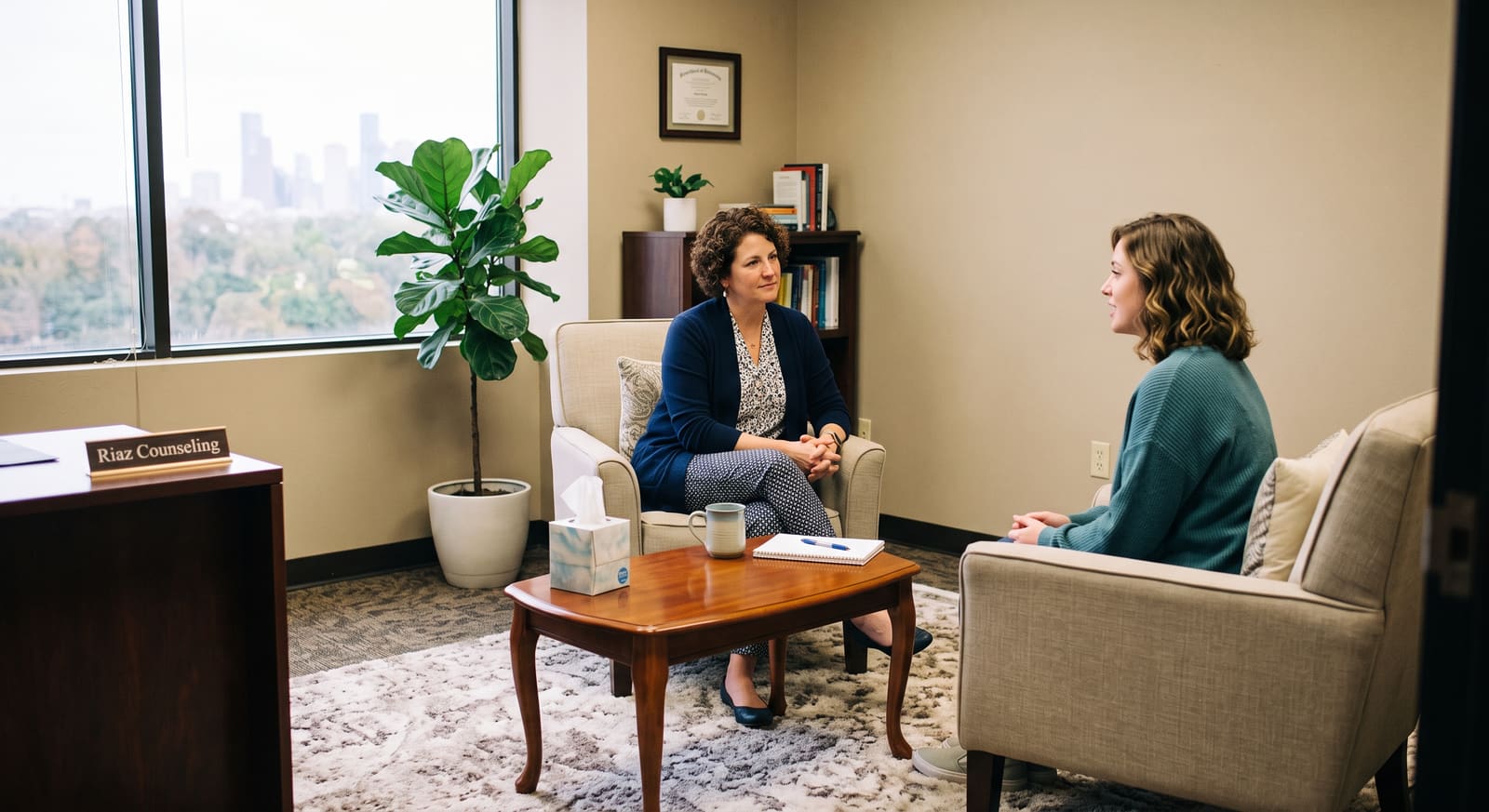
For people looking for in person therapy Riaz Counseling, understanding what face-to-face counseling involves can make the decision easier. In-person therapy provides a dedicated setting where you can step away from everyday responsibilities, meet with a therapist directly, and work together on concerns such as anxiety, depression, relationship difficulties, trauma, life transitions, or other mental health challenges.
Riaz Counseling offers in-person and telehealth therapy through locations across the Houston area, giving clients the opportunity to consider the format that best fits their needs.
Key Highlights
- In-person therapy gives you a dedicated space for private, face-to-face conversations with a therapist.
- A strong therapeutic relationship is an important part of effective psychotherapy, regardless of the therapy format.
- Some people prefer face-to-face counseling because it creates a clear separation between therapy and their home or work environment.
- In-person therapy is not necessarily more effective than online therapy for every person or condition; research has found comparable outcomes in many circumstances.
- Riaz Counseling provides in-person therapy through Houston-area offices as well as online therapy for people living in Texas.
What Is In-Person Therapy?
In-person therapy is traditional face-to-face counseling in which you and your therapist meet at a professional therapy office rather than communicating through video or telephone.
A typical appointment gives you private time to discuss what has been happening in your life, explore patterns or concerns, develop goals, and work with your therapist on appropriate strategies or therapeutic approaches.
Depending on your needs and the services offered by the therapist, counseling may address concerns such as:
- Anxiety and depression
- Relationship and couples concerns
- Family difficulties
- Grief and loss
- Trauma-related concerns
- Life transitions
- Parenting and teen concerns
- Self-esteem and identity
- College and career challenges
The specific goals and approach of therapy should be discussed with a qualified mental health professional.
Why Do Some People Prefer Face-to-Face Counseling?
There is no single reason people choose an in-person therapist. Often, the preference comes down to how someone feels most comfortable communicating and engaging in the therapeutic process.
1. A dedicated space can make it easier to focus
At home, therapy can compete with emails, household responsibilities, children, roommates, pets, or other distractions.
Walking into a therapy office can create a psychological boundary between everyday responsibilities and time spent focusing on yourself.
For example, someone who spends most of the day working from home may find it difficult to switch from "work mode" directly into a vulnerable conversation. Traveling to a therapy office can provide a natural transition.
2. Some people communicate more comfortably in person
People communicate through more than words. Facial expressions, pauses, posture, tone, and the rhythm of a conversation can all contribute to how people understand one another.
This does not mean that therapists cannot build meaningful relationships through telehealth. Research supports the importance of the therapeutic relationship across psychotherapy, and studies have found that telehealth can produce outcomes comparable to face-to-face care in many circumstances.
However, some clients simply feel more comfortable having important conversations in the same physical space as their therapist.
3. It can create a consistent routine
For some people, attending an appointment at a therapy office makes counseling feel like a clearly defined part of their week.
That routine can be useful for someone who has difficulty setting aside personal time at home.
The goal isn't simply to "show up." Therapy works best as a collaborative process in which the client and therapist work toward meaningful goals together.
4. Leaving home can create a transition before and after therapy
A therapy appointment can bring up difficult thoughts or emotions. Having a few minutes to travel to and from an appointment may give someone time to mentally transition into and out of the session.
For example, you might use the drive home to reflect on something discussed during the appointment rather than immediately returning to your computer and work.
Of course, people respond differently, and some clients may prefer the privacy and convenience of processing from home.
Does In-Person Therapy Work Better Than Online Therapy?
Not necessarily.
It is important to avoid the assumption that face-to-face therapy is always more effective. Research comparing telehealth and face-to-face psychotherapy has generally found no consistent evidence that one delivery method is universally superior. A systematic review of randomized trials found no significant differences across several outcomes between telehealth and face-to-face psychotherapy for the conditions included in that review.
Another meta-analysis found video psychotherapy outcomes were not significantly different from in-person psychotherapy overall, although results can vary depending on the type of therapy, condition, and individual circumstances.
The more useful question may be:
Which format allows you to feel comfortable, participate consistently, communicate openly, and work effectively with your therapist?
For one person, that may be an office appointment. For another, online therapy may be the better fit.
The Importance of the Therapeutic Relationship
One of the most important parts of therapy is the relationship between the client and therapist.
The American Psychological Association describes the therapeutic alliance as a cooperative working relationship involving the bond between therapist and client, along with agreement about the goals and tasks of therapy.
In practical terms, this means you should be able to work with your therapist toward goals that matter to you.
A good therapeutic relationship can involve:
- Feeling listened to and respected
- Being able to discuss concerns honestly
- Establishing shared goals
- Understanding what therapy is intended to address
- Asking questions when something is unclear
- Giving feedback about what is or is not working
- Adjusting the approach when appropriate
You do not need to feel completely comfortable during every session. Therapy can involve difficult conversations. But you should generally feel that your therapist is listening, taking your concerns seriously, and working collaboratively with you.
What Can You Expect From an In-Person Therapy Appointment?
If you have never attended therapy before, the first appointment may feel uncertain. Knowing what to expect can make the process less intimidating.
Before your appointment
You may be asked to complete paperwork or provide information about what brings you to therapy. Depending on the practice and your situation, this may include information about your concerns, history, goals, or practical considerations.
You do not need to have everything figured out before your first session.
You can simply begin with what feels most important.
During your first session
Your therapist may ask questions to better understand what you are experiencing and what you hope to accomplish through counseling.
You may discuss:
- Why you decided to seek therapy
- Current challenges
- Important areas of your life
- Previous experiences with counseling
- Your goals for therapy
- What you hope will change
Your first appointment is also an opportunity for you to decide whether the therapist feels like a good fit.
During ongoing sessions
Future appointments may focus more specifically on the goals you establish with your therapist.
Depending on your circumstances and the therapeutic approach being used, sessions may involve exploring thoughts and behaviors, discussing relationships, processing experiences, developing coping strategies, practicing communication skills, or working toward other individualized goals.
Therapy is not simply a conversation in which the therapist tells you what to do. Effective psychotherapy involves collaboration between the client and therapist.
Who Might Prefer an In-Person Therapist?
An in-person therapist may be a particularly appealing option if you:
- Prefer face-to-face conversations
- Find it easier to concentrate outside your home
- Want a clear separation between therapy and daily life
- Prefer attending appointments at a physical therapy office
- Feel more comfortable communicating in person
- Want a consistent routine outside your home
- Live or work close enough to a counseling office for regular appointments
These preferences are personal rather than clinical requirements.
If you are unsure which format would work best, you can discuss the options with a mental health professional.
When Might Online Therapy Be More Practical?
Online therapy can be a useful option for people who have difficulty traveling to an office or who prefer receiving care from home.
It may be convenient for someone with:
- A demanding work schedule
- Transportation challenges
- Mobility limitations
- A long commute
- Childcare responsibilities
- A preference for receiving therapy from a private location at home
Riaz Counseling currently offers online therapy to people living in Texas in addition to its Houston-area offices.
The important consideration is not whether one format is universally "better." It is whether the format allows you to engage meaningfully and consistently in therapy.
In-Person Therapy vs. Online Therapy
| Consideration | In-Person Therapy | Online Therapy |
|---|---|---|
| Setting | Professional therapy office | Private location chosen by the client |
| Travel | Requires transportation to the office | No commute |
| Privacy | Dedicated professional setting | Client is responsible for finding a private space |
| Routine | Physical appointment can create a clear weekly routine | Easier to fit around some schedules |
| Communication | Face-to-face interaction | Video or other remote communication |
| Convenience | May require additional travel time | Often more convenient geographically |
| Personal preference | Helpful for people who prefer an office environment | Helpful for people who prefer remote sessions |
Neither option should be viewed as automatically appropriate for everyone. Your circumstances, preferences, access, and clinical needs all matter.
Finding a Therapy Office in Houston
For someone searching for a local therapist in Houston, convenience can be an important practical consideration.
If getting to appointments is difficult, even a therapy format you prefer may become difficult to maintain. Choosing a location that fits naturally into your work, school, or home routine may make regular attendance easier.
Riaz Counseling has offices in the Houston area, including its Houston Galleria location, as well as offices in Sugar Land and The Woodlands. It also provides statewide telehealth services in Texas.
The Houston Galleria office is located at 5353 W Alabama St, Suite 570, Houston, TX 77056, and the practice reports that both in-person and telehealth sessions are available at that location.
Explore Riaz Counseling locations
How Do You Choose the Right Therapist?
The therapist you work with matters at least as much as the room where therapy takes place.
When considering a therapist, ask yourself:
Do I feel respected?
You should be able to discuss your concerns without feeling judged or dismissed.
Can I communicate honestly?
You may eventually discuss personal or uncomfortable subjects. Consider whether you feel able to be reasonably open with this therapist.
Do we have shared goals?
Therapy should involve a collaborative understanding of what you are working toward. The APA emphasizes collaboration and agreement around treatment goals as important aspects of the therapeutic relationship.
Does the therapist understand my concerns?
Different therapists have different areas of experience, approaches, and populations they work with. Ask about their experience with the concerns you want to address.
Does the practical arrangement work?
Consider location, scheduling, cost, insurance, transportation, and whether you can realistically attend appointments consistently.
Common Misconceptions About In-Person Therapy
"In-person therapy is always better."
Not necessarily. Evidence comparing delivery formats does not support a simple conclusion that face-to-face therapy is universally more effective.
"I need to know exactly what to talk about before therapy."
You don't. Your therapist can help organize the conversation and identify areas worth exploring.
"My first therapist has to be the right therapist."
Not always. Finding a good therapeutic fit can take time. The APA notes that the therapeutic relationship is important and that it is reasonable to discuss concerns about the fit or consider another therapist when necessary.
"Going to therapy means something is wrong with me."
Seeking counseling can simply mean that you want professional support while dealing with something difficult or while trying to make changes in your life.
People seek therapy for many different reasons, including relationship challenges, life transitions, stress, grief, anxiety, depression, and personal growth.
When Might Professional Mental Health Support Be Useful?
Consider speaking with a qualified mental health professional if emotional or behavioral concerns are interfering with your relationships, work, school, daily responsibilities, or overall quality of life.
You do not have to wait until a problem becomes overwhelming before asking for help.
A therapist can help you explore what you are experiencing, clarify goals, and determine whether counseling is an appropriate form of support.
This article provides general educational information and is not a diagnosis or a substitute for individualized professional mental health care. If you are experiencing an immediate mental health emergency or believe you may be in danger, seek emergency or crisis support in your area rather than relying on an online article.
How Riaz Counseling Can Support You
Riaz Counseling provides therapy and counseling services for individuals, couples, and families. Its current services include individual therapy, couples therapy, family therapy, and EMDR therapy, with specializations that include anxiety and depression, trauma, grief, life transitions, parenting and teens, college and career concerns, and other areas.
Explore Riaz Counseling's therapy services
If you are considering face-to-face counseling, you can explore the available locations and discuss your needs with the practice before deciding whether in-person or online therapy is the better fit for you.
The goal is not simply to find a therapy office. It is to find a setting and therapist where you can participate comfortably and work toward meaningful goals.
Questions to Ask Before Your First In-Person Appointment
If you are contacting a local therapist for the first time, consider asking:
- What concerns or types of therapy do you commonly work with?
- What should I expect during my first appointment?
- How do you typically establish goals for therapy?
- What therapy approaches might be appropriate for my concerns?
- How often would sessions typically take place?
- Do you offer both in-person and online appointments?
- What should I know about scheduling, fees, and insurance before beginning?
You do not need to ask every question at once. Start with the questions that matter most to you.
Frequently Asked Questions
Is in-person therapy more effective than online therapy?
Not necessarily. Research comparing telehealth and face-to-face psychotherapy has generally not found a universal advantage for one format. The best option can depend on the individual, the type of therapy, the concern being addressed, and practical circumstances.
What is the benefit of face-to-face counseling?
Some people appreciate having a dedicated professional environment, direct face-to-face interaction, and a clear separation between therapy and their everyday surroundings. These benefits are largely based on personal preference and circumstances.
How do I find an in-person therapist in Houston?
Start by considering the therapist's qualifications, experience, areas of focus, location, availability, and whether their approach feels appropriate for your goals. Convenience also matters because regular participation is an important part of the therapy process.
Can I switch from online therapy to in-person therapy?
In many practices, the available format can depend on the therapist, location, scheduling, and other circumstances. If you are already receiving online therapy and think an office setting may suit you better, discuss the possibility with your therapist or counseling practice.
What should I talk about during my first therapy session?
You can begin with whatever prompted you to seek help. You might describe what has been difficult recently, how it is affecting your life, and what you would like to change. You do not need to prepare a perfect explanation beforehand.
How do I know if a therapist is right for me?
Consider whether you feel respected, heard, and comfortable enough to communicate honestly. It is also important that you and your therapist can establish goals that make sense to you. A strong therapeutic alliance is an important component of psychotherapy.
Does Riaz Counseling offer in-person therapy in Houston?
Yes. Riaz Counseling currently lists in-person therapy among the services available through its Houston-area locations, including its Houston Galleria office. The practice also offers telehealth for people living in Texas.
Conclusion
Choosing between in-person and online therapy is not about finding the option that is universally best. It is about finding the option that fits your circumstances and helps you engage meaningfully in the therapeutic process.
For some people, meeting with an in-person therapist provides the focus, routine, privacy, and face-to-face connection they prefer. For others, online therapy may offer greater convenience and accessibility.
If you are in Houston and considering counseling, exploring an in-person therapy office can be a practical first step. Riaz Counseling offers in-person services through multiple Houston-area locations, along with online therapy across Texas.
Most importantly, give yourself permission to ask questions, consider your preferences, and look for a therapist with whom you can build a collaborative and respectful therapeutic relationship.
If you feel that you or someone you know may benefit from therapy, please reach out to our office for a FREE 15-minute consultation: LINK.